Accessibility Policy
Skip to content
Oracle
PeopleSoft Blog
Search
Exit Search Field
Clear Search Field
Menu
CATEGORIES
Campus Solutions
Cloud
ERP
Featured Posts
General
HCM
HCM Legislative Updates
PeopleTools and Technology
Blogs Home
RSS
PeopleSoft Blog
Connecting and inspiring the PeopleSoft community one blog post at a time
Follow:
RSS
Facebook
Twitter
LinkedIn
YouTube
Instagram
4
PeopleSoft Investment Update for 2025 with Paco Aubrejuan – ...
Greg Parikh
Srilakshmi Ramachandra
Russell Broom
3 minute read
Natural Language Assistant in PeopleSoft
Sasank Vemana
2 minute read
Transition to the New My Oracle Support Portal
Greg Parikh
2 minute read
PeopleSoft Now! Episode 6.2: 2025 in Review and a Glimpse of what’s ...
Greg Parikh
Srilakshmi Ramachandra
3 minute read
Search Oracle Blogs
Search this site
Type your search term and press Enter.
Receive the latest blog updates
Subscribe to Oracle Connect email updates
Campus Solutions
See all
Unlock the Full Potential of Your Campus Solutions Investment at ...
Steve Brawn
3 minute read
Announcing the New Fluid Faculty Center – Optimized for Small Form ...
Kevin O'Connor
2 minute read
The new PeopleSoft Campus Solutions Configurable Course Numbering ...
Kevin O'Connor
4 minute read
Campus Solutions Capabilities to Support Institutions’ Covid-19 ...
Steve Brawn
9 minute read
Cloud
See all
Announcing Cloud Manager Image 21
Dan Iverson
2 minute read
Your PeopleSoft Guide to Oracle AI World: Top Sessions to Attend
Robbin Velayedam
1 minute read
Announcing Cloud Manager Image 20: More Powerful and More Flexible
Dan Iverson
1 minute read
Webinar: Navy Federal Credit Union’s journey from PeopleSoft to ...
Robbin Velayedam
2 minute read
PeopleSoft Customers interested in their Oracle Cloud options now ...
Robbin Velayedam
2 minute read
Unlock savings with Cloud Manager Image 19’s latest features
Dan Iverson
2 minute read
Saint Paul Public Schools continues to invest and expand its ...
Vaseem Khan
3 minute read
PeopleSoft Cloud Manager 18 is generally available
Sasank Vemana
2 minute read
ERP
See all
PeopleSoft Introducing a New and Improved Way to Assign Project Costs ...
Joe Willever
4 minute read
PeopleSoft Powerful Page and Field Configurator Enhancements in ...
Joe Willever
4 minute read
Learn about the PeopleSoft FSCM Image #56 release and the list of ...
Tadipatri Sudarsan
7 minute read
Shaping the Future Together: Your Ideas Power New PeopleSoft Travel ...
Charlotte Jorgenson
2 minute read
PeopleSoft Financials Regulatory Update: NACHA PPD PAYROLL Requirement
Alicia Kinsey
6 minute read
IRS FIRE to IRIS: What PeopleSoft Customers Need to Know for 2026 ...
Alicia Kinsey
3 minute read
From Chaos to Control: Managing Requisition Exceptions in your ...
Stephen Morgan
3 minute read
New 100% Depreciation for Qualified Production Property: A Practical ...
Tina Thames
2 minute read
Featured Posts
See all
PeopleSoft Support Extended Through at Least 2037: Long-Term ...
Russell Broom
3 minute read
Notification Publisher: Delivering Timely, Targeted Communications
Russell Broom
4 minute read
Transforming the PeopleSoft Experience: The New PeopleSoft Landing ...
Russell Broom
3 minute read
Transition to the New My Oracle Support Portal
Greg Parikh
2 minute read
PeopleSoft Investment Update for 2025 with Paco Aubrejuan – ...
Greg Parikh
Srilakshmi Ramachandra
Russell Broom
3 minute read
Natural Language Assistant in PeopleSoft
Sasank Vemana
2 minute read
Evolving productivity: The PeopleSoft WorkCenter framework journey to ...
Richa Dubey
2 minute read
2025 PeopleSoft Innovator Announcement: Inspiring transformation ...
Greg Parikh
Srilakshmi Ramachandra
2 minute read
General
See all
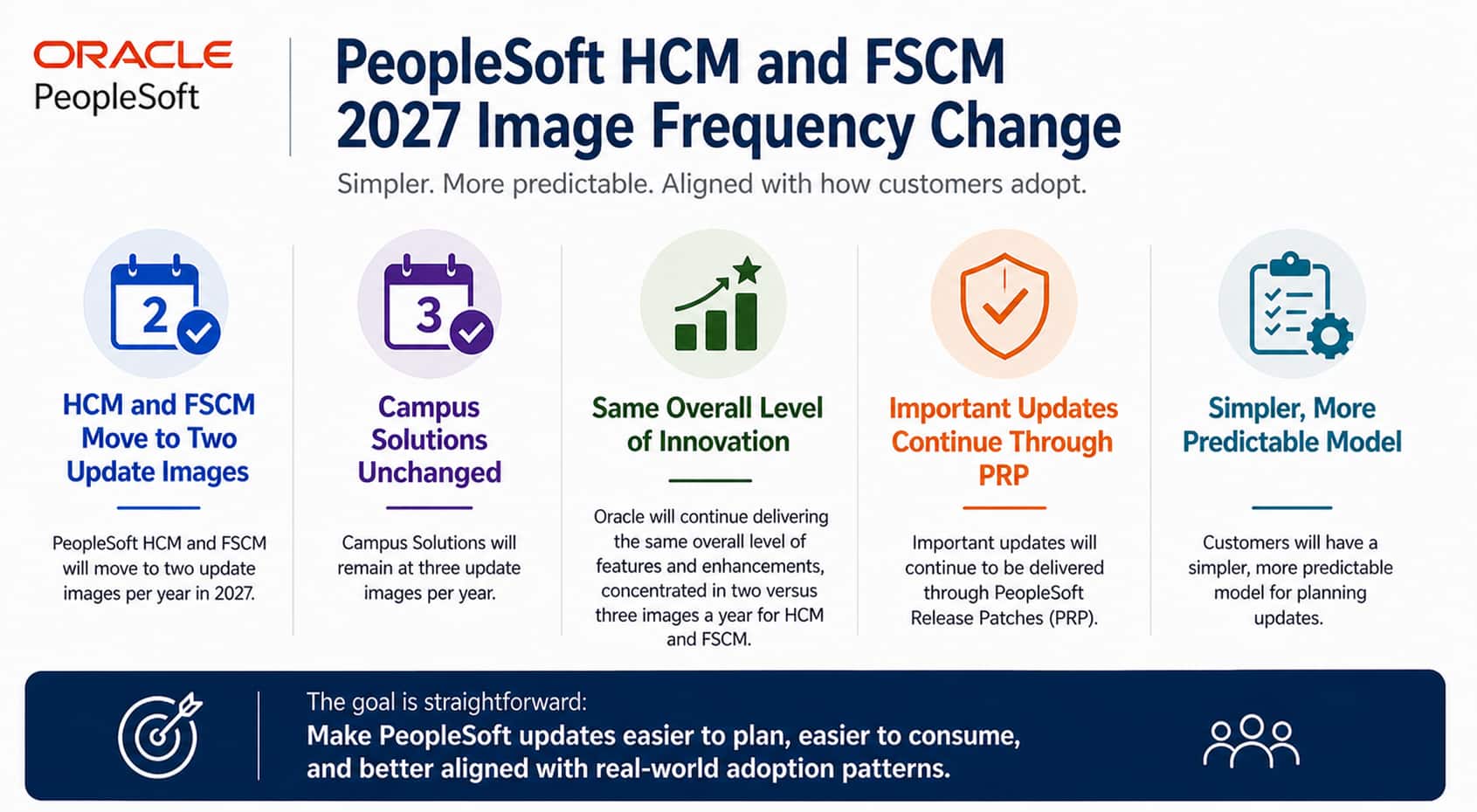
PeopleSoft Aligns HCM and FSCM Update Cadence with Customer Adoption ...
Russell Broom
4 minute read
PeopleSoft in 2025: 5 Blog Posts to Guide Your Roadmap, UX, and ...
Greg Parikh
Russell Broom
Srilakshmi Ramachandra
3 minute read
The New PeopleSoft Ideas Lab: Easier Discovery, Clearer Categories, ...
Russell Broom
3 minute read
Top 5 Must-Watch PeopleSoft Videos of 2025
Greg Parikh
Russell Broom
Srilakshmi Ramachandra
3 minute read
Unlocking the Power of PeopleSoft Life Cycle Management and ...
Greg Parikh
Srilakshmi Ramachandra
3 minute read
PeopleSoft Now! Episode 6.2: 2025 in Review and a Glimpse of what’s ...
Greg Parikh
Srilakshmi Ramachandra
3 minute read
The PeopleSoft Connection Episode #6: The Power of PeopleSoft’s New ...
Greg Parikh
Srilakshmi Ramachandra
2 minute read
The PeopleSoft Connection Episode #5: The Page and Field Configurator
Srilakshmi Ramachandra
Greg Parikh
3 minute read
HCM
See all
5 Key takeaways for U.S. Federal Agencies: How to improve the User ...
Venkatesh Kotikalapudi
4 minute read
Join our exclusive Oracle-led PeopleSoft HCM sessions at BLUEPRINT 4D!
Russell Broom
4 minute read
What’s New in PeopleSoft’s HCM Update Image 54: Key ...
Julie Alonso
3 minute read
Synchronizing Same Day Personnel Action Requests: Leveraging Position ...
Venkatesh Kotikalapudi
3 minute read
PeopleSoft HCM Update Image 53: Elevating User Experience with ...
Russell Broom
Greg Parikh
Srilakshmi Ramachandra
3 minute read
PeopleSoft ELM Image 25: Advances in Learning Experience & ...
Jeremy Pelley
4 minute read
HCM sessions at RECONNECT Dive Deep 2025 from October 27th – ...
Russell Broom
4 minute read
Enhancement School’s Name – Expand Description Length
Julie Alonso
1 minute read
HCM Legislative Updates
See all
Employee Termination Payment and Superannuation Guarantee threshold ...
Shankar Narayanan
1 minute read
FBT and Benchmark Interest Rate for 2027 – Legislative Update ...
Shankar Narayanan
1 minute read
California SB294 “Workplace Know Your Rights Act”
Julie Alonso
4 minute read
Budget 2026 Highlights – Legislative Update for PeopleSoft ...
Ravikanth Pandikunta
1 minute read
Income Tax Rules 2026 – Legislative Update for PeopleSoft HCM Global ...
Subramanian Srilal
3 minute read
Income Tax Withheld Statement Report (IRRF) – PeopleSoft HCM ...
Denise Campos
1 minute read
Health and Safety – OSHA 2025 required reporting (U.S.A Only)
Julie Alonso
2 minute read
Legislative Update for PeopleSoft Human Resources – Form I-9
Julie Alonso
1 minute read
PeopleTools and Technology
See all
Coming Soon – PeopleSoft Update Images on Containers
Dan Iverson
1 minute read
Announcing Cloud Manager Image 21
Dan Iverson
2 minute read
PeopleTools sessions of interest at BLUEPRINT 4D 2026
Sasank Vemana
5 minute read
The PeopleSoft Connection – Quest on Air podcast episode #4 ...
Greg Parikh
Srilakshmi Ramachandra
3 minute read
RECONNECT Dive Deep 2025 – Add These PeopleSoft Technology Sessions ...
Sasank Vemana
3 minute read
Unlocking cost savings with Customization Insights in PeopleTools 8.62
Dan Iverson
2 minute read
PeopleTools 8.62 is available for on-premise installation
Sasank Vemana
1 minute read
3 Content Reference Administration improvements in PeopleTools 8.62 ...
Sasank Vemana
6 minute read
Receive the latest blog updates
Subscribe to Oracle Connect email updates
Resources for
About
Careers
Developers
Investors
Partners
Startups
Why Oracle
Analyst Reports
Best CRM
Cloud Economics
Corporate Responsibility
Security Practices
Learn
What is Customer Service?
What is ERP?
What is Marketing Automation?
What is Procurement?
What is Talent Management?
What is VM?
What's New
Try Oracle Cloud Free Tier
Oracle Sustainability
Oracle COVID-19 Response
Oracle and SailGP
Oracle and Premier League
Oracle and Red Bull Racing Honda
Contact Us
US Sales 1.800.633.0738
How can we help?
Subscribe to Oracle Content
Try Oracle Cloud Free Tier
Events
News
© 2026 Oracle
Privacy
/
Do Not Sell My Info
Ad Choices
Careers