
For today’s Service IT leaders, the definition of success has undergone a radical transformation. It’s no longer just about “keeping the lights on” or maintaining system uptime. Success is now defined by measurable business outcomes: accelerated profitability, operational efficiency, and a frictionless customer journey.
Yet, a persistent gap remains. Despite a global surge in AI investment, fewer than half of field engineers report that technology makes their daily work easier. Only 57% express satisfaction with the reliability of the data required for their roles.1 This discrepancy points to a foundational challenge: the “patchwork” approach to enterprise software is reaching its architectural limit, especially as the industry moves toward Agentic AI.
1. The Strategic Pivot from Maintenance to Innovation
In a patchwork environment, IT organizations are often forced into the role of “integration plumbers,” where a disproportionate volume of resources is consumed by managing middleware and reconciling competing data models. By moving to a connected platform, IT leaders fundamentally reclaim their most precious resource: Time.
- Eliminate Brittle Middleware: Move away from third-party integration layers that fail during scaling.
- Minimize Ongoing Maintenance: Reduce “solution sprawl (homegrown/on-prem/Saas)” and simplify vendor management and procurement.
- From Reactive to Proactive: Shift IT labor from “keeping the lights on” to building intelligent, agentic workflows that drive revenue.
The Business Outcome: A significant reduction in Total Cost of Ownership (TCO) and the ability to reallocate engineering talent from reactive maintenance to revenue-generating innovation.
2. Embedded AI vs. The “Bolted-On” Trap
According to Gartner®, while nearly every company prioritizes AI ROI, “pressure to deliver on AI is at an all-time high — only 11% of leaders say their GenAI investment has met its primary business objective.”2 As the industry transitions from simple chatbots to multi-agent orchestration, the limitations of fragmented AI become clear.
In an orchestrated model, specialized agents—such as Triage, Supply Chain, and Finance agents—must collaborate in real-time to solve complex issues. Without native access to core business data, these tools require custom-built data pipelines that increase latency and decrease reliability.
A unified data foundation with embedded intelligence enables:
- Holistic Context: Agents have instantaneous access to enterprise data for autonomous decision-making.
- Simplified Architecture: By utilizing intelligence built into the business flow, organizations eliminate the need for external API calls and custom data pipelines.
- Cross-Departmental Action: Embedded agents can trigger business processes—such as checking part availability in Supply Chain while verifying a contract in Finance—without manual intervention.
- Reduced Latency: Faster response times by keeping intelligence where the data lives.
The Business Outcome: Lower cost-to-serve and enhanced customer lifetime value through autonomous, cross-functional resolutions.
3. Data Governance and the Secure Cloud Foundation
In 2026, one primary barrier to scaling AI is the integrity of data residency and governance.3 A native cloud foundation means that AI is built on a bedrock of security rather than being treated as an external add-on.
- Inherited Permissions: AI agents are designed to inherit existing data permissions and access controls, maintaining consistent governance.
- Zero-Export Security: Sensitive information remains in the primary secure environment, removing the need to move or duplicate data to third-party clouds.
- Data Residency Compliance: Operating within a unified architecture simplifies the logistical and legal challenges of maintaining compliance with global data residency requirements.
- Built-in Trust: Native cloud environments protect proprietary enterprise data by keeping it private. That data is never used to train public Large Language Models (LLMs).
The Business Outcome: Accelerated AI adoption through a centralized security framework that protects data privacy while grounding AI outputs in the organization’s specific truth.
The Oracle Fusion Difference: Any Product, Anywhere, One Service Platform
Oracle Service is specifically engineered to address these architectural challenges by providing a natively connected, outcome-driven suite:
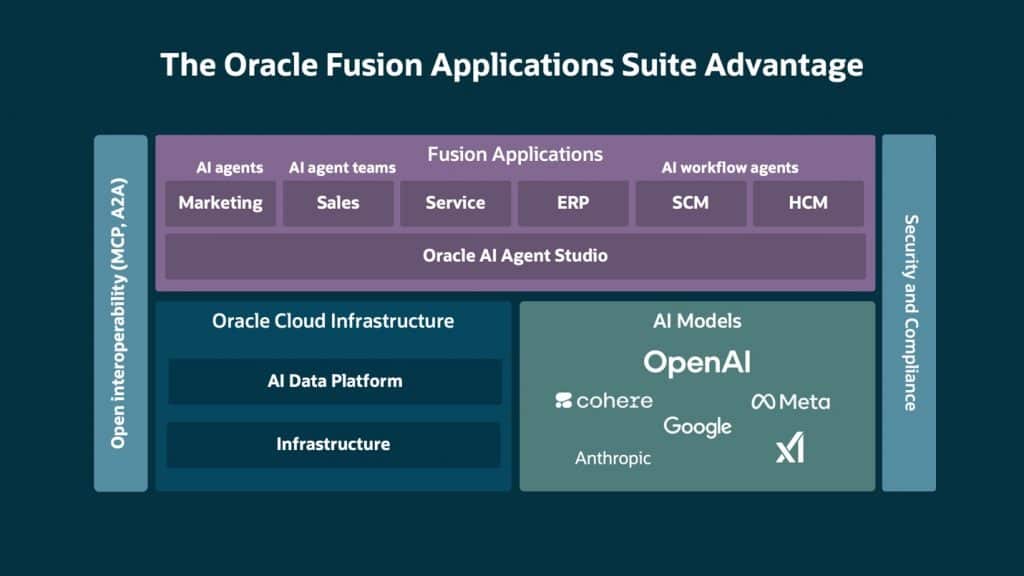
- Native Connections: Oracle Fusion offers a comprehensive suite of front-to-back-office applications—Marketing, Sales, Service, ERP, SCM, and HCM—built on a single platform.
- Agile Innovation with AI Agent Studio: Build, test, and deploy AI agents tailored to unique needs. AI Agent Studio allows for the selection of specific models and data sources while maintaining centralized control.
- Security by Design: Because these applications and tools are built on Oracle Cloud Infrastructure (OCI), they share a single data model and security framework. All the enterprise data remains within OCI and is protected by the same robust security standards as the core business applications.
The Bottom Line: Lead with Outcomes
Moving to a unified platform like Oracle Fusion, where Oracle Service is natively connected, is a fundamental shift in IT strategy. By trading costly, manual integrations for seamless, native automation, organizations do more than just fix systems—they empower the business to succeed in the AI era.
Stop building bridges between silos. Start building on a platform where silos don’t exist.
Extended reading:
Oracle Leads by Example: Reinventing My Oracle Support with Fusion Service
How APi Group Is Connecting Service and Revenue with Oracle Fusion
Learn more about Oracle Service
1. Service Council: Beyond Technology Investment: Closing the Frontline Enablement Gap to Drive CX
2. Gartner: Top 3 Strategic Priorities for Service and Support Leaders
GARTNER is a trademark of Gartner, Inc. and its affiliates.
3. TSIA: State of Support Services 2026: Winning the Services Era in an Age of AI Economics™