

For years, enterprise applications have been designed around transactions: create a record, update a field, complete a task, move to the next screen.
That model still matters. But it is not enough for the work many service teams need to do today.
A senior customer support representative does not start the day thinking, “Which transaction should I complete?” They think:
- Which service requests need my attention now?
- What is the real issue?
- What is the best next action?
- Can I resolve this consistently and confidently?
- How can this resolution help the next customer with a similar issue?
That is the shift behind the new Service Execution Workspace, the agentic application released in 26D.
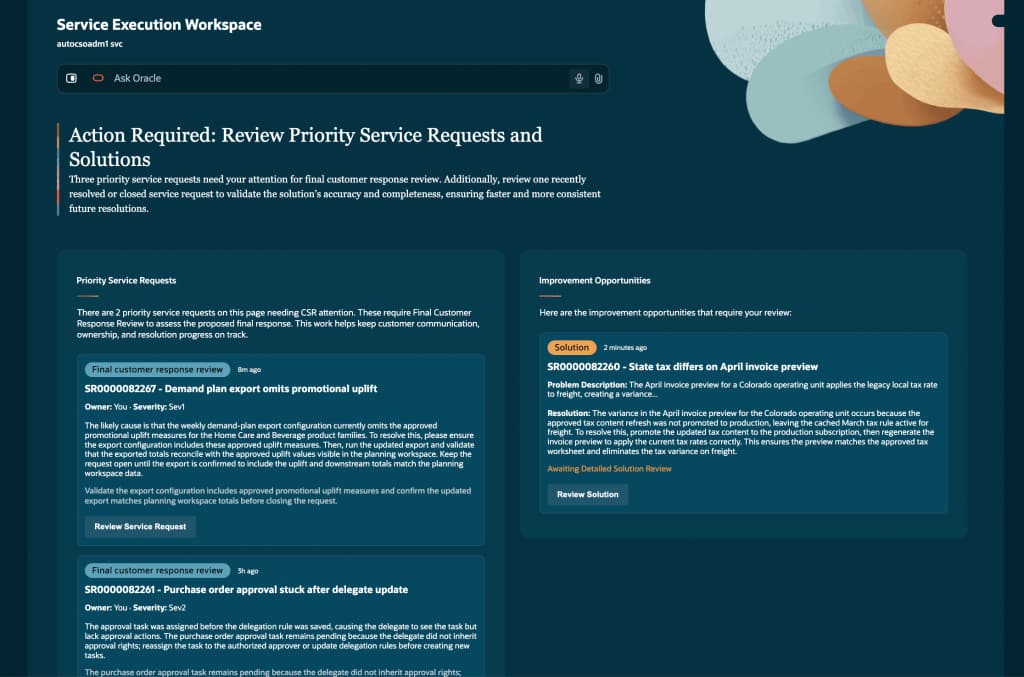
Learn more about Service Execution Workspace in the Oracle Fusion Service 26D readiness content.
Service Execution Workspace is our first step toward a more outcome-oriented, agentic application experience for service teams. It brings together the work that needs attention, the context needed to act, and the tools and guidance to move service requests toward resolution.
This is not about replacing people with AI. It is about helping experienced people spend less time assembling information, switching between screens, and repeating analysis—and more time applying judgment where it matters.
From a workspace for transactions to a workspace for outcomes
The Service Execution Workspace starts with the work itself.
On the landing page, senior representatives can see workload insights, priority service requests, and improvement opportunities. Instead of beginning from a list of disconnected records, they begin with a view of what needs attention and why.
When they open a service request, they can review the summary, progress, communication history, and recommended next action in one focused experience. They can use Ask Oracle to investigate the request and find supporting information.
AI can help prepare a resolution, but the representative stays in control. They can review, accept, or modify the proposed resolution before it is used in customer communication.
After resolution, the experience continues. Representatives can review an AI-generated procedure, validate it against evidence in the Evidence Locker, and submit it for knowledge article creation.
That flow matters. It connects service execution with learning.
Every well-resolved request has the potential to improve the guidance, automation, and knowledge available for the next one.
What makes this an agentic application foundation
An agentic application should not simply add an assistant to an existing page. It should organize work around a meaningful outcome, bring the right context together, recommend useful actions, and keep humans accountable for decisions.
Service Execution Workspace begins to establish that foundation:
- It focuses the experience on resolving service requests, not navigating transactions.
- It brings context, automation handoffs, and recommended next actions into one place.
- It supports human review of AI-prepared work.
- It turns resolution work into reusable knowledge, grounded in evidence.
- It respects existing service request access controls; the workspace does not create new data access.
This is a deliberate first step. The workspace is designed for guided, automation-related service work. It does not replace the full service request transaction experience, and capabilities such as knowledge authoring, SLA management, and stuck service request or service order management are not included in this release.
That focus is intentional. Agentic applications earn trust by solving a real problem well, with clear boundaries and human oversight.
The direction ahead
The future of enterprise service is not a single autonomous system making opaque decisions.
It is a better partnership between people, applications, automation, and AI: one where the system understands the work in context, helps move it forward, explains its recommendations, and continuously improves from validated outcomes.
Service Execution Workspace is an important first move in that direction.
It gives senior representatives a more focused way to understand what matters, act with consistent guidance, and turn resolved service work into better knowledge for the organization.
The goal is simple: help service teams move from managing transactions to achieving better customer outcomes.
Service Execution Workspace is only the beginning. In upcoming releases, we will continue building on this foundation as we evolve Oracle Fusion Service toward a more outcome-oriented, agentic experience. Stay tuned.