
(Note: this is the fourth post in a series, read part 1, part 2, and part 3 for more information)
Customers experience the business, not just the service workflow.
Customers do not leave because something went wrong. They leave when the business fails to deliver on what it promised. And that realization rarely happens in a boardroom or a sales cycle. It happens in service.
Usually, it is not a dramatic moment. It is a quiet accumulation: the part that does not arrive, the appointment that slips, the answer that does not quite line up with what was sold, the issue that gets handled but never really resolved. And somewhere in that experience, the customer asks: Is this a business I can rely on?
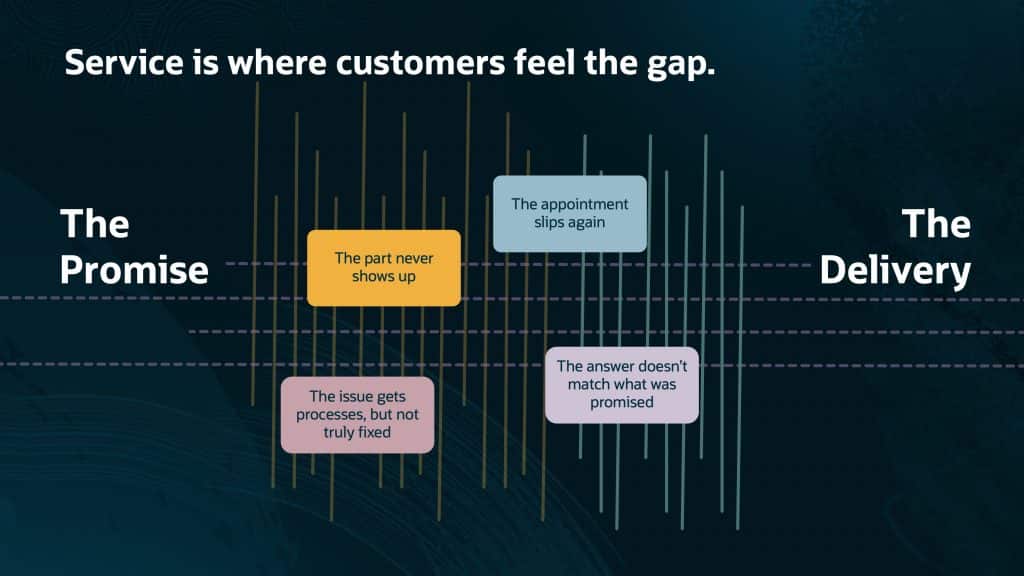
That is the decision point. Service is where trust is reinforced or lost, where revenue becomes vulnerable, and where the customer decides whether the relationship is still worth continuing.
For years, service technology has followed a familiar path. Service request management. Workflow automation. Omnichannel. Now AI.
Each step made service teams faster, more efficient, and better at moving work through the system. But that was never the real problem. Customers do not stay because the workflow moved faster. They stay when the business can understand the full situation, make the right decision, and follow through without forcing the customer to tolerate the gaps.
And that is where most service systems still fall short. They help teams respond within the service function. They do not help the business keep the customer.
Why the current service model still loses customers
This is where most AI in service still breaks down. It is very good at working from the data already inside the service application. It can summarize interactions, suggest next actions, improve routing and scheduling, and make service teams more productive. But productivity is not retention. Customers stay when the business recognizes risk early, interprets the situation correctly, and acts before trust is lost.
That requires more than service data. A service issue may look straightforward until install-base complexity changes the resolution path. A service request may appear urgent until entitlement status changes what should happen next. A customer interaction may appear routine until account status, customer value, or prior experience reveal a larger retention risk. A field request may look schedulable until parts availability or workforce constraints expose the real execution problem. In each of those cases, the business can still lose the customer because it did not see enough of the situation to make the right call.
When that happens, service teams compensate manually. They escalate more often, check more systems, override more decisions, and manually connect what should have been coordinated across the business. That is not intelligent service. That is manual coordination hiding behind automation. And it creates exactly the kind of inconsistent, frustrating experience that weakens trust, increases churn risk, and puts revenue at risk.
Agentic service changes the retention model
This is where agentic service starts to become meaningfully different.
Agentic service is not about making service and field service teams incrementally faster. It is about helping the business protect the customer relationship before it breaks down. That could mean preventing an issue before failure, moving the customer to the right resolution path immediately, coordinating work orders and field execution without forcing teams to piece the work together manually, or acting on churn risk before the customer decides to leave.
That is not simply a better service workflow. It is a different operating model.
In the old model, service begins after the customer feels the failure. In agentic service, the business can move earlier, align action across teams and systems, and reduce the chance that operational gaps become customer loss. The shift is from reacting to service issues to protecting trust before the relationship breaks down.
Why keeping the customer requires enterprise context
This is why service cannot operate in isolation. The customer does not experience the service workflow as a separate function. They experience whether the business can actually deliver.
That depends on shared business context across assets, entitlements, contracts, billing and account status, parts availability, workforce capacity, customer value, and the policies that determine what can be done and when. Without that context, the business may still respond. But it is still guessing at the real customer situation, still exposing the customer to internal gaps, and still increasing the risk of losing the relationship.
What matters is not just access to more data. It is access to a shared layer of business truth. Without that, AI can optimize pieces of the workflow. With it, AI can help the business make better decisions, coordinate execution more effectively, and act in time to protect trust, revenue, and retention.
The next generation of service will not be defined by who can summarize the most tickets or automate the most service processes. It will be defined by who can recognize risk earlier, understand the full customer situation, and coordinate execution end to end across service, field service, and the broader enterprise. That is how service moves from operational efficiency to customer retention.
The platform divide is about to become obvious
This is where the platform divide becomes impossible to ignore. Vendors that remain confined to workflow and front-office context will continue to act on incomplete data. They may improve productivity incrementally. They may eventually resolve the issue. But they will still leave service organizations guessing at the real customer situation through fragmented, siloed signals. They will still leave teams stitching together policy, execution, cost, scheduling, and follow-through manually. And they will still stop short of the outcome that matters most: keeping the customer and protecting the revenue tied to that relationship.
What comes next: service that keeps the customer across the enterprise
This is where agentic service becomes real: on a platform that can recognize risk earlier, act with full business context, and coordinate execution across the enterprise. That is the real promise of agentic service. Not a service solution, but a service execution platform. Not faster reaction, but better judgment, earlier action, coordinated execution, and ultimately a stronger ability to keep customers, protect revenue, and grow lifetime value.
That shift is underway now.
And it is bigger than service transformation.
It is a new model for keeping customers across the enterprise.