

The promise of AI has reached a critical juncture. While the potential is undeniable, many enterprises face a persistent value gap. According to recent MIT report, 95% of organizations still face challenges in achieving a clear return on their generative AI investments.1
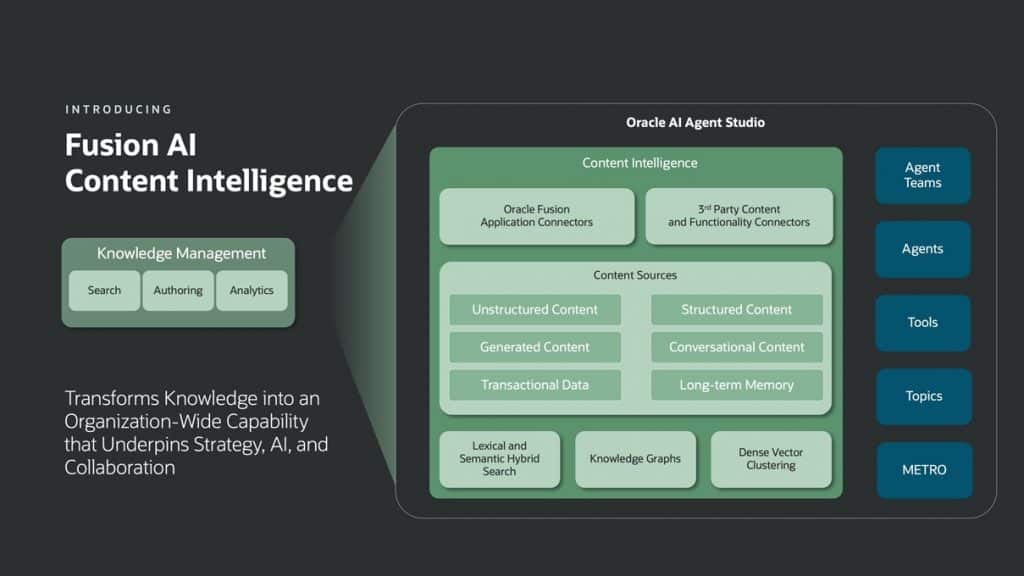
This struggle often stems from a fundamental context gap. AI initiatives that operate in a vacuum—isolated from the specific workflows and nuanced policies of the business—inevitably produce brittle, unpredictable results. To bridge this divide, a new capability is coming to the Oracle AI Agent Studio: Content Intelligence.
Here are three strategies to navigate current adoption barriers and prepare for the shift from local AI pilots to enterprise-wide agentic execution.
1. Eliminate the Vacuum: Accuracy Through Cross-Departmental Context
According to nearly 60% of AI leaders, one of the primary hurdles to adopting agentic AI is integrating with existing systems.2 Because AI agents are only as powerful as the data they reason over, most current models fail when they operate within disconnected systems.
Content Intelligence introduces a unified enterprise knowledge layer that brings together structured and unstructured data across all Fusion Applications and external sources, such as SharePoint and web crawlers. By utilizing hybrid information retrieval—combining semantic, lexical, and graph search—AI agents can navigate complex relationships across your entire enterprise knowledge base. This allows for more precise, grounded information that leads to reliable execution rather than just “plausible” answers.
2. Broaden the Perspective: Move Beyond the Front Office
Many organizations begin their AI pilots in customer-facing departments like marketing, sales, and service. This is often due to greater content readiness and lower security hurdles compared to proprietary back-office data. However, the back office holds the potential for even higher ROI.
For example, a finance AI agent can autonomously resolve an ERP invoice variance by simultaneously verifying vendor contracts, internal procurement policies, and historical precedents—all through a single, unified context.
With Content Intelligence bringing all departmental content and data into a native, organization-wide context layer, AI agents can now handle complex processes in back-office functions such as finance, HR, and supply chain management.
3. Lower the Token Tax: The Synergy of Knowledge and AI
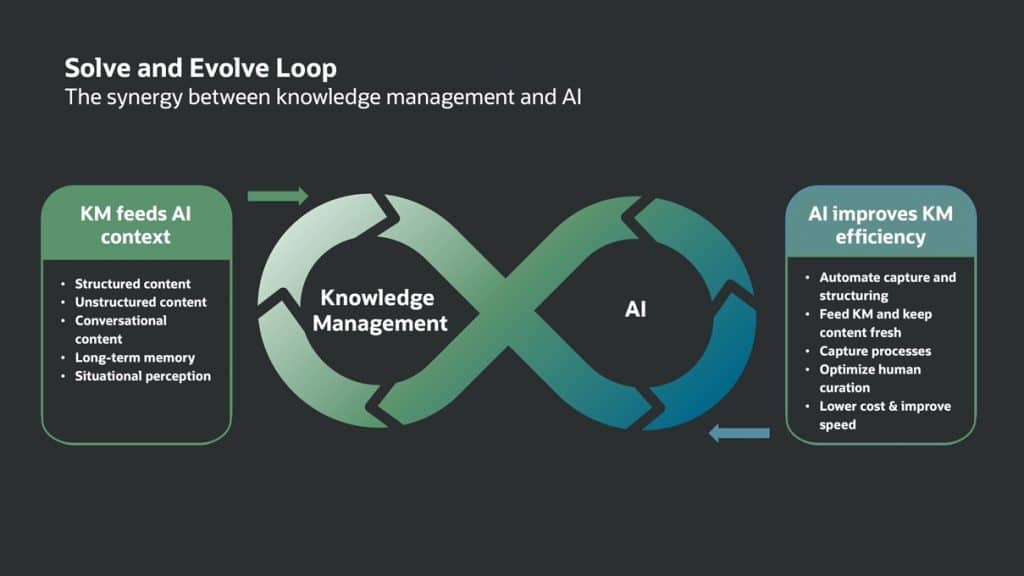
High computational costs and a lack of technical expertise often stall AI scaling. Content Intelligence helps reduce token costs and improve speed by treating AI agent resolutions as knowledge, forming a continuous “solve and resolve” context loop:
- Search and Reuse: AI agents can search for existing, successful resolutions before generating new reasoning from a Large Language Model (LLM), which lowers cost, improves resolution speed, and reduces outcome variability.
- Memory: AI agents can use long-term memory to recall intent and prior decisions, reducing the need for users to restate context as work progresses.
- Capture and Structuring: New AI resolutions are automatically captured and tied to outcomes, keeping the enterprise “brain” fresh without manual heavy lifting.
The Shift to a System of Outcomes
The future of enterprise software is not just AI answering questions; it is AI agents executing work with full enterprise context. This represents a move from a passive “System of Record” to an active “System of Outcomes.”
The shift is simple: Enterprise teams stop coordinating the business; the system coordinates growth.
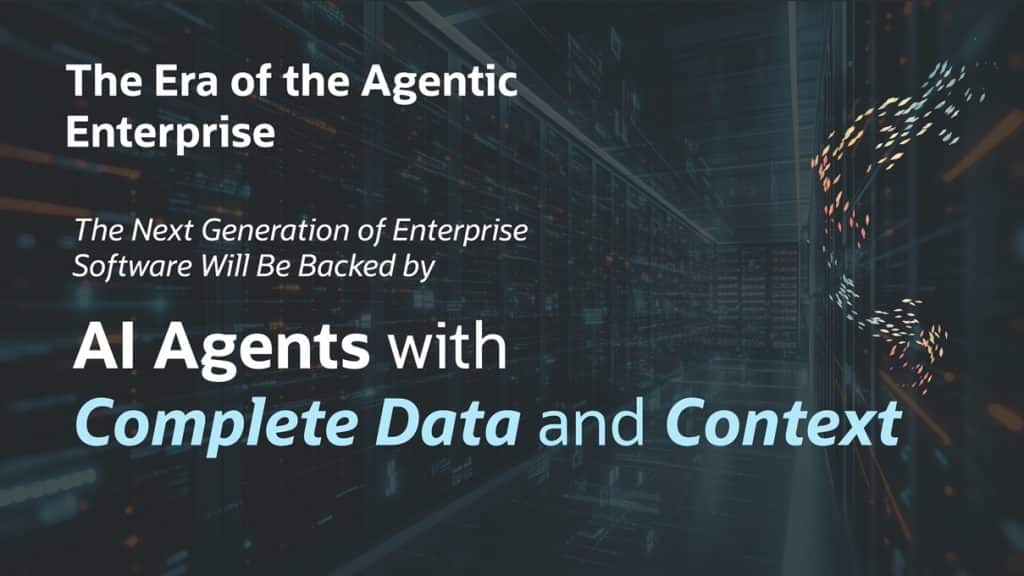
The time to architect your content for an agentic future is now. Is your organization’s knowledge ready to power the next generation of autonomous execution?