
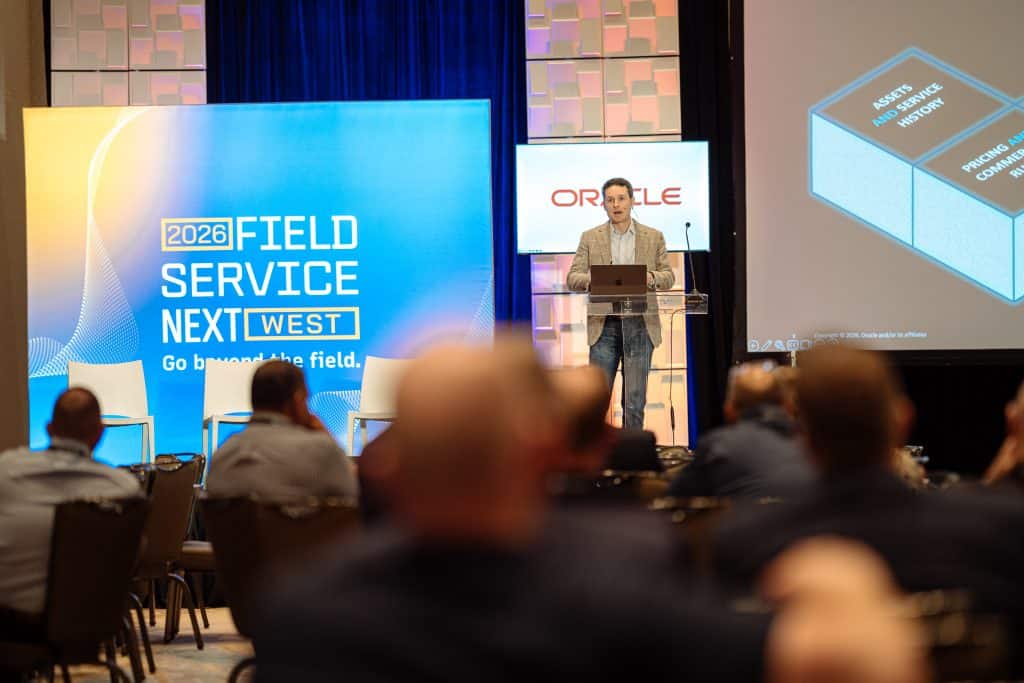
I recently attended Field Service Next West in San Diego. Across dozens of conversations with service leaders, one theme came through clearly:
Field service organizations don’t lack ambition around AI and transformation; they’re grappling with what it actually takes to make it real.
The industry has largely aligned on where it wants to go. The friction now sits in how to get there — operationally, culturally, and structurally.
Here are five realities shaping that journey:
1. Change Management Is the True Bottleneck
Technology is advancing faster than organizations can absorb it.
The constraint is no longer access to tools, it’s adoption. Dispatchers, technicians, and frontline leaders are being asked to work differently, make decisions differently, and trust new systems. That shift is significant.
The organizations making progress are not leading with technology. They are leading with enablement:
- Redesigning workflows, not just digitizing them
- Investing in training that goes beyond system navigation
- Embedding change into daily operations, not treating it as a one-time initiative
Transformation succeeds or fails at the human layer.
2. AI Interest Is High — But Confidence Is Still Forming
There is no skepticism about whether AI matters. That debate is over.
What remains unclear for many leaders is:
- Where to start
- How to prioritize use cases
- How much trust to place in AI-driven recommendations
- How to introduce AI without disrupting service delivery
As a result, many organizations are stuck in evaluation mode running pilots, exploring proofs of concept, but hesitating to scale.
The gap is not intent. It’s operational confidence.
3. Data Readiness Is the Gatekeeper to Value
Every serious AI discussion in field service eventually converges on the same issue: data.
AI is only as effective as the data it can access and interpret. And in many organizations, that data is:
- Fragmented across systems
- Incomplete or inconsistently captured
- Lacking the context needed for decision-making
Asset history, work orders, scheduling inputs, and service knowledge often exist, but not in a way that AI can reliably use.
This creates a clear dividing line:
- Organizations with connected, structured data are moving toward execution
- Those without it remain aspirational
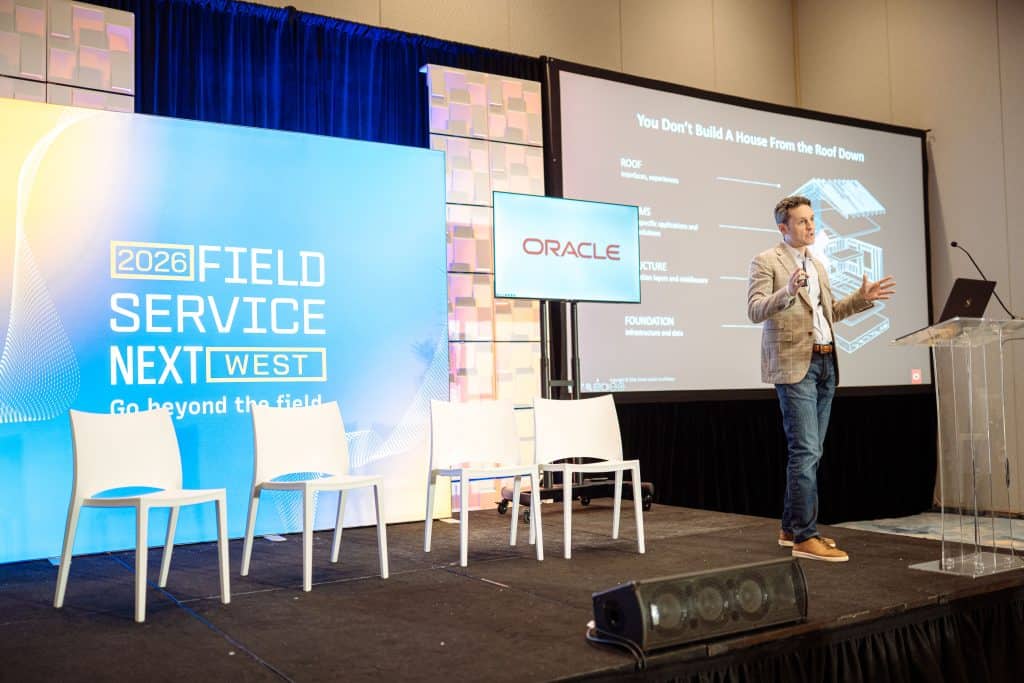
4. Field Service Is a High-Impact Entry Point for AI
Despite the challenges, field service stands out as one of the most practical environments to apply AI.
Why?
Because it is rich in:
- Repeatable decisions (scheduling, diagnostics, routing)
- Structured workflows
- Measurable outcomes (first-time fix rate, SLA adherence, cost per service)
This makes it ideal for applied, outcome-driven AI and not theoretical use cases.
The opportunity is not to replace the workforce. It’s to augment it:
- Helping technicians diagnose faster
- Automated real-time optimization, allowing dispatchers to focus on more critical tasks
- Supporting better decisions at every step of the service lifecycle
5. The Workforce Challenge Is Already Here
The technician shortage is no longer a future risk, and is actively shaping strategy today.
Experienced workers are retiring, and with them goes decades of institutional knowledge.
The challenge is not just backfilling roles. It’s preserving expertise:
- Capturing tribal knowledge
- Converting it into structured, accessible formats
- Embedding it into systems and workflows
Organizations that fail to do this aren’t just losing people, they’re losing operational intelligence.
From Vision to Execution
What stood out most at the event is this:
Field service doesn’t have a vision problem. It has an execution challenge.
The opportunity is real — and significant. But realizing it will require focus in three areas:
- People: Driving adoption and enabling new ways of working
- Data: Building the foundation for reliable, secure, and scalable AI
- Knowledge: Capturing and operationalizing expertise before it disappears
Field service may ultimately become one of the clearest proving grounds for AI in the enterprise, not because it’s simple, but because the path from insight to impact is measurable.
The organizations that close the execution gap will be the ones that turn AI ambition into sustained business value.
It’s also why many organizations are re-evaluating the role of their field service platforms. Systems like Oracle Fusion Field Service, for example, were designed around predictive decision-making, workflow optimization, and learning from operational data over time; capabilities that align closely with where AI adoption is heading.
The organizations that move forward fastest won’t treat AI as a separate initiative. They’ll build on the operational systems, data foundations, and workflows they already have, and evolve them into more intelligent, adaptive service models.
That’s how AI ambition turns into sustained business value.