
Service organizations today are under pressure from every direction. Customers expect faster resolutions, more transparency, and consistent experiences across every channel. At the same time, businesses are being asked to reduce cost-to-serve, improve operational efficiency, and adopt AI-driven automation.
Most organizations are not struggling because they lack tools. They are struggling because their tools were never designed to work together as a system.
Over time, service operations have evolved in layers adding CRM systems, field service tools, ERP platforms, scheduling engines, inventory systems, and billing applications. Each solves a specific problem, but together, they create fragmentation that becomes harder to manage as the business grows.
The real question for decision makers is no longer “Do we have the right applications?” but rather “Do our service operations function across a single, connected platform?”
The Real Issue Isn’t Tools—It’s Fragmentation
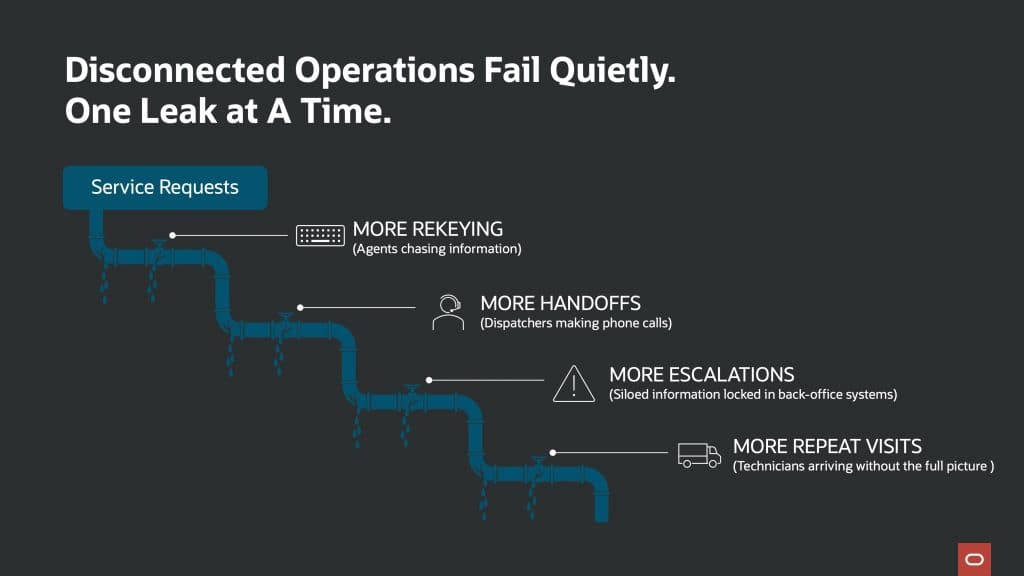
In most service organizations, fragmentation does not show up as a single failure. It shows up as friction across everyday work.
For example:
- Customer service agents cannot see complete asset or entitlement history
- Dispatchers lack real-time visibility into technician availability or parts
- Technicians arrive on-site without full context
- Finance teams must reconcile service delivery across multiple systems
Individually, these issues are manageable. But together, they create a service model that depends heavily on manual coordination and workarounds.
This leads to measurable business impact:
- Longer resolution times
- Repeat site visits
- Increased operational cost
- Billing inaccuracies and revenue leakage
- Inconsistent customer experiences
These are not isolated inefficiencies. They are symptoms of a structural problem: service operations that are not built on a shared data foundation.
Why Incremental Fixes Don’t Solve the Problem
When fragmentation becomes visible, organizations typically respond in familiar ways:
- Adding integrations between systems
- Automating specific workflows
- Introducing analytics or AI tools on top
While these steps can improve individual parts of the process, they do not address the underlying issue: the lack of a unified data and workflow model.
In many cases, they add complexity:
- More dependencies between systems
- More maintenance overhead
- More points of failure
- More difficulty scaling change across the organization
The result is often a more sophisticated version of the same fragmentation problem.
Why AI Makes the Problem More Visible
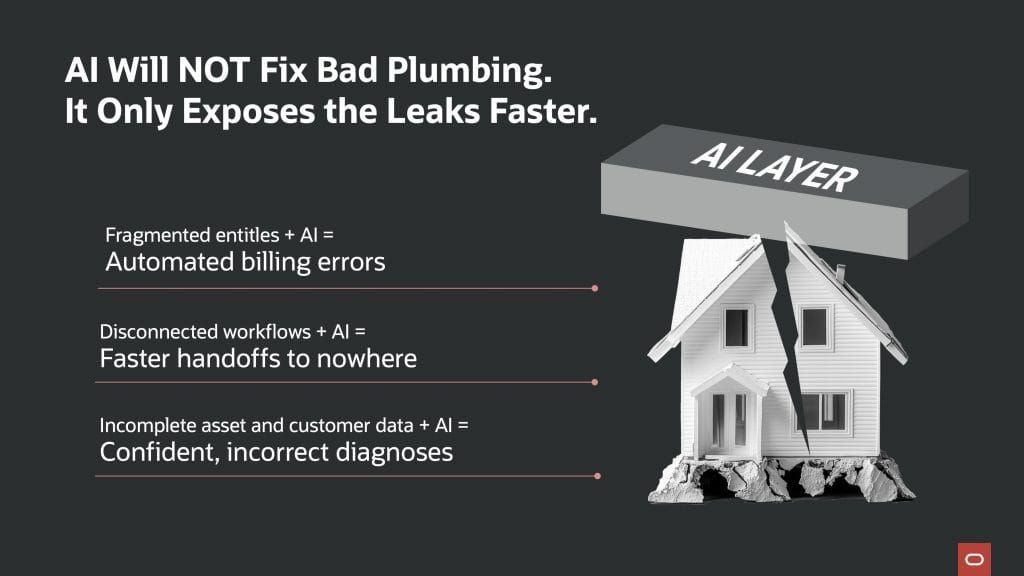
AI is now central to most service transformation strategies. But AI does not eliminate fragmentation—it exposes it.
When data and workflows are disconnected, AI tends to:
- Expose broken processes faster
- Amplify inconsistencies in data
- Produce recommendations without full context
- Scale incorrect decisions more efficiently
This leads to an important realization for decision makers:
AI is not a starting point for transformation. It is a multiplier of whatever foundation it is built on.
Without a unified foundation, AI adoption is limited in both trust and impact.
What Changes with a Unified Service Platform
A unified service platform addresses fragmentation at its source by bringing core service capabilities into a single environment with a shared data model.
Since Service and Field Service are part of Oracle Fusion, everything is connected to the entire enterprise:
- Service request and case management
- Field service scheduling and execution
- Asset and service history
- Parts and inventory visibility
- Contracts, entitlements, and billing
Because these functions operate across a single platform, data does not need to be synchronized across siloed point solutions and tools—it is inherently consistent.
This creates a different operating model.
What Decision Makers Typically See Improve
1. More Predictable End-to-End Execution
Workflows move continuously from request to resolution to billing without delays caused by system handoffs or missing data.
2. Better Visibility Across the Service Lifecycle
Leaders gain a complete view of performance, not just within individual teams or applications, but across the entire service operation.
3. Improved Cross-Functional Alignment
Service, operations, finance, and customer experience teams operate from the same data and processes, reducing misalignment and rework.
4. Revenue Protection
When contracts, entitlements, and service delivery are connected, organizations reduce billing errors and improve financial accuracy.
5. A Stronger Foundation for AI and Automation
With consistent, contextual data, AI can move from basic task automation to more meaningful decision support and operational intelligence.
When This Becomes a Strategic Decision
Not every organization needs to change immediately. But a shift toward a unified platform becomes more relevant when:
- Service processes regularly cross multiple disconnected systems
- Manual reconciliation is required to resolve data inconsistencies
- Operational improvements are difficult to sustain over time
- Scaling service increases complexity faster than efficiency
- AI and automation initiatives are constrained by data quality
At that point, the issue is no longer about optimizing disparate solutions, but it is about rethinking the operating model behind service delivery.
A Shift in How Service Is Structured
Moving to a unified platform like Oracle Fusion is not simply a technology decision. It represents a structural shift in how service organizations operate.
It moves organizations from:
- Coordinated systems → connected system
- Fragmented workflows → continuous processes
- Reconciled data → shared real-time truth
- Reactive service → more proactive and intelligent operations
This shift is what enables service organizations to operate with greater speed, consistency, and scalability.
The Bottom Line
Service and Field Service have become a core driver of customer experience, operational efficiency, and revenue performance. But many organizations are still constrained by systems that were never designed to function together.
The challenge is not simply improving individual tools. It is addressing the fragmentation between them.
For decision makers, the key question is:
Are your service operations working as one connected system, or are your teams still spending their time working around the gaps between systems?
Because as service expectations continue to rise, the cost of fragmentation only increases, and the value of a unified foundation becomes harder to ignore.
In practice, this is why many enterprises are rethinking their service architecture entirely, moving toward platforms that unify case and service request management, field service, contracts, inventory, and billing on a shared data model rather than stitching them together across multiple systems.
Solutions like Oracle Service reflect this shift, bringing core service capabilities into a single environment so organizations can reduce fragmentation, improve visibility across the service lifecycle, and create a more reliable foundation for AI and automation to operate on.
Not as a replacement for strategy but as the structure that allows strategy to actually scale.