
Consider this scenario: a customer contacts a service team about an issue. They receive a confident answer and a promised next step, but the work never starts. The conversation ends, yet the customer’s issue remains unresolved.
For customer service and operations leaders, the opportunity is to connect every service promise with the work needed to fulfill it. AI can help by acting on enterprise data and advancing resolution within defined business rules.
That is the direction of Oracle’s agentic service strategy.
We’re pleased that Oracle has been named a Leader in the 2026 Gartner® Magic Quadrant™ for CRM Customer Engagement Center. As we view this recognition, we feel we’re continuing to advance Oracle Fusion Service around a clear objective: to help organizations resolve customer needs through AI execution, enterprise context, and human expertise.
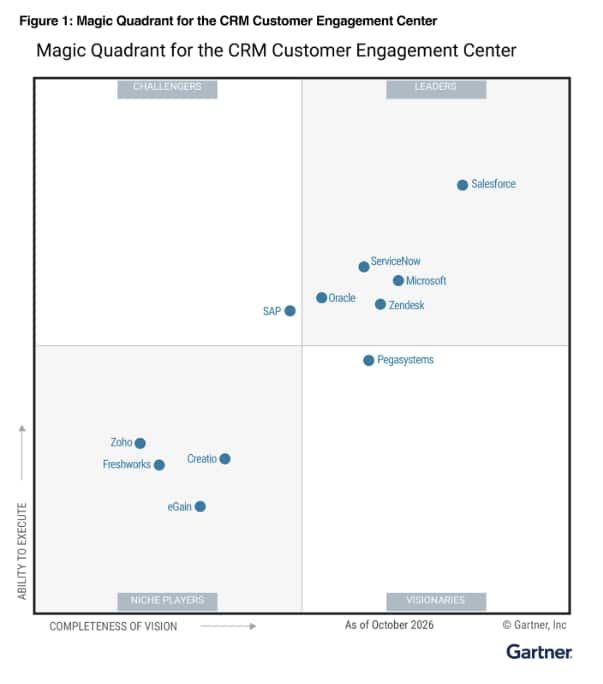
[Get the complimentary 2026 Gartner report.]
Put AI to work delivering service outcomes
Oracle’s broader applications strategy advances AI from assisting with work to doing work in pursuit of defined outcomes. In service, that means taking responsibility for more of the work required to resolve a customer’s need.
Resolving a customer’s issue may require understanding the request, checking an entitlement, researching a solution, ordering an item, and initiating a work order. Each action needs to contribute to resolution.
Oracle Fusion Service applies AI across service intake, classification, routing, summarization, knowledge discovery, and resolution guidance. Our latest agentic applications bring this direction into the daily work of service representatives and managers.
In 26D, Service Execution Workspace will bring priority service requests, relevant context, and recommended next actions into one experience. Representatives will be able to investigate issues through Ask Oracle and review or refine AI-prepared resolutions before communicating with customers. Explore Service Execution Workspace.
For service leaders, Service Operations Workspace, released in 26C, surfaces escalations, stalled requests, and performance trends to prioritize issues requiring intervention, recommend actions, and reveal opportunities to improve automation across customer journeys. Explore Service Operations Workspace.
These agentic applications and Fusion Claw capabilities help teams organize work around resolution, with people reviewing AI-prepared work and directing the decisions that need their expertise.
Give execution the context it needs
Service decisions depend on information across the enterprise. Is the asset covered? Is the replacement part available? What happened in the previous interaction? Which actions does policy permit?
Oracle Fusion Service shares a common data model, business objects, security, and workflow services with other Oracle Fusion Applications. For organizations using Fusion as their operational backbone, that foundation connects service with the transactions and processes behind resolution.
Trusted knowledge adds further context. Oracle’s knowledge management capabilities and Content Intelligence help service teams and AI agents find relevant information from governed sources to inform answers and actions.
In 26D, Service Execution Workspace will also connect resolution with knowledge reuse. Representatives will be able to validate an AI-generated procedure against supporting evidence and submit it for knowledge article creation, helping turn resolved issues into guidance for future service.
Match autonomy to the work
Different service situations call for different levels of autonomy.
For complex, sensitive, or high-risk issues, AI can research and prepare recommendations while people make the decisions. For repeatable work, AI can coordinate workflows and surface exceptions. Known, policy-supported issues offer opportunities for autonomous resolution within defined controls.
People establish the objectives, permissions, and approval requirements. Service representatives exercise judgment where it matters, while managers oversee performance and improvement.
This is the service team we’re building toward: people and AI working together, with clear authority and accountability.
Build toward proactive service and stronger retention
Proactive service starts with recognizing where intervention could improve an outcome.
In 26D, Service Health Check and Process Improvement will bring Fusion Claw into Service Operations Workspace to help leaders investigate performance problems, recommend interventions, and track results. Customer health reviews will connect recurring issues, escalations, and customer frustration to identify retention risks, while SLA analysis will reveal patterns and opportunities for corrective action. Explore Service Health Check and Process Improvement.
Our longer-term vision continues to connect monitoring, diagnosis, authorized action, and learning from results, helping teams address emerging issues before they undermine the customer experience.
The business objective remains consistent: fulfill the customer’s need, protect trust, and strengthen the relationship while reducing cost-to-serve. Oracle’s investment in agentic service puts AI to work on resolution, helping organizations deliver on their promises, earn customer trust, and strengthen retention.
[Get the complimentary 2026 Gartner® Magic Quadrant™ for CRM Customer Engagement Center report.]
Learn more about Oracle Fusion Service.
Gartner, Magic Quadrant for the CRM Customer Engagement Center, Pri Rathnayake, Jim Robinson, Drew Kraus, Francesco Vicchi, Devra Struzenberg, 2 November 2026
Gartner and Magic Quadrant are trademarks of Gartner, Inc. and/or its affiliates.
Gartner does not endorse any vendor, product or service depicted in its research publications, and does not advise technology users to select only those vendors with the highest ratings or other designation. Gartner research publications consist of the opinions of Gartner’s research organization and should not be construed as statements of fact. Gartner disclaims all warranties, expressed or implied, with respect to this research, including any warranties of merchantability or fitness for a particular purpose.
This graphic was published by Gartner, Inc. as part of a larger research document and should be evaluated in the context of the entire document. The Gartner document is available upon request from Oracle.
The report was titled as Magic Quadrant for CRM Customer Service Contact Centers in 2012.