
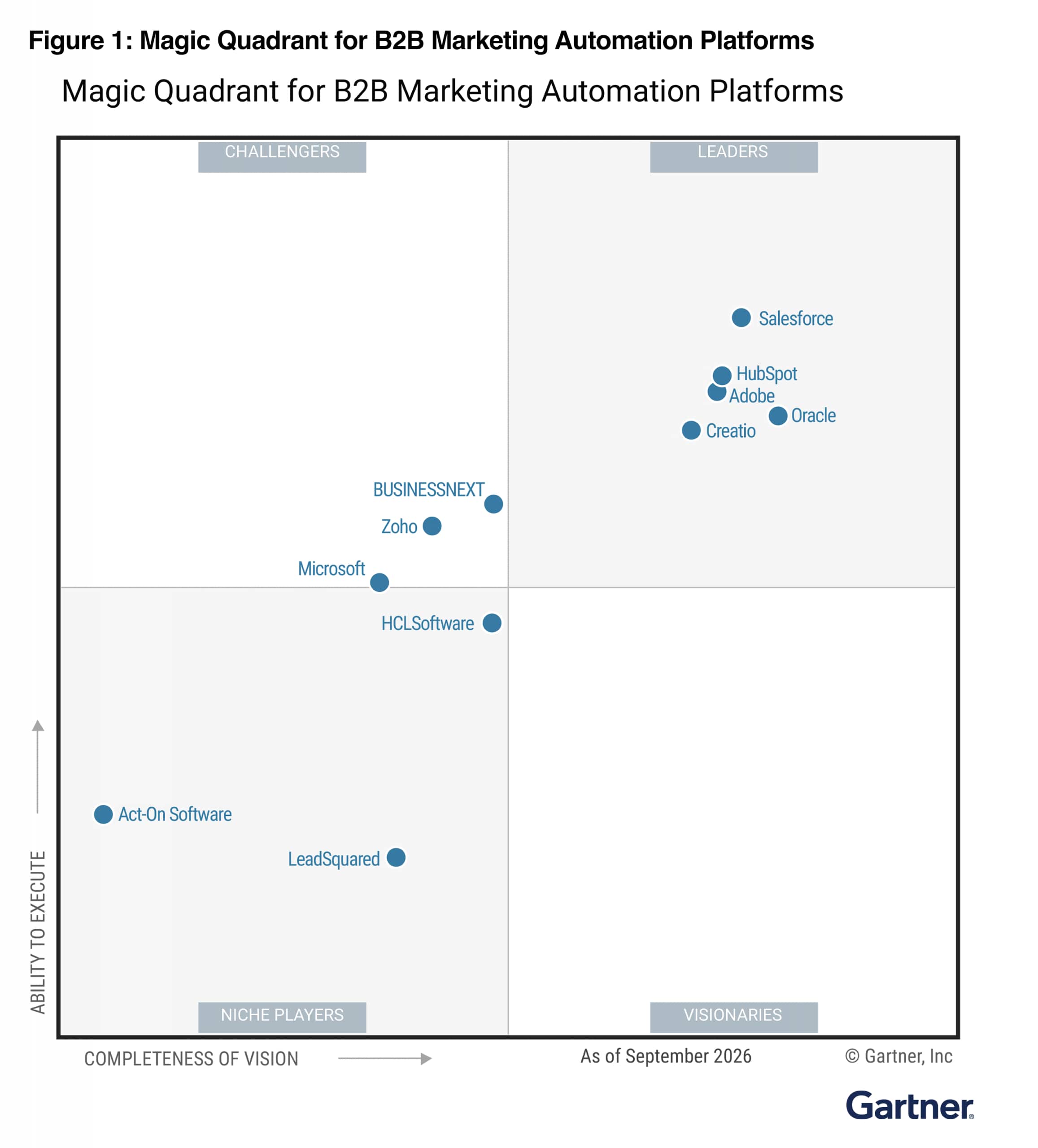
We are proud to share that, for the fourteenth consecutive year, Oracle has been named a Leader in the 2026 Gartner® Magic Quadrant™ for B2B Marketing Automation Platforms. ¹ ² We believe this recognition highlights Oracle’s commitment to helping B2B organizations move from campaign execution to agentic growth orchestration.
What we believe sets Oracle apart
From Oracle’s perspective, B2B marketing is entering a new phase. As organizations pursue more predictable, measurable growth, marketing teams must go beyond executing campaigns to identify opportunities, coordinate action across teams, and improve business outcomes. This requires a connected foundation that brings together trusted enterprise context, marketing automation, AI, and governance.
This connected approach builds on campaign automation while extending it with shared customer and account context, closer coordination between marketing and sales, and governed AI. It helps marketing teams move beyond executing individual campaigns to identifying growth opportunities and coordinating the actions needed to pursue them.
Oracle’s B2B marketing portfolio connects Oracle Eloqua Marketing Automation, Oracle Fusion Marketing—including Fusion Unity Data Platform and Fusion Marketing Orchestration—and Oracle AI Agent Studio for Fusion Applications. Customers can adopt these capabilities modularly while building on a shared data, security, and governance foundation.
Oracle Eloqua supports sophisticated multichannel B2B marketing through flexible Campaign and Program Canvases. Fusion Unity Data Platform brings together customer, account, transaction, service, product, and buying-group data to provide broader context for planning and execution. Oracle AI Agent Studio provides a governed way to build and manage AI agents, including the Buying Group Assistant. Together, these capabilities can help marketing and sales teams identify growth opportunities, coordinate the right actions, and connect marketing activity more clearly to pipeline, renewals, expansion, and other measurable business outcomes. Marketers remain responsible for strategy, governance, approvals, and performance, while AI can assist with audience discovery, program recommendations, content development, workflow setup, and optimization.
For example, the Cross-Sell Program Workspace helps teams turn installed-base whitespace into coordinated marketing and sales action. Oracle also applies this approach through its Oracle-at-Oracle practice, using Fusion Marketing to identify buying-group whitespace, plan programs, and help create conversation-ready opportunities across Oracle’s Fusion Applications customer base.
Looking ahead
Oracle plans to extend Eloqua with deeper AI capabilities and continued enhancements to authoring, analytics, integration, and usability, while connecting Oracle AI Agent Studio with Eloqua and related suite workflows. This gives customers a customer-paced path toward agentic marketing without replacing production campaigns, CRM integrations, governance models, or operating processes.
For organizations running on Fusion, marketing can operate on the same enterprise data, security, and AI foundation as sales, service, finance, and operations. Organizations seeking standalone B2B marketing automation can continue to use Eloqua as a proven enterprise platform with open interoperability.
Get your copy of the 2026 Gartner® Magic Quadrant™ for B2B Marketing Automation Platforms
1. From 2013 to 2020 this Magic Quadrant was known as Magic Quadrant for CRM Lead Management.
2. In 2013, we were recognized by the name: Oracle (Eloqua)
2026 Gartner® Magic Quadrant™ for B2B Marketin Automation Platforms.
Published: September 22, 2026 – ID G00841633.
By: Jeff Cohen, Upasna Chandna, Martin DeWitt, Julian Poulter
This graphic was published by Gartner, Inc. as part of a larger research document and should be evaluated in the context of the entire document. The Gartner document is available upon request from Oracle. Gartner does not endorse any vendor, product or service depicted in its research publications, and does not advise technology users to select only those vendors with the highest ratings or other designation. Gartner research publications consist of the opinions of Gartner’s research organization and should not be construed as statements of fact. Gartner disclaims all warranties, expressed or implied, with respect to this research, including any warranties of merchantability or fitness for a particular purpose.
Gartner and Magic Quadrant are trademarks of Gartner, Inc. and/or its affiliates.