




Part 2 — Architecture and Operational Design
Fig 1. OCI Enterprise Evaluation Series – Part 2
Series Navigation
- Part 2: Architecture and Operational Design (You are here)
- Part 3: Value and Sustainability
Introduction
This article is Part 2 of a three-part series exploring the most common questions enterprises ask when evaluating Oracle Cloud Infrastructure (OCI). To start from the beginning, you can read Part 1. Once the strategic and commercial aspects of cloud adoption are understood, the conversation naturally shifts toward technical architecture and operational design.
Enterprise architects and engineering teams begin asking questions such as:
- How will applications be deployed and managed?
- How does the cloud platform support scalability and performance?
- What networking and security capabilities are available?
- How easily can workloads migrate from existing environments?
These questions are essential because organizations must ensure their chosen platform can support both current enterprise workloads and future cloud-native architectures.
In this part of the series, we focus on the technical and architectural questions enterprises often ask during OCI evaluations, along with answers that explain how OCI supports modern enterprise environments.
Security & Compliance
Q1: How do Oracle Cloud Infrastructure (OCI) ensure and demonstrate GDPR compliance across Oracle services and regions used by customer workloads, including data residency, data processing, and cross‑border transfer controls?
Oracle ensures GDPR compliance across its cloud services through a comprehensive set of controls, certifications, and documentation that address data residency, processing, and cross-border transfer requirements for workloads hosted in the regions you use
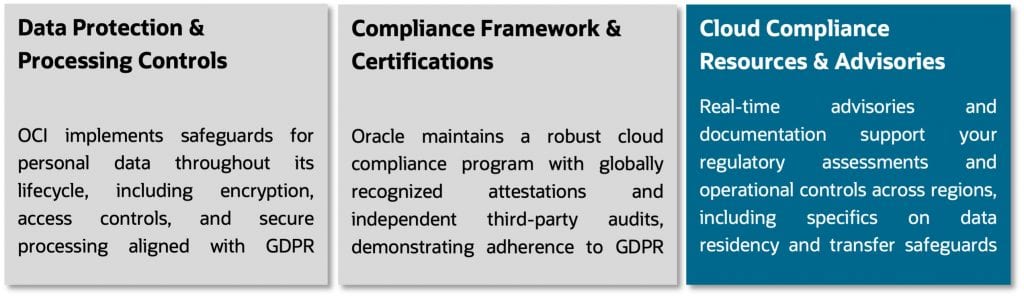
| For more info, please refer * Data Protection & Processing Controls – Detailed GDPR guidance is available here * Compliance Framework & Certifications – Available compliance attestations are published here * Cloud Compliance Resources & Advisories – Detailed guidance available here |
Q2: What certifications and attestations do Oracle Cloud Infrastructure (OCI) hold that are relevant to our industry (e.g. ISO 27001, SOC 2, PCI DSS, and where applicable support for frameworks like TISAX), and can OCI provide recent audit reports or summaries?
Oracle Cloud Infrastructure (OCI) maintains a broad set of globally recognized certifications and third-party attestations that support compliance across highly regulated industries. These include frameworks such as ISO 27001, SOC 1/SOC 2/SOC 3, PCI DSS, FedRAMP, HIPAA, and region-specific programs like TISAX where applicable. All current certifications, attestations, and audit summaries are published centrally in the Oracle Cloud Compliance portal. Customers can access and download the most recent audit reports by navigating to:
| https://cloud.oracle.com → Compliance |
Documents can be downloaded as PDFs and must be opened in Adobe Reader (not a browser) to accept the confidentiality notice and view the full report. This centralized compliance library provides you with the latest independent assessments required for due-diligence, regulatory commitments, and internal risk management
Q3: How will Oracle Cloud Infrastructure (OCI) help customer meet sector‑specific regulatory requirements?
We help customers meet sector-specific regulatory requirements by leveraging Oracle Cloud Infrastructure’s security-first design, certified controls, and comprehensive compliance documentation. OCI provides strong foundational capabilities such as tenant isolation, encryption by default, identity and access management, audit logging, and network segmentation that support regulated workloads in industries like financial services and automotive.
For regulatory assurance, we rely on Oracle’s independently audited compliance attestations (including SOC, ISO/IEC, and CSA STAR) and regulatory advisories, which customers can use directly to support audits and regulator engagements. Oracle’s GDPR advisory clearly defines shared responsibilities and demonstrates how OCI services align with data protection and privacy requirements. All current certifications, attestations, and audit summaries are published centrally in the Oracle Cloud Compliance portal. Customers can access and download the most recent audit reports by navigating to:
| https://cloud.oracle.com → Compliance |
In summary, OCI enables compliant cloud adoption through a combination of built-in security, validated compliance evidence, and reusable architectural guidance, allowing customers to meet regulatory expectations while maintaining operational agility.
Q4: Describe Oracle Cloud Infrastructure (OCI) technical and organisational security measures: identity and access management, encryption, key management, logging, SIEM integration, and vulnerability management?
Oracle Cloud Infrastructure (OCI) implements a comprehensive set of technical and organizational security measures designed to protect your data and workloads across identity, access, encryption, key management, logging, SIEM integration, and vulnerability management.
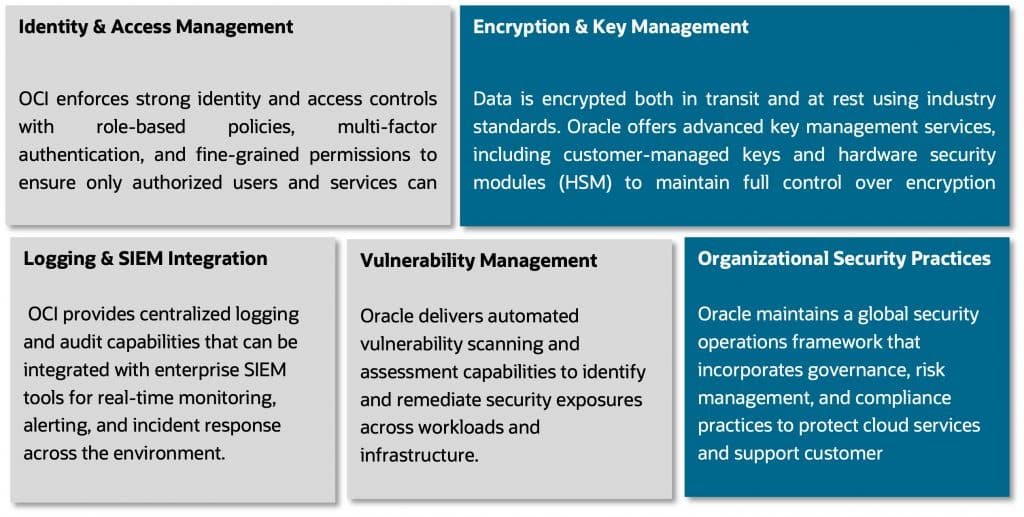
| For more information, please refer below links. > Identity & Access Management – https://www.oracle.com/security/identity-management/ > Encryption & Key Management – https://www.oracle.com/security/cloud-security/key-management/ > Logging & SIEM Integration – https://www.ateam-oracle.com/integrating-siem-with-oracle-cloud-applications > Vulnerability Management – https://www.oracle.com/security/cloud-security/vulnerability-scanning-service/ > Organizational Security Practices – https://www.oracle.com/corporate/security-practices/ and https://www.oracle.com/europe/corporate/security-practices/cloud/ |
This combination of identity controls, encryption and key management, logging and SIEM support, and proactive vulnerability management delivers a robust security posture for enterprise workloads on OCI. Let me know if you want this formatted for an RFP or executive briefing deck.
Q5: How do Oracle Cloud Infrastructure (OCI) support regular security audits, penetration testing and continuous compliance monitoring, and what evidence will OCI provide on an ongoing basis?
Oracle Cloud Infrastructure (OCI) supports robust security assurance practices including regular security audits, penetration testing, and continuous compliance monitoring to help you maintain a strong security posture for your workloads.
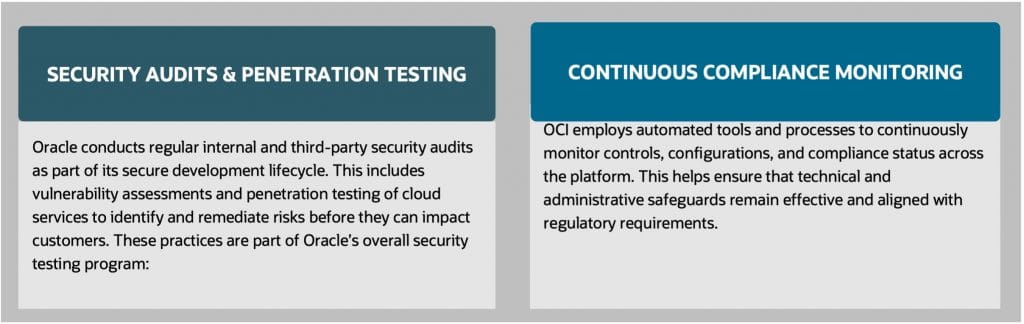
For more information on security testing program, please refer https://www.oracle.com/corporate/security-practices/testing/cloud/
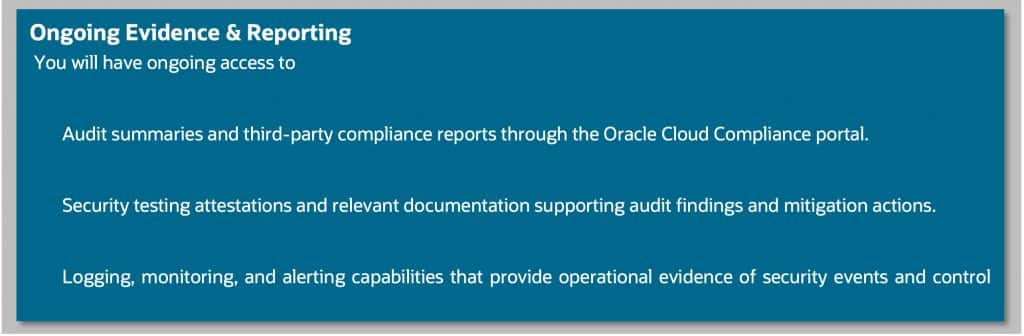
Together, these measures ensure Oracle’s platform remains secure, compliant, and transparent while providing you with the evidence needed for your internal and external complian
Performance, Reliability & Scalability
Q1 : How will Oracle Cloud Infrastructure (OCI) help customer achieve improvement in application performance and increase in peak load handling, and how will this be measured and validated?
Below are some of the items that are proven to improve performance:
| # | Category | Details |
| 1 | Bare Metal Performance | Bare metal instances eliminate hypervisor overhead, allowing direct access to CPU/GPU, in some cases leading to significantly faster throughput |
| 2 | High performance networking | OCI uses RDMA over Converged Ethernet (RoCE v2) with 200/400 Gbps bandwidth and ultra-low latency |
| 3 | Auto Scaling & Load Balancing | OCI’s flexible load balancers and Container Engine for Kubernetes (OKE) allow for seamless scaling. Moreover, Auto-scaling groups enable dynamic scaling based on metrics (OCI Autoscaling) |
OCI provide built-in tools to measure, validate, and visualize these performance gains:
| Measurement and Validation Methods | ||
| # | Category | Details |
| 1 | Application Performance Monitoring (APM) | This tool provides distributed tracing, allowing you to monitor user interactions, page loads, and API calls |
| 2 | OCI Monitoring | Uses machine learning to calculate baselines for key metrics |
| 3 | Operations Insights | Provides capacity planning for compute instances, allowing for forecasting and analyzing resource utilization |
| 4 | Synthetic Monitoring | Allows to simulate user traffic from 50+ global locations to measure application availability and performance |
As organizations increasingly turn to cloud solutions like Oracle Cloud Infrastructure (OCI) to meet their computing needs, optimizing performance becomes paramount. We recommend following best practices for managing OCI to ensure optimal performance and maximize the benefits of cloud technology.

Right-Sizing Resources: One of the key factors in optimizing OCI performance is right-sizing resources. This involves selecting the appropriate computing, storage, and networking resources based on workload requirements. By accurately estimating workload demands and provisioning resources accordingly, businesses can avoid over-provisioning or under-provisioning, leading to cost savings and improved performance

Implementing High Availability Architectures: High availability is essential for ensuring continuous access to applications and data. Implementing high availability architectures in OCI involves leveraging features such as fault tolerance, load balancing, and automatic failover to minimize downtime and maintain service availability. By designing resilient architectures, organizations can enhance performance and reliability, even in the face of hardware failures or network disruptions.

Utilizing Performance Monitoring and Optimization Tools: OCI offers a suite of performance monitoring and optimization tools that enable businesses to gain insights into their infrastructure’s performance and identify areas for improvement. By leveraging tools such as Oracle Cloud Infrastructure Monitoring, Metrics, and Resource Manager, organizations can proactively monitor performance metrics, analyze trends, and optimize resource utilization to enhance performance and efficiency.

Implementing Security Best Practices: Security is a critical aspect of performance optimization in OCI. By implementing security best practices such as encryption, access control, and network security policies, organizations can protect their data and applications from unauthorized access, data breaches, and other security threats. Secure environments not only enhance performance by minimizing the risk of security incidents but also instill confidence in customers and stakeholders.
Regular Performance Tuning and Optimization: Performance optimization is an ongoing process that requires regular monitoring, tuning, and optimization. By continuously monitoring performance metrics, identifying bottlenecks, and fine-tuning configurations, organizations can optimize OCI performance to meet evolving business requirements and ensure peak efficiency.
Optimizing performance in Oracle Cloud Infrastructure requires a holistic approach that encompasses right-sizing resources, implementing high availability architectures, utilizing performance monitoring and optimization tools, implementing security best practices, and conducting regular performance tuning and optimization. By following these best practices, organizations can unlock the full potential of OCI and drive business success in the cloud.
Examples of customers who have benefited from OCI performance:
- Hypercare achieves a 3X performance increase and cuts costs in half with OCI
- MXstore boosts system performance by 200X with Oracle HeatWave MySQL
- Cognition+ boosts insurance processing performance by 90% with OCI
Q2: What high‑availability and disaster recovery patterns (multi‑AZ, multi‑region, active‑active/active‑passive) do Oracle cloud Infrastructure (OCI) propose for customer critical workloads, and what RPO/RTO can OCI commit to?
OCI provides tools to implement varied high-availability (HA) and disaster recovery (DR) patterns using multi-Availability Domain (AD) and multi-region strategies, including Active-Active and Active-Passive setups. For critical workloads, these solutions aim for near-zero RPO and low RTO by leveraging synchronous replication within regions and asynchronous replication across regions. Any specific KPI for RTO / RPO will require additional insight into application design, technologies used, and requirement limitations.
Oracle has an Architecture Center with many different resources for designing HA/DR based on patterns. One example is the “Implement Mid-tier Replication in an OCI Disaster Recovery Architecture”
| # | Category | Details |
| 1 | Multi-AD/Multi-Fault Domain | For high availability, OCI uses multiple fault domains or multiple Availability Domains within a region |
| 2 | Multi-Region | For true DR, OCI recommends deploying across different regions to handle region-wide failures, enabling cross-region data replication. |
| 3 | Active-Active Configuration | Deployed for maximum uptime, this pattern runs applications across multiple, geographically dispersed regions |
| 4 | Active-Passive Configuration | A standby database in another region is kept updated, allowing for fast failover if the primary region fails. |
.
Q3: Can Oracle cloud Infrastructure (OCI) demonstrate how OCI platform manages auto‑scaling, self‑healing and traffic management under peak loads, using real customer examples and performance reports?
OCI manages peak application loads through metrics-driven auto scaling of compute instances, database OCPUs, and storage. OCI also leverages Load Balancing and DNS Traffic Management to distribute demand and handle peak traffic.
Self-healing is provided via automated instance replacement and health checks.
| # | Category | Details |
| 1 | Compute Auto-Scaling | OCI instances are added/removed from pool based on defined CPU/memory thresholds. |
| 2 | DB Scaling | Autonomous Database scales OCPUs and memory up or down automatically, allowing for cost efficiency |
| 3 | Storage Auto-tuning | OCI Block Volume dynamic performance scaling automatically adjusts storage performance levels during high demand |
| 4 | Traffic Management & Load Balancing | OCI Load Balancer performs health checks on backend servers and redirects traffic away from unhealthy instances |
| 5 | Self-Healing | OCI’s Pulse system provides reporting on automated corrective actions for easy tracking |
.
Q4: How will Oracle cloud Infrastructure (OCI) provide customer with performance dashboards and analytics to monitor response time, throughput, and error rates across all environments?
OCI provides comprehensive performance monitoring through a suite of observability services to deliver real-time dashboards.
| # | Category | Details |
| 1 | APM | Provides end-to-end tracing, capturing user experience metrics, and server-side traces |
| 2 | OCI Monitoring | Collects, visualizes, and alerts on metrics from all OCI resources, including custom metrics |
| 3 | Stack Monitoring | Offers pre-built dashboards for tools such as Oracle E-Business Suite, and PeopleSoft, and WebLogic |
| 4 | Analytics & Visualization | Dashboards feature pre-built and custom widgets, allowing for metric visualization to identify bottlenecks |
Operational Excellence
Q1: How do Oracle Cloud Infrastructure (OCI) implement observability, logging, alerting, and incident management?
OCI provides a full observability stack including Logging Analytics, Monitoring, Events Service, and Notifications (OCI Observability). Logs, metrics, and events are aggregated to detect anomalies, trigger alerts, and automate remediation. Incident management integrates with ITSM tools, enabling escalation and resolution with full traceability.
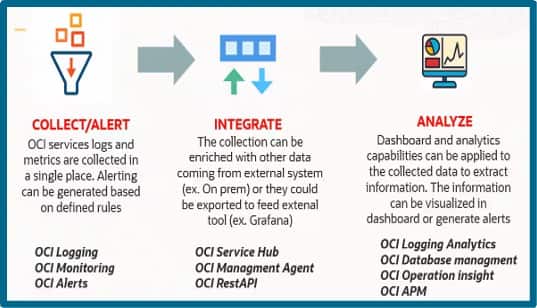
Fig 2. OCI Observability
As organizations adopt cloud services, IT operations and DevOps practitioners often struggle to gain insight into how resources are performing and being accessed. Traditionally, IT organizations lack standardized and centralized logging solutions, and every component of the IT stack has its own logging and analysis mechanism. Use the Oracle Cloud Infrastructure Logging and Logging Analytics services to access, monitor, and analyze logs for your cloud resources.
Logging
Logging is a highly scalable and fully managed single pane of glass for all the logs in your tenancy. Logging provides access to logs from Oracle Cloud Infrastructure (OCI) resources. These logs include critical diagnostic information that describes how resources are performing and being accessed.
Use Logging to enable, manage, and search the following types of logs:
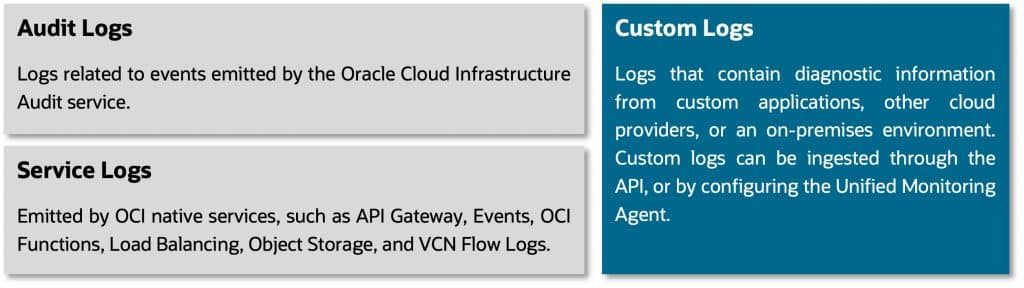
| For more information, please refer to the links for Audit Logs, Service Logs and Custom Logs |
Logs are indexed in the system, and searchable through the Console, API, and CLI. OCI logs are encrypted in-flight (that is, while they are in the process of being ingested), at disk level after the logs are in the system, when they are archived, and while in storage.
Tutorials The Essentials of Cloud Observability: OCI Logging Workshop | Plugins Oracle Cloud Infrastructure Fluentd Plugin |
| Blogs and other resources A simple guide to custom log consolidation using OCI Logging Learn how to be the best at using OCI Logging service to explore Object Storage logs Logging |
Logging Analytics
Logging Analytics is a cloud solution in Oracle Cloud Infrastructure that lets you index, enrich, aggregate, explore, search, analyze, correlate, visualize and monitor all log data from your applications and system infrastructure. To get started with Logging Analytics, see Oracle Cloud Infrastructure Logging Analytics Quick Start Guide. The Logging Analytics videos are another helpful resource. For steps to use hundreds of Oracle-defined sources and parsers, or to create your own custom source or parser, see Logging Analytics Administration Guide.
Events and Notifications Strategy
As enterprises take advantage of cloud services, IT Operations and DevOps practitioners often struggle to respond to service events across applications and infrastructure. Traditionally, IT organizations implement custom solutions or use manual sampling to keep up with events. Oracle Cloud Infrastructure (OCI) services such as Events, Notifications, OCI Functions, and Streaming let you implement a scalable and efficient IT events management and notifications strategy.
About Events
Use the Events service to allow your development teams to automatically respond when a resource changes its state. The Events service enables you to create automation based on the state changes of resources throughout your tenancy. Events are structured messages that indicate changes in resources. Event messages follow the CloudEvents industry standard format hosted by the Cloud Native Computing Foundation (CNCF).
Here are some examples of how you might use Events:
- Send a notification to a DevOps team when a database backup completes.
- Convert files of one format to another when files are uploaded to an Object Storage bucket.
Control plane events and Data plane events are available.
| Control plane events are audit events, and they are available through the following OCI services: > Audit, where events can be listed. > Events, where events are produced. > Logging, where audit events are represented as logs that can be searched and log matching rules can be created. |
| Data plane events are available only in Events and Logging. For a list of OCI services that emit events, see Services that Produce Events. |
About Notifications
Use Notifications to get messages whenever alarms, service connectors, and event rules are triggered. The Notifications service broadcasts messages to distributed components through a publish-subscribe pattern, delivering secure, highly reliable, low latency and durable messages for applications hosted on Oracle Cloud Infrastructure and externally. You can also directly publish messages to Notifications. Use the Notifications service to set up communication channels for publishing messages using topics and subscriptions. When a message is published to a topic, the Notifications service sends the message to the topic’s subscriptions. To get started, see Complete Developer’s Guide to the Oracle Notification Service.
Q2: What automation tools do Oracle cloud Infrastructure (OCI) provide for repetitive tasks and incident response?
Oracle Cloud Infrastructure (OCI) provides a comprehensive set of automation tools that enable organizations to reduce manual effort and standardize operations. One of the core services is Resource Manager, which is based on Terraform and allows users to define infrastructure using code (Infrastructure as Code). This approach enables automated provisioning, configuration, and lifecycle management of resources, ensuring consistency and repeatability across environments. You can explore it here: OCI Resource Manager Overview
Resource Manager automates deployment and operations using Terraform configurations, allowing teams to version, share, and reuse infrastructure setups efficiently.
In addition to provisioning automation, OCI supports event-driven automation through the Events Service and OCI Functions. The Events Service monitors changes in cloud resources and triggers automated actions in near real time, such as invoking serverless functions, sending notifications, or initiating workflows. This allows systems to automatically respond to incidents,.. for example, scaling resources, restarting services, or alerting teams without human intervention. You can learn more here: OCI Events Service Documentation
By combining events, functions, and predefined runbooks, OCI enables automated incident response workflows that improve system resilience and reduce operational overhead.
Q3: How do Oracle cloud Infrastructure (OCI) measure operational efficiency and reliability?
OCI measures operational efficiency and reliability using a combination of performance metrics and intelligent advisory tools. Key metrics include Mean Time to Recovery (MTTR), system availability (uptime), resource utilization (CPU, memory, storage), and cost per workload. These metrics help organizations evaluate how quickly systems recover from failures, how reliably they operate, and how efficiently resources are being used. Monitoring and analytics services continuously track these indicators to provide visibility into system performance and operational health.
To enhance decision-making and continuous improvement, OCI provides services like Cloud Advisor and Operations Insights. Cloud Advisor analyzes cloud resources and delivers recommendations to optimize cost, performance, availability, and security. Operations Insights complements this by offering historical analysis and capacity forecasting, enabling organizations to anticipate future demand and prevent performance bottlenecks. Together, these tools allow businesses to continuously monitor, analyze, and optimize their cloud environments, ensuring high reliability and operational efficiency.
Conclusion
Technical architecture is where cloud strategy becomes operational reality. The questions discussed in this section reflect how enterprises evaluate performance, scalability, reliability, and operational simplicity when selecting a cloud platform.
OCI is designed to support both traditional enterprise workloads and modern cloud-native applications, allowing organizations to migrate, modernize, and scale without compromising control or performance.
In the final part of this series, we will explore how enterprises drive value and long-term impact through FinOps, data and analytics, workforce enablement, and sustainability on OCI, while also evaluating future innovation capabilities such as AI services, ecosystem integration, and emerging technologies.