




Part 1 — Strategic and Commercial Considerations
Series Navigation
Fig 1. OCI Enterprise Evaluation Series – Part 1
- Part 1: Strategic and Commercial Considerations (You are here)
- Part 3: Value and Sustainability
Introduction
When enterprises evaluate a cloud platform, the discussion rarely begins with technology alone. It typically starts with strategy, cost models, and long-term business outcomes.
CIOs, CTOs, and enterprise architects want to understand how a platform will impact operational efficiency, total cost of ownership, vendor flexibility, and long-term innovation potential. These early conversations help organizations determine whether a cloud platform can support not just current workloads, but also future growth.
In many enterprise discussions, leaders ask very practical questions:
- How will costs evolve over time?
- What commercial advantages does the platform offer?
- How flexible are the pricing models?
- Can the cloud platform support both legacy and modern workloads?
This article is the first part of a three-part series exploring common questions enterprises ask when evaluating Oracle Cloud Infrastructure (OCI).
Below are representative evaluation questions along with detailed responses that explain how OCI approaches cost efficiency, commercial flexibility, and enterprise value.
Strategy and Business Outcomes
Q1: How will Oracle Cloud Infrastructure (OCI) help Customers achieve reduction in overall IT costs over three years, and what concrete levers will Oracle use to get there?
Oracle Cloud Infrastructure (OCI) delivers a lower three-year Total Cost of Ownership (TCO) by combining industry defining commercial incentives with a unique architectural philosophy: performance should not require a “commitment tax”. While a common industry practice is to force customers into 1- or 3-year commitments just to reach a competitive price point, OCI provides industry-leading price-performance on an on-demand basis. This allows organizations to remain architecturally agile, scaling resources up or down without being penalized for adjusting architectural decisions such as instance type or region.
Commercially, OCI leverages the Universal Credit model, providing a single “prepaid wallet” that can be applied across any service from GPU clusters for AI to high-performance block storage, preventing the “shelfware” common in fragmented cloud contracts. This is further amplified by Oracle Support Rewards, which acts as a powerful reinvestment mechanism. For every dollar spent on OCI, customers earn back 25% to 33% in rewards that can be used to reduce, or even eliminate, their existing on-premises Oracle software support bills. This “double-dip” effect allows the OCI migration to fund other parts of the IT budget, a differentiated capability within Oracle’s commercial model.
From a technical perspective, OCI supports through a three-phased optimization strategy designed for long-term sustainability. In the short term, we achieve immediate savings by utilizing OCI’s Flexible VM Shapes, which allow you to customize OCPUs and memory independently, eliminating the “over-provisioning tax” inherent in fixed instance sizes. In the medium term, we optimize architectural efficiency across multi-cloud environments, taking advantage of OCI’s free 10 TB monthly data egress and low networking fees. Finally, in the long term, we drive deep structural savings through database consolidation, moving fragmented workloads onto dense, high-performance platforms like Oracle Autonomous Database. This reduces both the management overhead and the licensing footprint, ensuring the third year of cloud journey is even more cost-effective than the first.
Q2: Can Oracle Cloud Infrastructure (OCI) model projected cloud spend over five years for Customer environment, including migration, optimisation, and ongoing services, and show how this compares to Customers’ current baseline costs?
Yes. We perform a comprehensive 5-year TCO analysis beyond simple price-list comparisons that maps your current baseline (on-premises or other cloud) against a transition to OCI. This model is not a static quote; it is a dynamic forecast that includes four critical pillars: Infrastructure and licensing costs, Operational support, Optimization opportunities, and Migration Costs and Investment assumptions. Most enterprise customers, even after accounting for migration costs, see savings starting in Year 1, with significantly greater savings in Years 2 and 3 as OCI’s cost advantages compound. This results in a significantly lower steady-state cost compared to the rising management and egress costs often seen with other providers.
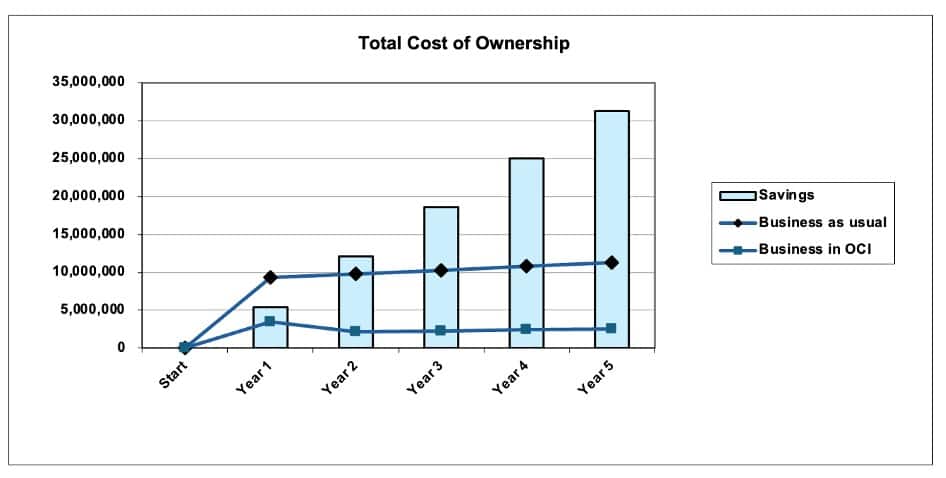
Fig 2. Total Cost of Ownership – Sample Chart
Q3: What commercial constructs can Oracle Cloud Infrastructure (OCI) offer to de‑risk Customers’ phased multi‑cloud migration and support Customers’ initial transformation costs (migration, optimisation, training)?
OCI offers several mechanisms to de-risk transformation costs. Customers can leverage free self-paced training with optional paid certifications (Oracle Cloud Training). Commitment-based pricing models, EDP-like agreements, and credits can support migration, optimization, and training. From a human capital perspective, OCI training and Customer Success Services (CSS) ensure staff are prepared for cloud adoption and optimized operations.
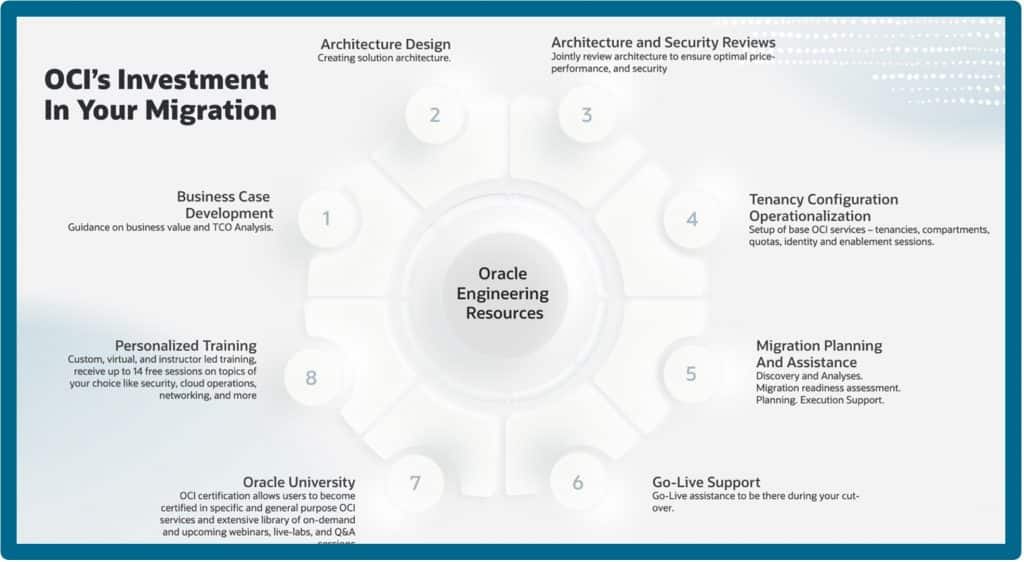
Fig. 3 – OCI’s Investment In Customer Migration
Q4: How will Oracle Cloud Infrastructure (OCI) help Customer continuously improve cost efficiency (FinOps support, tools, governance) to sustain 25 -30% cloud spend reduction over time?
OCI provides multiple tools to ensure ongoing cost efficiency. The Cost and Usage Reports page offers OCI proprietary and FOCUS (FinOps Open Cost & Usage Specification) reports (Cost Reports). Budgets can be set to define soft spending limits (Budgets Overview), while Cost Anomaly Detection monitors daily usage for abnormal trends (Cost Anomaly Detection). OCI Ops Insights assists with database resource optimization (Ops Insights), Cloud Advisor identifies inefficiencies (Cloud Advisor), and tagging allows precise cost allocation (OCI Tagging). Together, these tools create a robust governance framework for sustained cost savings. In addition, OCI Solutions Architects and Enterprise Cloud Architects help with optimizing cloud resources and review architecture on a regular basis.
Multi-Cloud Architecture and Migration
Q1: How do Oracle Cloud Infrastructure (OCI) services and partner ecosystem support a phased multi‑cloud strategy across AWS, Azure and Google Cloud, including portability and avoiding lock‑in at the application and data layers?
OCI leverages open-source technologies such as Kubernetes and the Fn Project, along with monitoring tools like Grafana and Prometheus, to avoid vendor lock-in. Multi-cloud universal credits allow customers to use Oracle DB services across other clouds. Additionally, OCI provides high-bandwidth dedicated connectivity to other clouds (Oracle Multicloud), enabling seamless phased multi-cloud adoption. OCI only charges for the interconnect dedicated connection, and there are no additional charges for data transfer over the interconnect, thus enabling customers to use a multi cloud approach without worrying about the data transfer charges on OCI.
Here are some architecture resources for multicloud deployments:
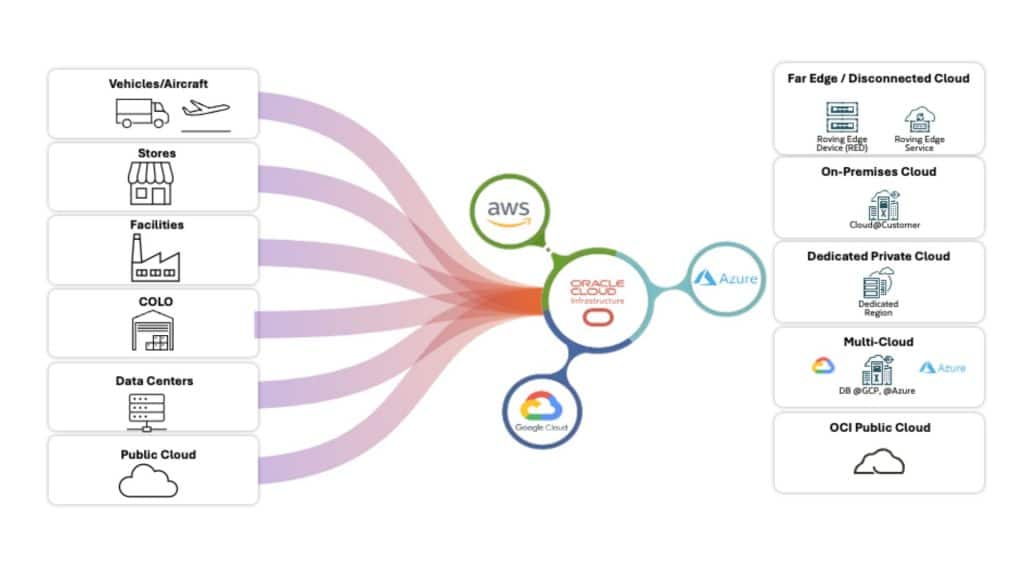
Fig. 4 – Enterprise-Class Compute Hub In An Interconnected Cloud Ecosystem
In today’s multi-cloud environments, organizations are continuously looking for different ways to achieve seamless connectivity from OCI to other cloud providers. One common way of achieving this is through partner connectivity. The blog link below walks through the steps to configure interconnection between OCI and AWS using Equinix’s new virtual routing service, Fabric Cloud Router (FCR).
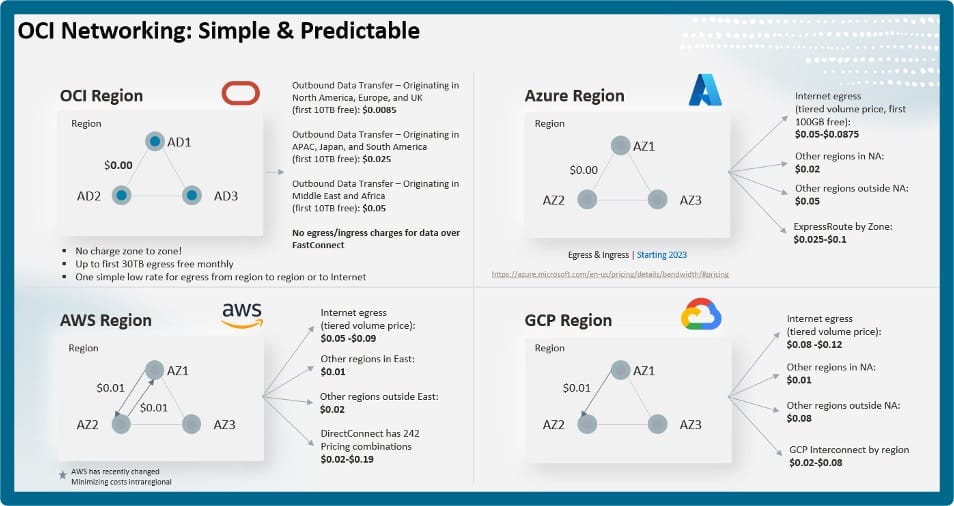
Fig. 5 – OCI Networking Cost Comparison with other Major Cloud Providers.
Q2: What specific migration methodologies, tools, and accelerators will Oracle Cloud Infrastructure (OCI) use for lift-and-shift and refactoring workloads?
For lift-and-shift migrations, OCI provides prebuilt methodologies, migration accelerators, and tooling to move legacy applications to the cloud efficiently. For cloud-native refactoring, OCI supports modernization strategies through OCI Migrate, Cloud Lift, and application refactoring guides (Migrate Custom Applications, Cloud Lift, Migration Overview). These approaches ensure minimal disruption while modernizing workloads for agility and scalability.
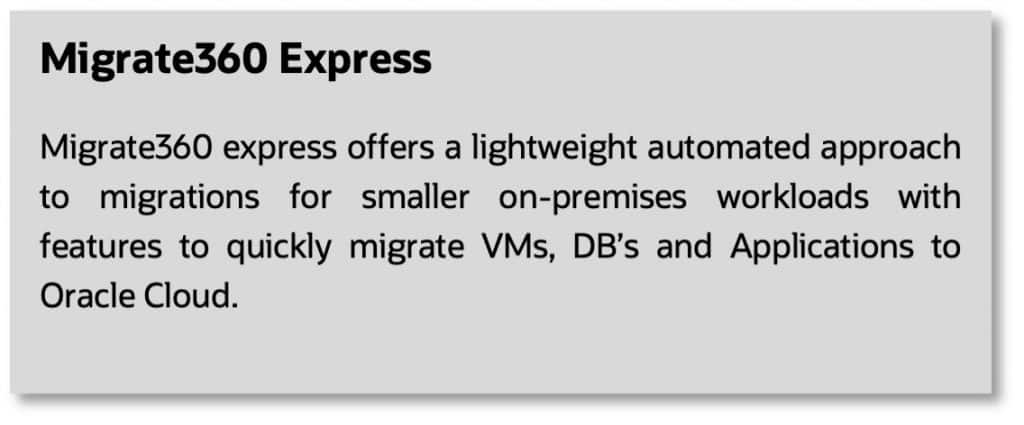
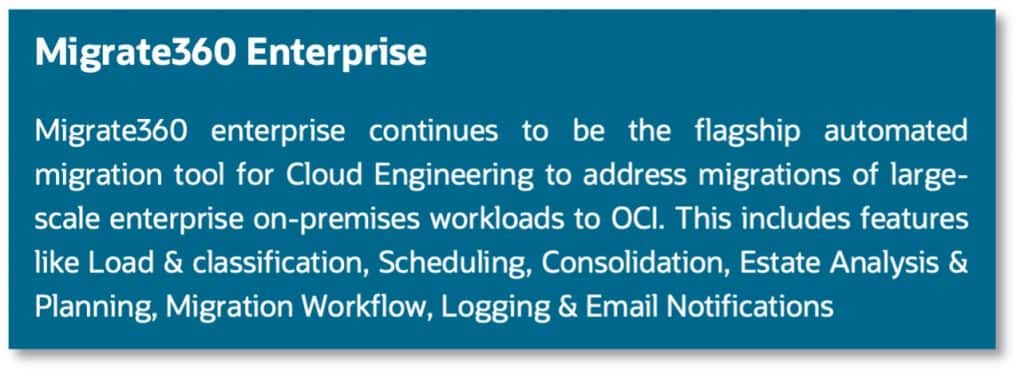
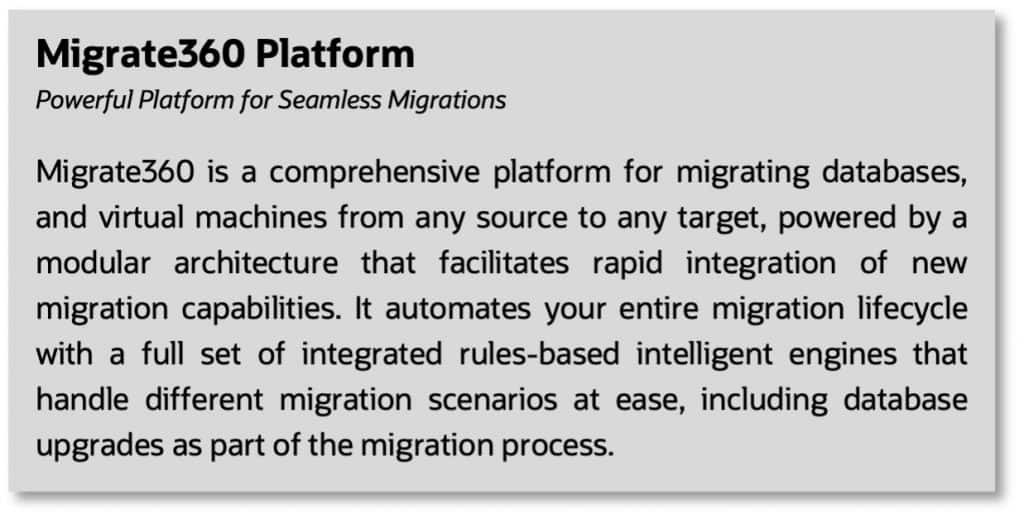
OCI’s Cloud Engineering Services organization has a methodology and supporting technology called Migrate360. Migrate360 is a planning and migration execution tool. It offers a comprehensive approach to enterprise migration for Database and VM Workload migrations to OCI. Migrate360 uses a rules-based engine to analyze, plan, orchestrate, and execute the migration of customers’ workloads.
Following are the two versions of Migrate360:
Oracle supports several technologies to support migration of workloads to OCI. Oracle Cloud Migrations supports migrations from both on-premises VMware estates and AWS EC2 VMs in the cloud to OCI Compute virtual machines. Partner tools such as Mathilda and Rackware are also supported to help with automated discovery and resource migration to OCI.
Q3: Can Oracle Cloud Infrastructure (OCI) provide example migration roadmaps with timelines and prior outcomes?
The Cloud Adoption Framework (CAF) helps organizations unlock the full potential of cloud computing. With a tailored set of guidelines and best practices, it helps ensure a smooth onboarding process and the optimal use of cloud resources. With the framework, Oracle helps support improved operational efficiency and innovation outcomes in the cloud.
Oracle has many case studies of customers following this approach to success. You can find these case studies with descriptions of the workloads migrated and the particular approach.
Capabilities:
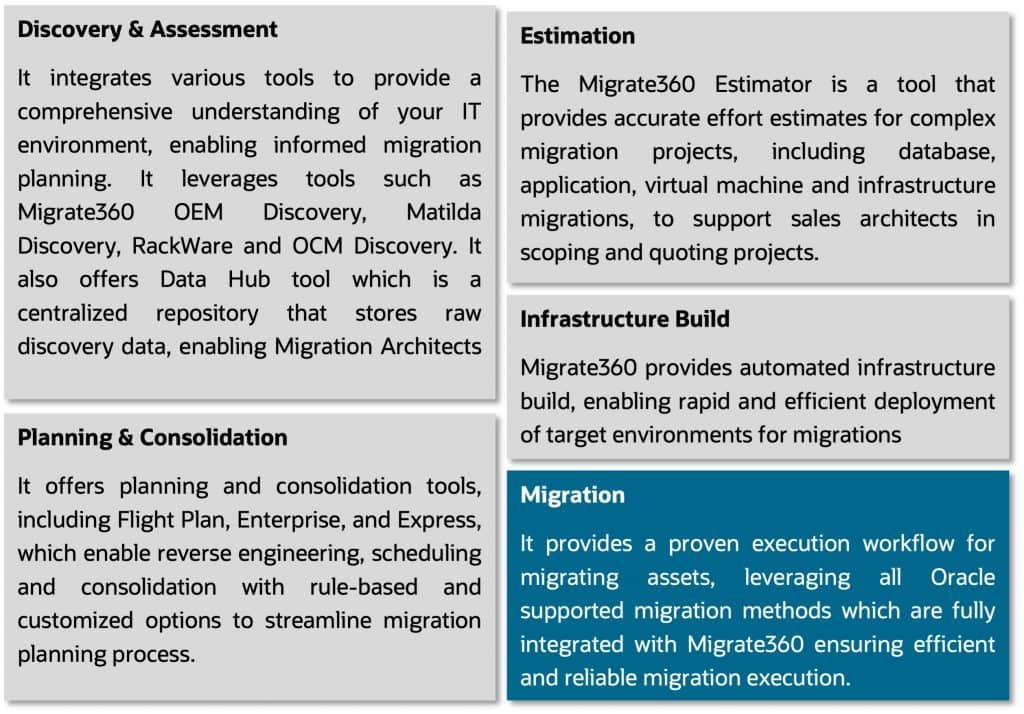
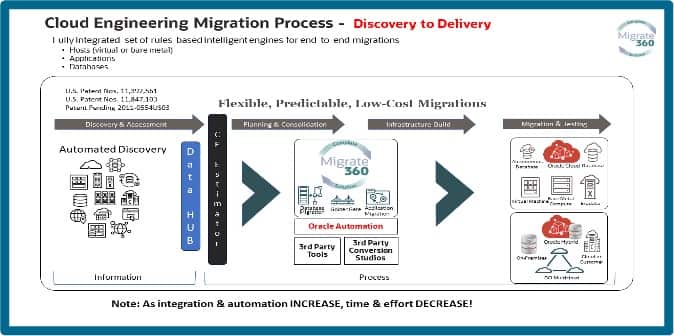
Fig. 6– Cloud Engineering Migration Process – Discovery to Delivery
Q4: How does Oracle Cloud Infrastructure (OCI) ensure adherence to a Well-Architected Framework and evidence this for customer workloads?
Oracle Cloud Infrastructure (OCI) provides infrastructure and platform services for a wide range of enterprise workloads. With each service, you can choose from a rich array of features based on your goals. We recommend a set of best practices to help you design and operate cloud topologies that deliver the maximum business value.
The OCI Well-Architected Framework is organized into five pillars: security and compliance, reliability and resilience, performance and cost optimization, operational efficiency, and distributed cloud. The topics covered for each pillar feature one or more personas that map to typical architect roles within organizations using Oracle Cloud Infrastructure. Additionally, the framework presents the OCI Landing Zones as the ideal templates for deploying secure, performant, reliable, and efficient architectures on OCI.
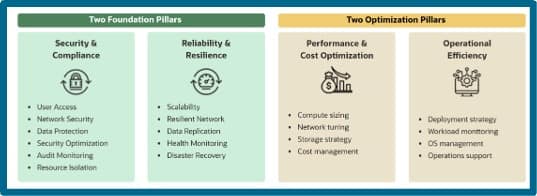
Fig. 7– OCI Well-Architected Framework
OCI Well-Architected Framework: To help organizations make the most of OCI, Oracle has developed a set of best practices called the well-architected framework for OCI. Through goals of security, reliability, performance-cost optimization, and operational efficiency, this framework enables organizations to design, deploy, and manage workloads on OCI effectively.
Oracle CIS Landing Zones is an approach and a set of Terraform scripts to adhere to the Center for Internet Security (CIS) Benchmark.
Oracle CIS Landing Zones Overview
The following information describes the Oracle Cloud Infrastructure (OCI) landing zones.
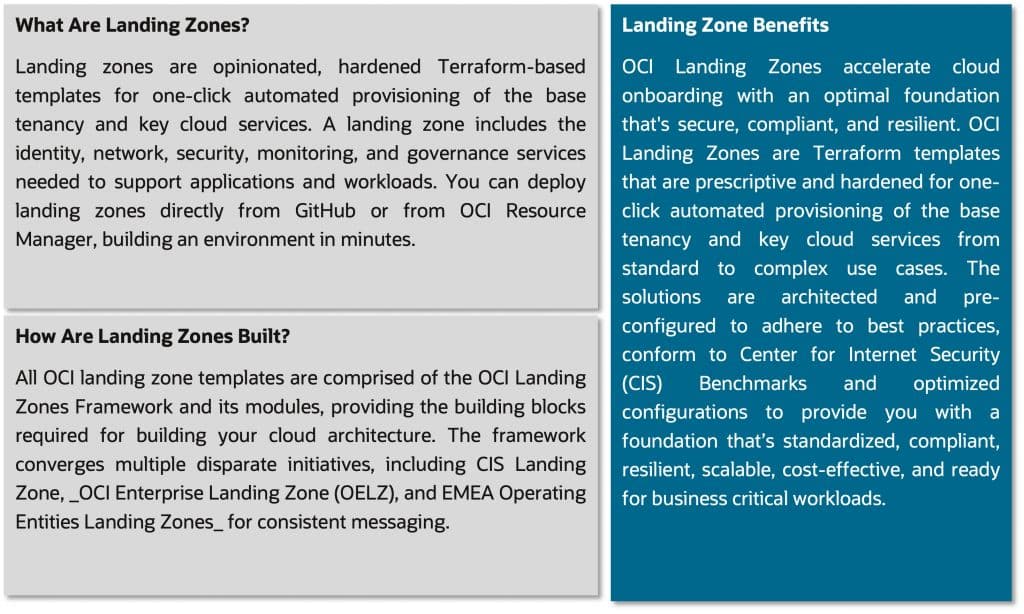
The following diagram outlines components of the OCI Landing Zones framework.
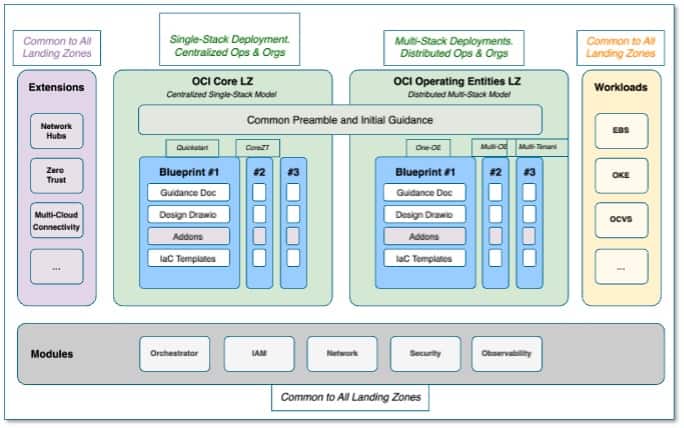
Fig. 8– OCI Landing Zone Framework
Landing zone blueprints are pre-built solutions that provide prescriptive solutions to support common and specific requirements. The framework provides a common set of generic Terraform modules that provide infrastructure as code (IaC) capabilities to all landing zones. Extensions are pluggable elements that augment a blueprint, such as custom hub and spoke configurations and multicloud connectivity.
Workloads are also pluggable elements designed to simplify the onboarding of specific application workloads and platform as a service (PaaS) solutions, such as OCI Kubernetes Engine (OKE), Exadata Cloud Service (ExaCS), E-Business Suite (EBS), Oracle Cloud VMware Solution (OCVS), AI services, and so on. All landing zone components, such as blueprint, modules, extensions, and workloads are pre-configured by default to enforce the CIS OCI Foundations Benchmark.
Q5: What success metrics and KPIs will Oracle commit to for migration?
Migration success will be tracked via KPIs including percentage of workloads migrated on time, performance improvements, and post-cutover defect rates. These metrics ensure transparency and continuous improvement, supporting operational efficiency and risk management.
The migration project is designed to have a smooth execution phase, which includes migration readiness, migration, and post-migration support. The customer should be satisfied with the migration results, and the project should be completed within the scheduled timeframe and budget.
Some key performance indicators (KPIs) that can be used to measure the success of a Migrate360 project include:
- Completion of the project within the scheduled timeframe and budget
- Customer satisfaction with the migration results
- Successful migration of all identified assets
- Minimal downtime and disruption to the customer’s business operations
- Effective communication and collaboration between the Oracle project team and the customer
- Identification and mitigation of potential risks and issues
Overall, a successful Migrate360 project is based on careful planning, effective execution, and strong collaboration between the Oracle project team and the customer.
Oracle North America – Consulting (ONA-C) can provide professional services on a Fixed Fee with Deliverables basis.
Cloud Uptime, and Support
Q1: What SLAs can Oracle contractually commit to for:
- Q1a: Uptime (targeting at least 99.99%)?
OCI provides competitive SLAs for over 50 IaaS and PaaS services, with uptime commitments at 99.99% (Service SLA).
- Q1b: Critical incident response time (e.g. 15 minutes)?
Oracle Priority Support delivers an advanced level of IT support that provides fast problem resolution through priority handling of service requests and proactive guidance. At a high level, the metrics below provide a guidance on response times.
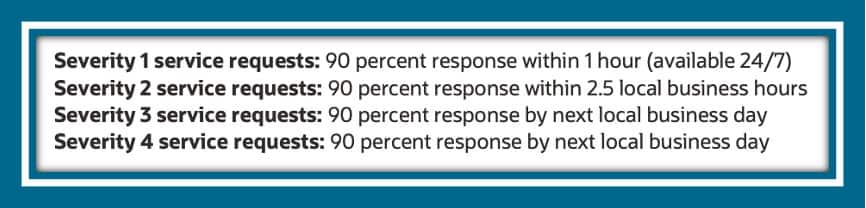
Oracle Advanced Customer Services delivers a personalized support relationship with tailored guidance based on customer’s business and technical priorities. (Priority Service) & (SLA Support)
- Q1c: Mean Time to Resolve (e.g. < 1 hour for Sev1)? Please provide historical performance data?
For Oracle Cloud Infrastructure (OCI), incident management timelines are aligned to defined severity levels and Oracle Support response objectives. Historical performance is tracked primarily against initial response time targets rather than guaranteed resolution times. The current response objectives are: Severity 1 service requests – 90% response within 1 hour with 24×7 availability; Severity 2 – 90% response within 2.5 local business hours; Severity 3 – 90% response by the next local business day; and Severity 4 – 90% response by the next local business day. Actual Mean Time to Resolve (MTTR) can vary depending on issue complexity, affected services, and customer-specific environments. Detailed historical MTTR or service performance reports can be shared through Oracle Support reporting channels upon request.
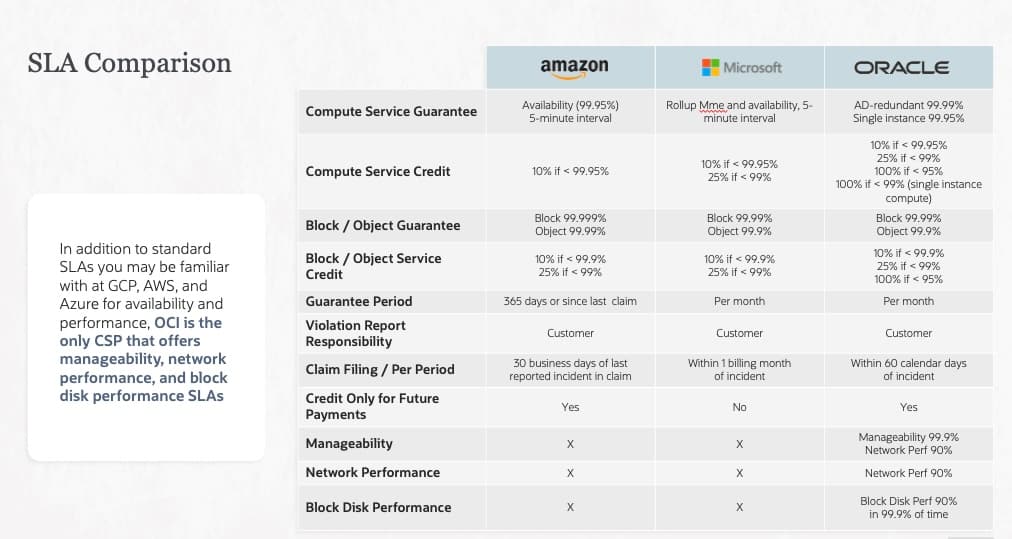
Fig. 9– SLA Comparison
Q2: Describe your 24/7 support model: locations, staffing, support tiers, hand‑offs, and how major incident management and escalation work in practice.
Below is a summarized view of the details of the support model
Locations and Staffing | ||
| S# | Category | Details |
| 1 | Global Reach | OCI support is global, providing 24/7 assistance across 175 countries |
| 2 | Staffing | Oracle utilizes a team of more than 18,000 support and service specialists |
Support Tiers | ||
| S# | Category | Details |
| 1 | Tier 0 (Self-Service) | OCI support is global, providing 24/7 assistance across 175 countries |
| 2 | Tier 1 (Frontline) | Oracle utilizes a team of more than 18,000 support and service specialists |
| 3 | Tier 2/3 (Advanced/Engineering): | SMEs & product engineers who handle complex, technical, or high-impact incidents |
Note: OCI support operates on a tiered model to ensure appropriate expertise for the complexity of the issue
Support Levels |
| Depending on the contract, this includes Premier Support (continuous updates/ patches) or Extended Support. |
Hand-offs and Workflow | ||
| S# | Category | Details |
| 1 | Initial Triage | Incidents are created in the OCI Console, where they are initially reviewed and assigned a severity level. |
| 2 | Incident Routing | If a Tier 1 agent cannot resolve the issue, it is escalated to Tier 2 or specialists. |
| 3 | Tracking | All actions, including hand-offs between teams, are tracked within the Incident Manager, allowing for, at minimum, tracking of ownership, resolution status, and prioritization. |
Incident Management | ||
| S# | Category | Details |
| 1 | Detection & Response | Oracle monitors system performance metrics to detect potential failures, such as region-wide disruptions |
| 2 | Critical Outage | For a complete outage with no redundancy, the incident is routed to a specialized Major Incident Management team. |
| 3 | Response Team | A specialized team is engaged to conduct investigation, containment, and recovery, particularly for security incidents. |
| 4 | Communication | During a major incident, updates are provided through the OCI Service Health Dashboard. |
| 5 | Post Mortem | After resolution, a Post-Incident Review (post-mortem) is conducted to identify root causes and improve future response. |
Escalation | ||
| S# | Category | Details |
| 1 | Support Portal | Verify all necessary information and logs have been provided. |
| 2 | Call Support | Call the Global Support phone number, provide the SR number, and request to speak to a manager (“Option 2” in some regions). |
| 3 | Automation | Internal Oracle systems use rules to escalate incidents based on age (e.g., if a ticket remains open without update for a set period). |
Additional Details (Support & Incident Management, Premier Support).
Q3: How does Oracle cloud Infrastructure (OCI) implement proactive monitoring, alerting and automated remediation for customer workloads, and what tools and dashboards will the customer have access to?
OCI implements monitoring and remediation using multiple services enabling real-time metric evaluation and automated response to security/performance events.
Some of the key Tools and Capabilities are highlighted below.
| S# | Category | Details |
| 1 | OCI Monitoring Service | Collects metrics on resource utilization, enabling threshold-based alarms via Monitoring Query Language (MQL) |
| 2 | OCI Notifications & Events: | Automates remediation by sending alerts (via email, PagerDuty, Slack, HTTPS) based on triggers. |
| 3 | Cloud Guard: | Proactive security monitoring and automated remediation by identifying misconfigured resources / potential threats. |
| 4 | Application Performance Monitoring (APM): | Offers end-to-end tracing and diagnostics for applications. |
| 5 | Logging Analytics: | Analyzes logs from various sources to visualize performance, security incidents, and trends using pre-built dashboards. |
OCI users have access to multiple different Dashboards and Visualization and can be leveraged for varied use cases:
| S# | Category | Details |
| 1 | Native Dashboards | Built-in visualizations in the OCI Console for monitoring metrics, logging, and audit trails, including specialized views |
| 2 | Performance Hub | Used for monitoring database performance and identifying bottlenecks. |
| 3 | Cost Analysis Service | Dashboard to visualize cloud usage and spending patterns over time. |
For additional details regarding monitoring, please refer to the document link provided below.
Q4: How will Oracle Cloud Infrastructure (OCI) integrate with customers’ internal teams (DevOps, platform, security, business) for incident management, change management and communication during major events?
OCI integrates with customer internal teams during incidents, changes, and major events through a mix of automated event-driven services, proactive communication channels, and shared, structured support workflows.
Incident Management | ||
| S# | Category | Details |
| 1 | Automated Notification | The OCI Notifications service sends alerts, and updates via email, SMS, or HTTPS webhooks |
| 2 | Portal | Customers access the Oracle Operations Management (OM) Portal to track, manage, and receive updates on support tickets. |
| 3 | Cloud Guard Integration | Cloud Guard provides continuous monitoring, and in the event of a security threat, it can automate remediation actions |
Change Management | ||
| 1 | Procedures | Formal procedures for service maintenance and updates are in place and, which are communicated in advance. |
| 2 | Automated Guardrails | OCI uses automated guardrails to prevent or mitigate the impact of changes |
| 3 | Tracking | The Events Service acts as a change tracking tool, alerting customers in real-time when infrastructure is modified. |
Communication | ||
| S# | Category | Details |
| 1 | Real Time Alerts | The Events Service enables proactive monitoring and alerting immediately when a state change occurs in a resource |
| 2 | Direct Integration | OCI supports direct integration with collaboration tools via Webhooks |
| 3 | Service Dashboards | Dashboards are used to communicate the status of regions and services during outages |
Oracle North America – Consulting (ONA-C) can build custom events / notifications to their SIEM or Incident Management platforms.
Conclusion
When organizations begin evaluating a cloud platform, business and financial considerations often lead the conversation. Enterprises want to ensure the platform they choose delivers both technical capability and long-term economic value.
In this first part, we explored questions related to business outcomes, multi cloud architectures, uptime, support and strategic value when adopting OCI.These discussions help decision-makers determine how a cloud platform fits into their broader technology strategy.
However, once the commercial and strategic aspects are clear, the conversation quickly shifts toward architecture and operational design.
In Part 2 of this series, we will explore the technical architecture and operational questions enterprises commonly ask when designing workloads on OCI.
Continue reading:
Part 2 of 3 — Architecture and Operational Design