

Enterprises adopt multi-cloud for strategic and practical reasons: reducing concentration risk, meeting regulatory and data-residency requirements, improving resilience, and enabling teams to choose best-fit services per workload. In many organizations, multi-cloud is also the natural outcome of growth—different business units standardize differently, SaaS ecosystems pull integrations toward specific hyperscalers, and acquisitions introduce new platforms.
For CIOs, CTOs, and chief architects, the takeaway is clear: multi cloud must be treated as an architectural discipline, not a collection of one-off connections. The goal is to make cross cloud delivery repeatable—standardizing identity, connectivity, security, data movement, integration, observability, and cost governance—so the organization can enable choice without multiplying operational complexity.
This post proposes a capability-led model for multi-cloud and maps it to OCI-supported patterns such as private interconnect designs and Database@Hyperscaler options.
A capability-led view of multi-cloud (the model that scales)
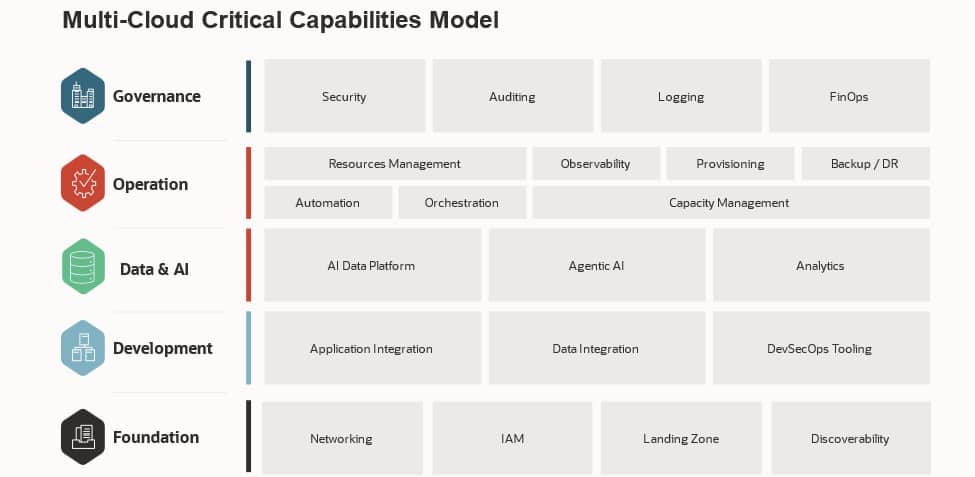
This cloud agnostic model groups critical multi cloud capabilities into five layers:
- Foundation:
- Networking and segmentation
- Identity and access management (IAM)
- Landing zones (repeatable cloud environments)
- Discoverability
- Development:
- Application Integration
- Data Integration & Pipelines
- DevSecOps Tooling & Patterns
- Data & AI:
- AI Data Platform
- Agentic AI
- Analytics
- Operation:
- Landing zones (repeatable cloud environments)
- Automation and orchestration
- Observability (logs, metrics, traces)
- Backup, disaster recovery (DR), and capacity management
- Governance:
- Security controls & Posture management
- Auditing & Logging
- FinOps (allocation, optimization, showback/chargeback)
This framing shifts discussions from “which cloud?” to “which capabilities must be consistent everywhere?”
How OCI supports multi-cloud beyond basic connectivity
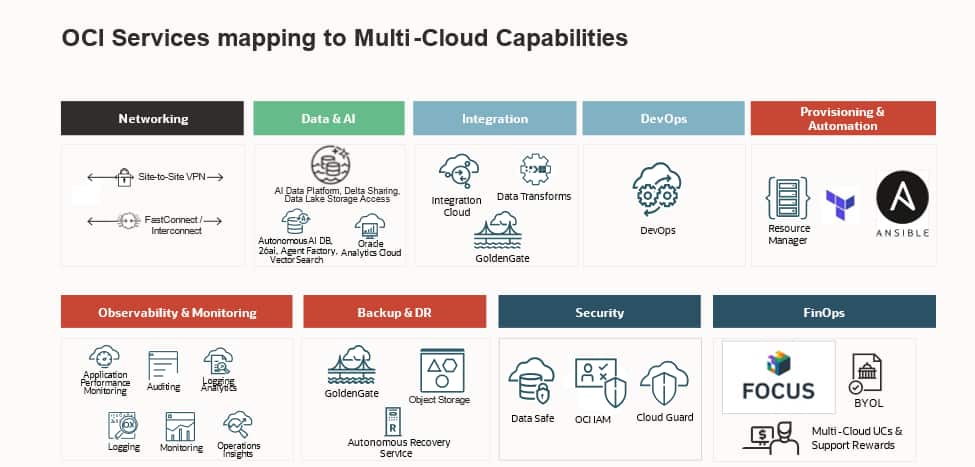
The broader challenge facing enterprise IT environments when to choosing a multi-cloud IT strategy is “how do we run the whole system?”; OCI contributes to multi cloud success across the listed capability layers in the above diagram which can described as the following:
Foundation: Networking, IAM, landing zones:
- OCI Networking: segmentation and controlled routing for OCI-hosted components, plus secure connectivity patterns to other environments.
- OCI IAM: authentication and authorization for OCI resources; typically integrated with corporate identity providers for federation and consistent enterprise access controls.
- Landing zone patterns: standardized compartments, policies, tagging, baseline logging/audit, and network blueprints to make OCI environments repeatable and governable.
Development: Integration and data pipelines:
- Oracle Integration Cloud (OIC): application and process integration across SaaS, on prem, OCI, and other clouds—reducing bespoke point to point integrations via reusable connectors and standard patterns.
- Data Transforms and Golden Gate: governed pipelines and orchestration across heterogeneous sources; useful for real-time & batch ingestions, transformation, and publishing strategies over multi-cloud environments.
Data & AI: Analytics and AI-ready data foundations:
- AI Data Platform on OCI: to establish curated datasets, governance, and scalable compute so AI initiatives don’t become fragmented across clouds.
- Agentic AI Hub: intelligent and autonomous AI execution to achieve business goals across multi-cloud environments, reducing complexity and increasing response time to changing demands.
- Oracle Analytics Cloud: centralized analytics capabilities that can consume data from multiple environments.
Operations: Provisioning, automation, observability, backup/DR:
- OCI Resource Manager (Terraform-based): infrastructure as code provisioning to standardize builds, reduce drift, and improve auditability.
- Automation/config management: commonly paired with IaC to enforce consistent OS/middleware configuration across clouds.
- Observability: logging/monitoring/APM capabilities to capture telemetry required for cross cloud operations and incident response.
- Backup/DR and replication patterns: durable storage (Object Storage) and data movement/replication technologies to support continuity designs aligned to RPO/RTO.
Governance: Security, audit, FinOps:
- Database security posture (e.g., Data Safe): supports database security controls as part of a broader enterprise security program.
- Audit/logging: essential for compliance and investigations; strongest when integrated with enterprise SIEM and centralized governance reporting.
- FinOps: consistent tagging/allocation and reporting so costs remain attributable and optimizable across providers.
The following framing is useful because it shifts the conversation from “which cloud?” to “which capabilities must be consistent everywhere?” OCI supports patterns across each layer—and can complement other hyperscale’s as part of a coherent multi cloud platform.
Interconnects: The backbone for predictable cross cloud performance
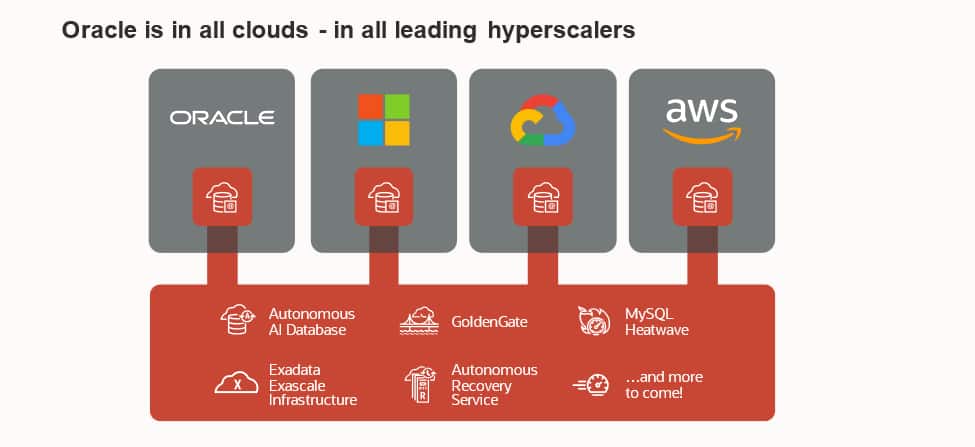
Many multi cloud challenges emerge at the boundaries: latency between application and database tiers, throughput limitations for data replication, inconsistent security controls, and complex troubleshooting across environments. Network Interconnect patterns address these problems by establishing private connectivity between clouds.
Architecturally, an interconnect approach is designed to provide:
- Lower and more predictable latency than internet-based routing
- Higher throughput for data movement, replication, and shared services
- Improved security posture with private paths, controlled routing, and segmentation
- Operational clarity (routing/DNS conventions, fewer brittle endpoints)
A Common interconnect-based pattern Split-stack by layer
A widely used enterprise pattern is:
- Application tier in Hyperscaler A (aligned with team skills, existing platform services, or enterprise standards)
- Data tier on OCI (Oracle database services)
- Private interconnect between the environments
This enables phased modernization (move the app tier first), supports latency sensitive OLTP systems, and reduces the need for invasive application redesign that would otherwise be required to tolerate high network latency.
Database@HyperScaler: Reducing friction between application ecosystems and Oracle data platforms
Database@Hyperscaler models are about bringing Oracle database services closer to where application ecosystems run—helping enterprises keep Oracle database capabilities while allowing application delivery to standardize elsewhere.
From an architecture standpoint, Database@Hyperscaler is most valuable when you need:
- Low-latency app-to-database calls for transactional workloads
- A consistent Oracle database capability set and lifecycle management
- A clear separation of responsibilities between application and data platform teams
- A pragmatic path to modernization (minimize risk by migrating layers independently)
Reference example: Oracle Database@Azure
A representative pattern is:
- Web/API/microservices on Azure
- Oracle database services via Database@Azure
- Private connectivity patterns to support latency-sensitive traffic
- Alignment with enterprise identity, logging, and security controls
Outcome: application teams keep an Azure centered delivery model, while database services remain Oracle managed and optimized for the use case.
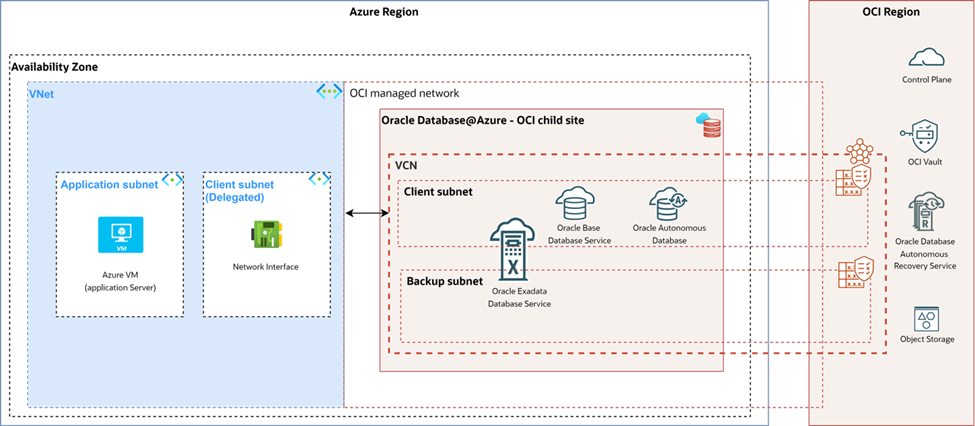
Note: Availability, regions, and supported configurations vary by offering and location—architects should validate service coverage and constraints during design.
Multicloud Universal Credits: simplifying cross-cloud procurement and consumption
Oracle has introduced Multicloud Universal Credits, a consumption option intended to help customers procure Oracle Database and OCI services across the cloud of their choice. Beyond procurement efficiency, the architectural benefit is improved operational consistency: a more standardized way to consume and govern platform services when workloads span multiple clouds (subject to the relevant cloud marketplace policies).
This will provide customers with unique capabilities such as
- A single consumption model across clouds
- Expanded access to regions across clouds
- Workload portability and flexibility
When Interconnects or Database@Hyperscaler aren’t available; Design patterns that still scale
Multi cloud architectures should remain viable even without dedicated connectivity or co located services in a specific region. Practical fallback patterns include:
- Federated identity and least privilege policies for OCI components
- Secure baseline connectivity (VPN) plus application resiliency (timeouts, retries, circuit breakers, caching)
- Integration-first architecture using OIC to decouple systems a
- Governed data movement with OCI Data Integration to avoid uncontrolled data sprawl
- IaC-driven standardization via Resource Manager to keep environments consistent and auditable
- Centralized observability and audit integration for operational coherence
Conclusion: Make Multi-cloud repeatable with a capability-led architecture
Multi-cloud is now a mainstream enterprise reality, and a strategic necessity, but success depends on repeatable architectural patterns across the critical capability layers: foundation, development, operations, and governance.
OCI supports this model with interconnect-based designs for predictable cross cloud performance, as well as Database@Hyperscaler offerings that reduce application and data friction across hyperscalers, and broader services for AI, Identity, Integration, Data Pipelines, Provisioning, Observability, Monitoring, Security, and strong Governance.
Practical takeaways for CTOs and chief architects:
- Standardize capabilities, not providers: identity, logging, IaC, tagging, and baseline security
- Design for boundaries: most multi-cloud failures occur in networking, identity, and operations—not inside a single cloud.
- Prefer repeatable reference patterns over bespoke integrations.
- Treat consumption and procurement models as part of the architecture because they influence governance, portability, and speed.
In subsequent blogposts, we will explore some popular multi-cloud strategies and what are the architecture representations for each and every strategy. Stay tuned for more architectural insights about the multi-cloud world.
References and Resources to explore more:
https://www.oracle.com/cloud/multicloud
https://docs.oracle.com/en-us/iaas/Content/database-at-azure/oaa.htm
https://docs.oracle.com/en-us/iaas/Content/database-at-gcp/home.htm
https://docs.oracle.com/en/solutions/oci-aws-gcp-multicloud/