
Oracle University continues to expand its professional-level learning portfolio, helping database administrators, cloud architects, and infrastructure engineers build the skills needed to deploy, manage, and optimize Oracle Database services across Oracle Cloud Infrastructure (OCI) and multicloud environments.
Following the release of professional-level learning paths for Oracle Autonomous AI Database, Oracle AI Database@AWS, Oracle AI Database@Azure, and Oracle AI Database@Google Cloud, Oracle University is introducing the new Oracle Exadata Database Service Professional learning path.
This new learning path provides comprehensive coverage of Oracle Exadata Database Service across three deployment options: Dedicated Infrastructure, Cloud@Customer, and Exascale Infrastructure.
Through 14 modules organized into three key learning areas, learners can develop the knowledge and practical skills needed to provision, manage, scale, protect, monitor, and maintain Exadata Database Service environments.
This learning path is only available with a paid Oracle University Learning Subscription.
Expanding Oracle University’s Database Learning Portfolio
Oracle University offers a growing portfolio of learning paths covering Oracle Exadata technologies across OCI and multicloud environments.
- Oracle Autonomous AI Database Professional: Covers Autonomous AI Database architecture, deployment, management, monitoring, and database capabilities across supported deployment options.
- Oracle AI Database@AWS Architect Professional: Covers Oracle Database services available through Oracle AI Database@AWS.
- Oracle AI Database@Azure Architect Professional: Covers Oracle Database services available through Oracle AI Database@Azure.
- Oracle AI Database@Google Cloud Architect Professional: Covers Oracle Database services available through Oracle AI Database@Google Cloud.
The new Oracle Exadata Database Service Professional learning path complements these offerings by expanding Oracle University’s OCI database learning portfolio with a focus on Exadata Database Service architecture, infrastructure management, Grid Infrastructure, and Oracle Database administration.
It provides a structured learning experience for professionals responsible for managing Exadata Database Service environments, from initial planning and provisioning to ongoing database operations and maintenance.
One Learning Path, Three Deployment Options
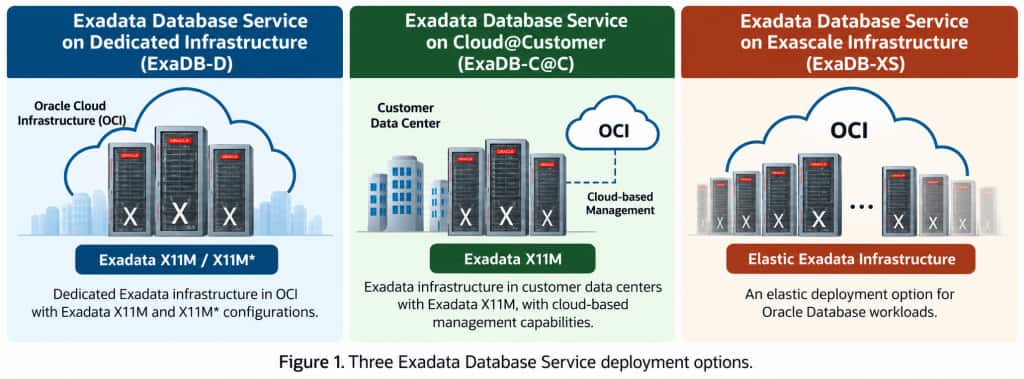
One of the key highlights of this learning path is its coverage of all three Exadata Database Service deployment options.
Exadata Database Service on Dedicated Infrastructure (ExaDB-D)
Exadata Database Service on Dedicated Infrastructure provides dedicated Exadata infrastructure in OCI, including Exadata X11M and X11MV configurations. Learners explore service architecture, infrastructure planning, provisioning, VM cluster management, and compute and storage scaling.
Exadata Database Service on Cloud@Customer (ExaDB-C@C)
Exadata Database Service on Cloud@Customer brings Oracle Exadata Database Service to customer data centers, including Exadata X11M, while providing cloud-based management capabilities. The learning path covers architecture, deployment considerations, networking, and infrastructure management for Cloud@Customer environments.
Exadata Database Service on Exascale Infrastructure (ExaDB-XS)
Exadata Database Service on Exascale Infrastructure provides an elastic deployment option for Oracle Database workloads. Learners explore Exascale architecture, infrastructure provisioning, Exascale VM clusters, and resource management.
By covering these three deployment options within a single learning path, learners can understand their architectural differences, deployment considerations, and operational capabilities.
What’s Covered in the Learning Path?
The Exadata Database Service Professional learning path consists of 14 modules organized into three key learning areas, covering Exadata infrastructure, Grid Infrastructure and Oracle Database administration, and common operational capabilities.
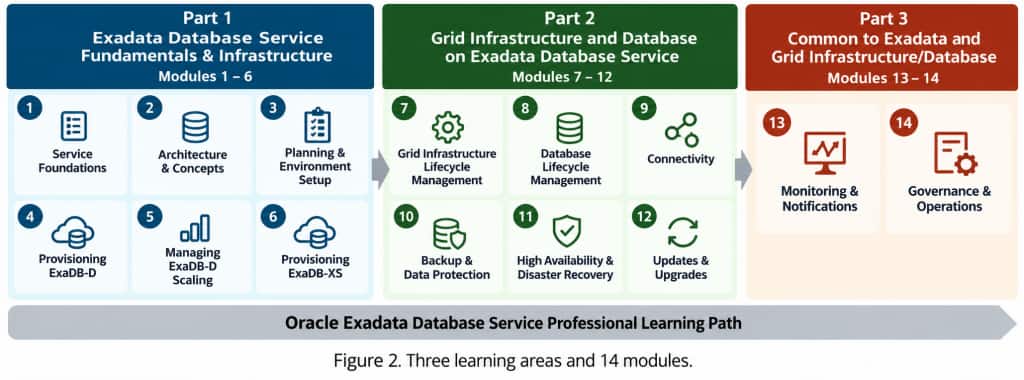
Part 1: Exadata Database Service Fundamentals & Infrastructure
The first six modules focus on Exadata Database Service foundations, architecture, planning, provisioning, and infrastructure management.
- Module 1: Service Foundations
- Module 2: Architecture & Concepts
- Module 3: Planning & Environment Setup
- Module 4: Provisioning ExaDB-D
- Module 5: Managing ExaDB-D & Scaling
- Module 6: Provisioning ExaDB-XS
Learners begin by exploring Exadata Database Service architecture, deployment models, and core capabilities, including Exadata compute, storage, networking, and security features.
The learning path then moves into planning and provisioning Exadata environments, including networking requirements, Identity and Access Management (IAM), infrastructure resources, and VM clusters.
Learners also explore infrastructure management and scaling capabilities, including compute and storage resource management.
Through technical lessons and demonstrations, this section helps learners understand how to deploy and manage Exadata Database Service infrastructure across the supported deployment options.
Part 2: Grid Infrastructure and Database on Exadata Database Service
The next six modules focus on managing Oracle Grid Infrastructure and Oracle Database running on Exadata Database Service.
- Module 7: Grid Infrastructure Lifecycle Management
- Module 8: Database Lifecycle Management
- Module 9: Connectivity
- Module 10: Backup & Data Protection
- Module 11: High Availability & Disaster Recovery
- Module 12: Updates & Upgrades
This section builds on the infrastructure concepts introduced in the first part of the learning path and shifts the focus to database administration and lifecycle operations.
Learners explore Grid Infrastructure and Oracle Database home management, database creation and administration, and connectivity configurations.
The learning path also covers important data protection and availability capabilities, including backup and recovery, Oracle Data Guard, Active Data Guard, and disaster recovery configurations.
In addition, learners examine software updates, upgrades, and maintenance operations required to keep Exadata Database Service environments secure, available, and up to date.
Together, these modules provide the database administration knowledge needed to manage Oracle Database workloads on Exadata Database Service.
Part 3: Common to Exadata Database Service and Database on Exadata Database Service
The final two modules focus on monitoring, governance, and operational practices that apply across Exadata infrastructure and database environments.
- Module 13: Monitoring & Notifications
- Module 14: Governance & Operations
Learners explore monitoring capabilities, notifications, events, and announcements to understand how to observe Exadata Database Service environments and respond to operational changes.
The learning path also covers governance and resource management practices, including compartments, tagging, and resource optimization.
These modules bring together the infrastructure and database administration concepts covered throughout the learning path, helping learners develop a broader understanding of Exadata Database Service operations.
Learn Through Technical Lessons and Demonstrations
The Exadata Database Service Professional learning path combines technical lessons with practical demonstrations to help learners connect architectural concepts with real-world administration tasks.
The learning experience covers key activities such as infrastructure provisioning, VM cluster management, resource scaling, database lifecycle operations, connectivity, backup and recovery, and maintenance.
Learners can also reinforce their understanding through Skill Checks throughout the learning path.
Additional learning resources include exam preparation materials, a practice exam, and opportunities to ask instructors questions through Oracle University’s learning support channels.
These resources help learners assess their knowledge, identify areas for further review, and prepare for professional certification.
Who Should Take This Learning Path?
The Exadata Database Service Professional learning path is designed for professionals who design, deploy, administer, or manage Exadata Database Service environments.
- Cloud and Solution Architects responsible for designing Exadata Database Service solutions.
- Database Administrators and Cloud DBAs who manage Oracle Database workloads and lifecycle operations.
- OCI Cloud and Infrastructure Engineers responsible for provisioning, managing, and maintaining cloud infrastructure.
Learners should have working knowledge of Oracle Database administration and architecture, along with an understanding of OCI fundamentals, particularly networking and Identity and Access Management (IAM).
Familiarity with Exadata concepts and database infrastructure operations is also recommended.
Validate Your Skills with Exadata Database Service Professional Certification
After completing the learning path, learners can validate their knowledge and skills through the Oracle Exadata Database Service Professional certification.
The certification exam details are summarized below.
- Certification: Oracle Exadata Database Service Professional
- Exam Number: 1Z0-1193-26
- Exam Format: Multiple Choice
- Exam Duration: 90 minutes
- Total Questions: 50
- Passing Score: 68%
The certification covers seven key objectives spanning Exadata Database Service architecture, deployment, administration, data protection, and operational management.
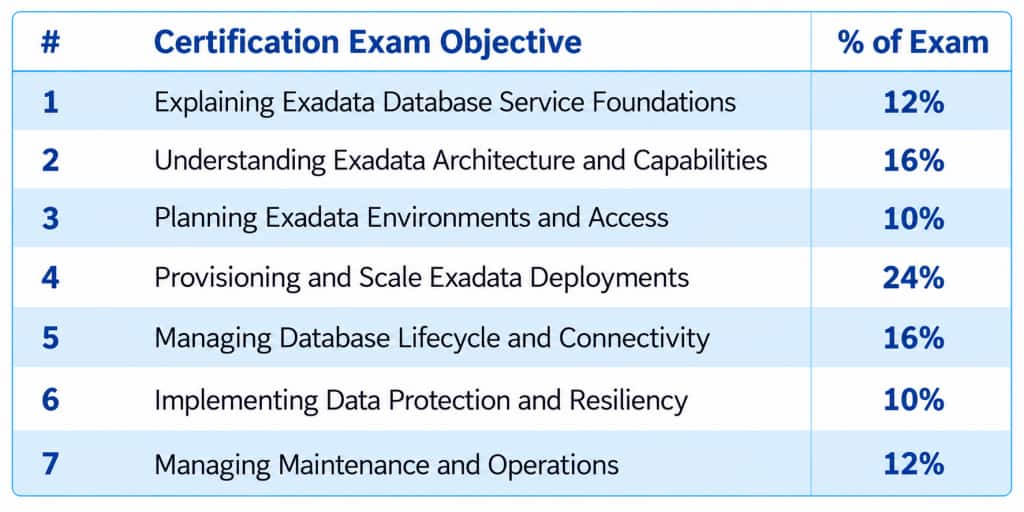
The certification validates the skills needed to design, provision, administer, scale, protect, monitor, and maintain Exadata Database Service environments across Dedicated Infrastructure, Cloud@Customer, and Exascale deployment models.
Learners are encouraged to complete the learning path, review the exam preparation materials, and take the practice exam before attempting certification.
For the latest exam information and certification requirements, refer to Oracle University.
Start Your Exadata Learning Journey
With the release of Oracle Exadata Database Service Professional, Oracle University continues to expand its learning portfolio for Oracle Database technologies across OCI and multicloud environments.
Whether you’re a database administrator managing Oracle Database workloads, a cloud architect designing Exadata solutions, or an infrastructure engineer responsible for cloud operations, this learning path provides a structured way to develop your Exadata Database Service expertise.
Explore the new learning path, build your skills through technical lessons and demonstrations, and take the next step toward Oracle Exadata Database Service Professional certification.
Get started today: