

For end-user enablement, change management and training teams, the AI Assistant in Oracle Guided Learning should be viewed as a practical tool for greater efficiency. Its value is not simply in adding AI to the workflow but how AI will help teams create content faster, improve content quality, reduce manual effort, and spend less time on repetitive tasks.
Enablement teams are often under pressure to support change quickly. They need to build guides, refine messaging, gather feedback, support users, and respond to evolving business processes with limited time and resources. In that environment, any capability that accelerates content creation and reduces friction has immediate value.
That is why the AI Assistant in Oracle Guided Learning matters. It helps teams save time while improving the speed and consistency of guide development, text refinement, translation, and support.
AI can help teams move faster when there is no base content to start from
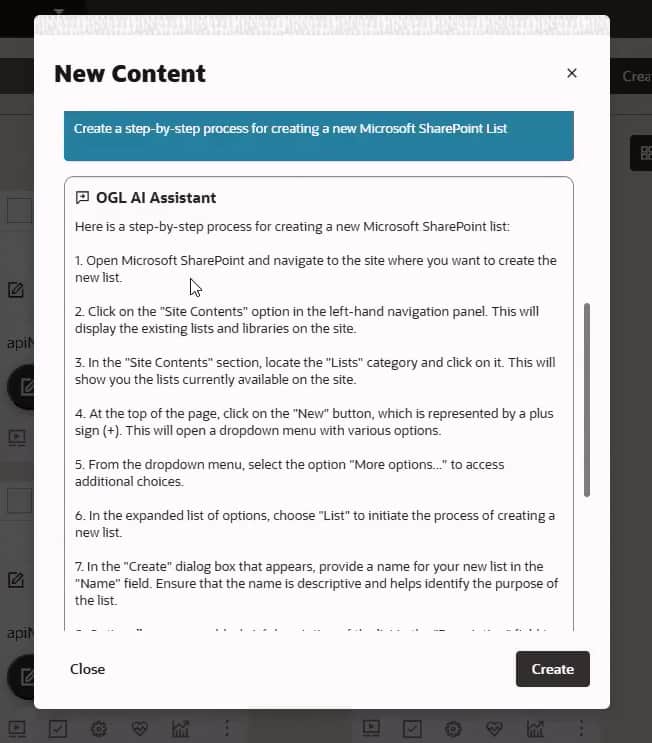
One of the most practical use cases for the AI Assistant is guide creation when no active base guide content is readily available.
Oracle Guided Learning comes with an extensive library of pre-built Base Content, which allows customers to pick and choose from a variety of heavily used guides, mapped to important business processes. These templates come with validated content and defined selectors, allowing customers to accelerate guide deployment.
End-user enablement teams frequently need to create support content for processes that are unique to their organization or extend beyond standard workflows. This could be a customized process involving multiple paths or workflows that exist across different applications such as Salesforce, Microsoft SharePoint, ServiceNow or Workday. In scenarios like this, teams may not have existing guide content to build from, which means they are starting with a blank page.
This is where AI Assistant for Guides can create real efficiency. As of Release 26B, customers can use AI to create Process Guides, Smart Tips, and Surveys, including NPS. Oracle Guided Learning console users will be able to receive intelligent AI recommendations when creating multi-step and multi-tip guides, helping accelerate guide creation.
For enablement teams, this means less time spent drafting every step manually and more time spent reviewing, tailoring, and publishing useful guidance.
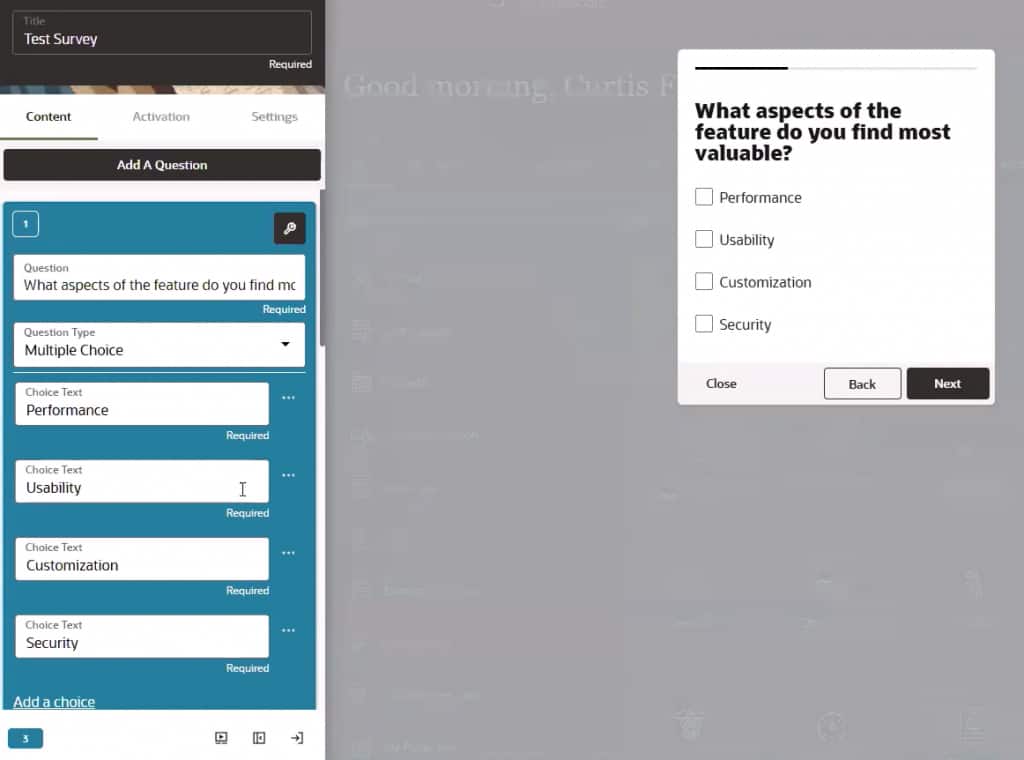
AI can simplify survey creation and accelerate feedback collection
Feedback is essential for end-user enablement teams, but creating surveys can often become a low-priority task because of the time it takes to design effective questions and build them into the platform.
The expansion of AI Assistant for Guides to include Surveys and NPS creates a meaningful opportunity to change that. With AI support for survey creation, teams can generate survey steps, suggested tip text, and survey content more efficiently. That makes it easier to launch feedback mechanisms quickly and consistently.
This matters because feedback loops are critical to improving adoption. When enablement teams can create surveys faster, they can collect user insight earlier, understand friction points sooner, and respond more effectively to user needs. AI helps remove the effort barrier that often delays survey creation.
Instead of spending unnecessary time drafting and redrafting survey language, teams can use AI recommendations to build a strong first version and then fine-tune it for the right audience and objective.
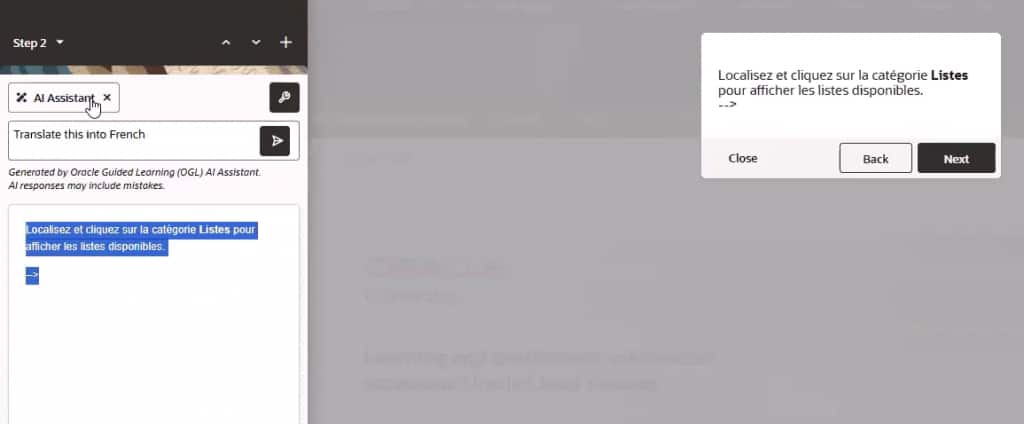
AI Assist for Steps helps improve clarity, quality, and translation
Another high-value use case is using AI Assist for Steps to refine existing content.
Enablement teams know that writing the first draft is only part of the work. Step text often needs to be clarified, shortened, simplified, reworded for different audiences, or translated for global teams. These tasks are important, but they are also time-consuming when done manually across large volumes of content.
This is where AI can deliver immediate gains. The AI Assistant can help refine text within guide steps, improve tone and readability, and support text translations. Based on the OGL 26B release notes, the AI Assistant can also:
- rephrase existing tip text using different writing styles and for different audiences,
- improve quality and clarity of language,
- fix spelling and grammar issues instantly, and
- translate tip text with ease.
For end-user enablement teams, this means content can be improved more quickly and with greater consistency. Instead of spending excessive time polishing wording line by line, teams can use AI to accelerate editing and translation while maintaining control over the final output.
This is especially valuable in large Oracle environments where the same message may need to be adapted across multiple user groups, business units, or regions.
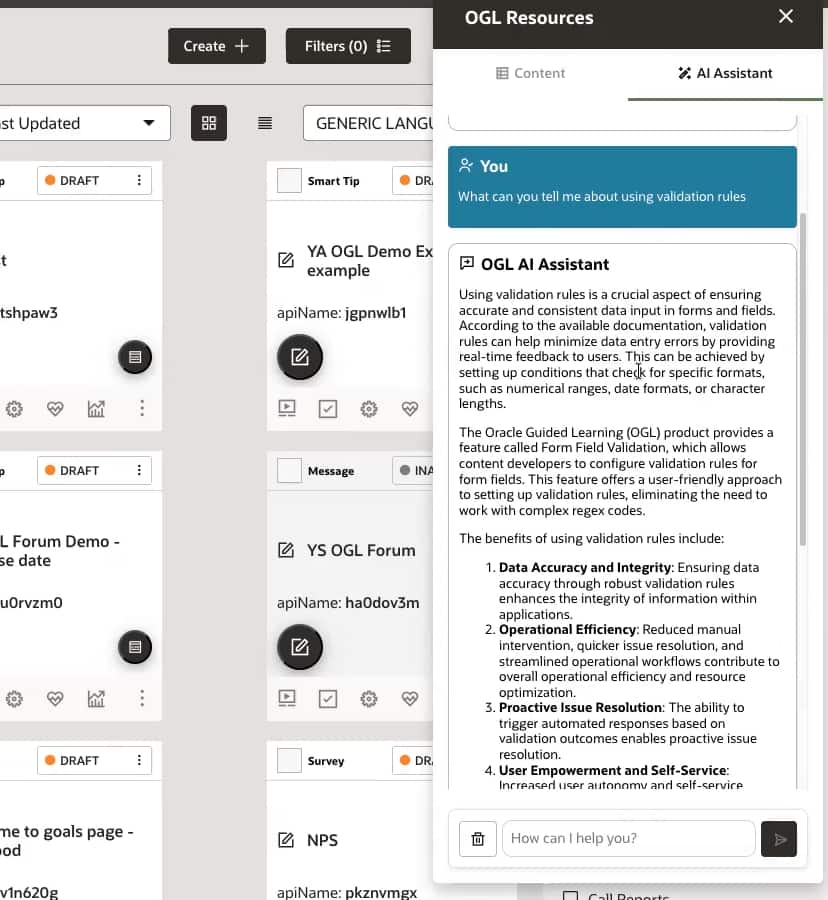
AI in OGL can also reduce time spent searching for setup and support answers
Efficiency is not only about content creation. It is also about reducing the time enablement teams spend looking for answers.
Teams often lose momentum when they need help with setup, configuration, or support questions. Searching documentation, reviewing help content, or escalating routine issues can slow down work and interrupt delivery timelines.
The AI Assistant in Oracle Guided Learning can help address this by providing assistance with setup, configuration, and support-related questions directly within the OGL experience. For enablement teams, that means fewer interruptions and faster resolution of common questions.
Instead of pausing work to search across multiple resources, teams can use AI in OGL to get guidance more quickly and stay focused on creating and maintaining enablement content. That makes the AI Assistant valuable not only as a content-generation feature, but also as a productivity tool for day-to-day administration and support.
The broader point of view
The broader point of view is clear: using AI in Oracle Guided Learning can help end-user enablement teams become more efficient and save time.
Its value comes from helping teams:
- create guides faster when no base content exists,
- build surveys more easily to collect feedback,
- refine and translate content more efficiently, and
- get setup and support answers without disrupting workflow.
For end-user enablement teams, AI should not be seen as a replacement for expertise. It should be seen as a force multiplier. The team still provides the business context, the process knowledge, and the judgment needed to create effective guidance. AI simply helps remove the manual effort that slows the work down.
Call to action
The best way to understand the value of the AI Assistant in Oracle Guided Learning is to use it in real work: on the next process guide that starts from a blank page, on the next survey that needs to go out quickly, on the next round of text refinement, or on the next setup question that would otherwise take time to research.
The teams that begin using it now will be the ones that learn fastest, build faster, and scale enablement more effectively.
For more resources please visit:
- Oracle Guided Learning Website
- A demonstration of AI Capability in action (start from 43:26)
- Verbiage around AI Assist for Guides Release
- AI Assistant for Steps
- AI Assistant for OGL Console