Oracle Integration advances enterprise connectivity in this release with AI-powered capabilities that simplify and accelerate integration development. Using natural language prompts, Oracle Integration can assist in designing integrations, automatically configuring REST endpoints, and enabling intelligent semantic search by leveraging Oracle ATP’s native AI Vector Search through the ATP Adapter, alongside the new OpenSearch Adapter that enables secure, seamless connectivity between enterprise data and AI agents for vector search and Retrieval-Augmented Generation (RAG) use cases.
This release also introduces the OpenSearch, NetSuite REST Adapter and the Google Sheets Adapter, expanding connectivity across ERP and productivity applications. In addition, it delivers enhancements across SaaS, database, messaging, and GraphQL-based integrations, including stronger OAuth security with PKCE support, enhanced query customization, and improved runtime response handling.
***Important Note: Salesforce Adapter Updates***
Salesforce Username–Password Policy Retirement
Salesforce plans to retire its Username Password authentication policy with the Summer ’27 release.
In the Salesforce (SOAP) Adapter, this policy is not supported for API versions 65 or later, but will remain available for versions 31 to 64 until the Summer ’27 release.
Salesforce (SOAP) Adapter customers are strongly advised to upgrade their existing connections to use either the Authorization Code Credentials or Resource Owner Password Credentials security policy. For more details, please review this blog.
Deprecation of WSDL-Based Salesforce Connections
As part of ongoing improvements in Oracle Integration, support for WSDL-based Salesforce connections is being deprecated. Integrations that rely on uploaded Enterprise WSDL files must be migrated to the new Salesforce connection type to avoid integration disruption. Customers are required to complete this migration before Oracle Integration Release 26.02 for development instances and before Oracle Integration Release 26.03 for production instances.
WSDL-based connections require frequent regeneration and re-import of WSDLs when Salesforce metadata changes. To reduce maintenance overhead and simplify metadata management, Oracle Integration will no longer support this connection model. For more details, please review this blog.
New Adapters
- OpenSearch Adapter : enables secure, seamless connectivity between enterprise data and AI agents by powering vector search and Retrieval-Augmented Generation (RAG) use cases.
- NetSuite REST Adapter: REST-based connectivity for NetSuite, aligned with NetSuite’s transition from SOAP, supporting JSON, SuiteQL, RESTlets, and OAuth 2.0 Authorization Code Credentials.
- Google Sheets Adapter: Partner-developed adapter enabling spreadsheet creation, data operations, batch processing, and OAuth-based access to Google Sheets.
Refer to the Google Sheets Adapter User Guide for usage patterns.
AI-Powered Enhancements
- REST Adapter – AI-powered auto configuration
- Oracle ATP Adapter Enhancement – AI vector search that enables intent-based data retrieval
OCI AI Native Actions & LLM Adapter
- Document Understanding – Custom model support for key/value extraction
- Speech – Updated wizards and improved sentiment/transcription workflows
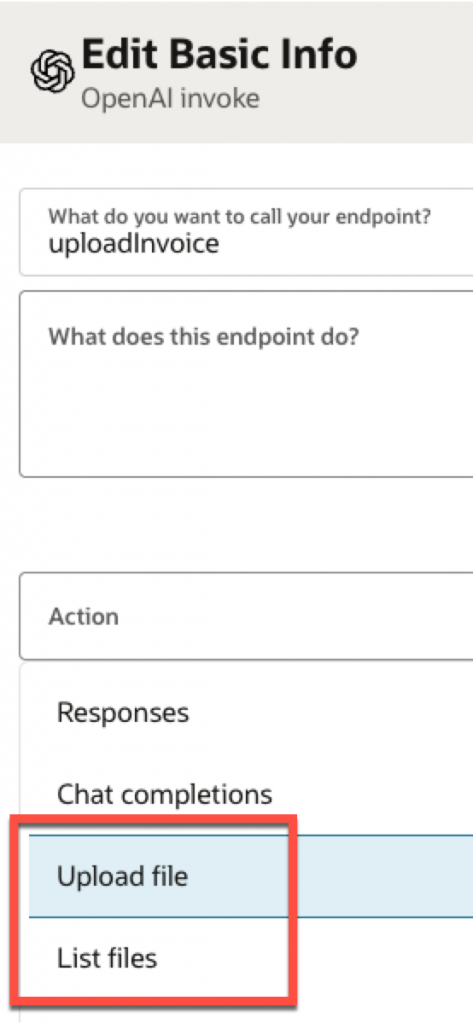
- OpenAI Adapter – Document upload and structured JSON output for downstream automation
Adapters Enhancements
- ADW & ATP Adapter Enhancement – Certification on Oracle Database@Azure
- Microsoft Dynamics 365 Adapter Enhancement – Return response header support
- Shopify GraphQL Adapter Enhancement – Query customization improvements
- GraphQL Adapter Enhancement – PKCE Support with OAuth Authorization Code Security Policy
- OFSC Adapter – Support OAuth security policy
Open Search Adapter – New Adapter
The Open Search Adapter is the latest addition to Oracle Integration’s AI adapters, providing a robust, general-purpose connector for Oracle OpenSearch Database. It serves as a foundational component for modern AI strategies, enabling seamless connectivity to vector databases for Retrieval-Augmented Generation (RAG) .
It allows organizations to bridge the gap between their enterprise data and AI agents, providing a secure way to index, search
In this release, the Open Search Adapter supports outbound invoke connections with the following capabilities:
- Standard Operation
- Open Search Action: Execute single commands for immediate data retrieval or indexing.
- Dynamic “Curl-Like” Flexibility Unlike traditional adapters with fixed fields, the Open Search adapter allows developers to specify a Relative URI and a JSON Payload at runtime. This provides full access to the entire Open Search API surface, including cluster health checks, index management, and document CRUD operations.
- Advanced AI & RAG Support The adapter acts as the connectivity layer for OIC Knowledge Bases. It enables the RAG Ingestion and RAG Search activities to fetch, embed, and store document content into OpenSearch indices, powering intelligent, context-aware AI agents.
- Flexible Connectivity & Security
- Private Subnet Support: Connect securely to OpenSearch instances within a private OCI subnet using Private Endpoints, ensuring data never leaves the internal network.
- Public Access: Supports connectivity via public URLs or reverse proxies (e.g., Nginx) for externally hosted instances.
- Authentication: Supports Basic Authentication for secure access control.
NetSuite REST Adapter – New Adapter
The NetSuite REST Adapter is the latest addition to Oracle Integration adapters’ ERP segment, providing modern REST-based connectivity as NetSuite transitions away from SOAP APIs. It enables streamlined integration using REST, SuiteQL, and RESTlet operations with lightweight JSON processing.
In this release, the NetSuite REST Adapter supports outbound invoke connections with the following capabilities:
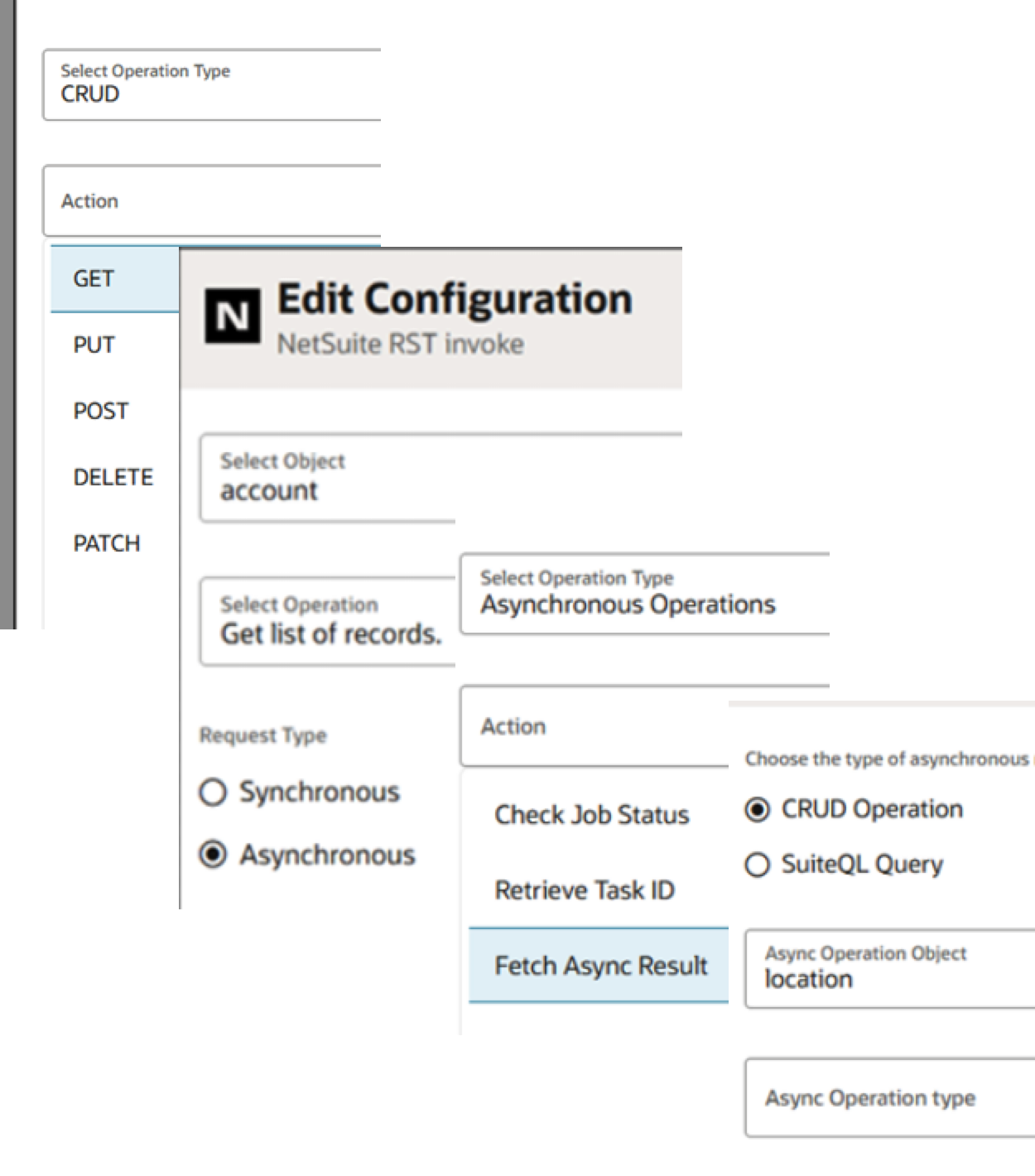
- CRUD Operations
Perform create, retrieve, update, and delete actions using standard REST methods (POST, GET, PATCH, PUT, and DELETE). - SuiteQL Search Support
Retrieve single or multiple records using SuiteQL queries with support for binding parameters. - Synchronous and Asynchronous Processing
- Synchronous execution is supported for record payloads up to 104 MB, returning results immediately.
- Asynchronous execution is suited for long-running tasks or larger payloads (greater than 104 MB) and returning a Job ID for tracking.
- Additional asynchronous operations include:
- Check Job Status
- Retrieve Task ID
- Fetch Async Results
- RESTlet Operations
Define custom logic through JavaScript and expose it as RESTlet operations within NetSuite. - Security
Supports OAuth 2.0 Authorization Code Credentials for secure connectivity.
To connect with the NetSuite REST Adapter, specify the NetSuite Account ID, Client ID, Client Secret, and the required scopes such as REST Web Services and RESTlets.
Google Sheets Adapter – New Adapter
The Google Sheets Adapter is a partner-developed addition to Oracle Integration adapters’ Productivity and Collaboration segment, offering simplified connectivity with Google Sheets for reporting, collaboration, and workflow automation.
In this release, the Google Sheets Adapter supports outbound invoke connections with the following capabilities:
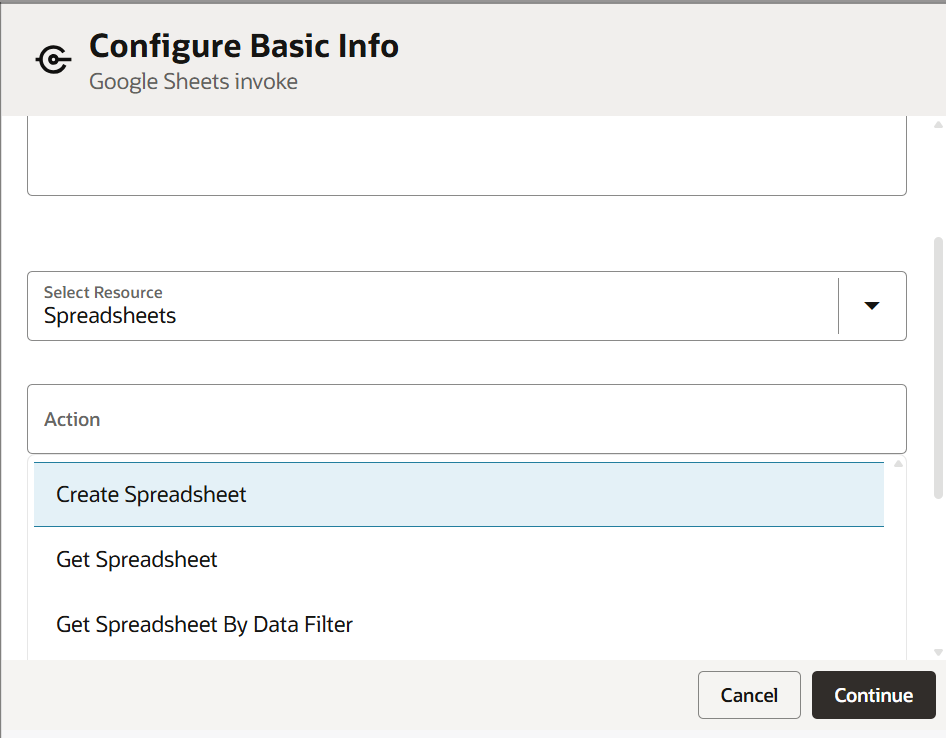
- Spreadsheet Management
Create spreadsheets, retrieve existing ones, and work with specific sheets or defined ranges. - Data Operations
Retrieve, update, clear, or delete single or multiple cell values. - Bulk and Batch Processing
Execute batch reads, updates, and clears using A1 or R1C1 notation or dynamic Data Filter objects. - Copy and Append Operations
Copy sheets between spreadsheets or append new rows to existing sheets for incremental updates. - Authentication
Connect securely using the Authorization Code Credentials policy. - Public Resource Connectivity
Access publicly available spreadsheet resources through direct internet connectivity.
To connect with the Google Sheets Adapter, specify the Google Cloud Project details, OAuth Client ID, and Client Secret, and authorize access to the Google Sheets API.
For detailed configuration steps and usage patterns, refer to the Google Sheets Adapter for Oracle Integration.
AI-Assisted Endpoint Configuration for REST Adapters
With NLP, the REST Adapter can automatically configure endpoints by interpreting user intent along with the provided REST API documentation. The AI-assisted experience generates the required endpoint configuration and automatically populates the wizard, reducing manual effort and ensuring consistent REST configurations.
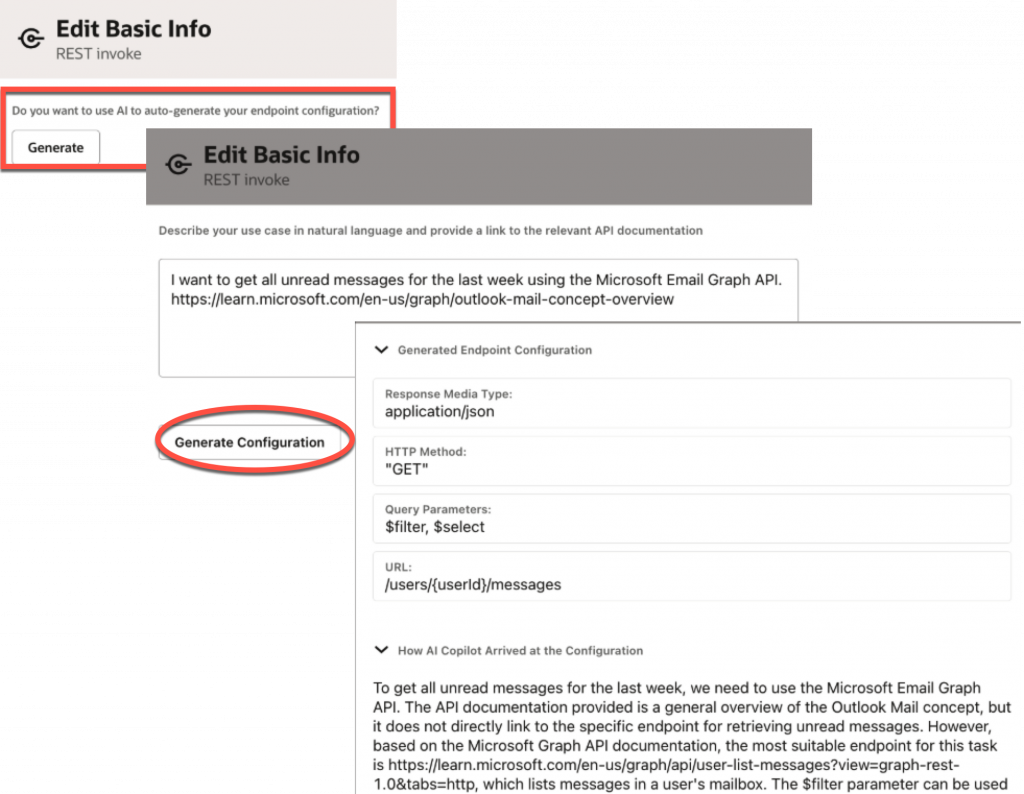
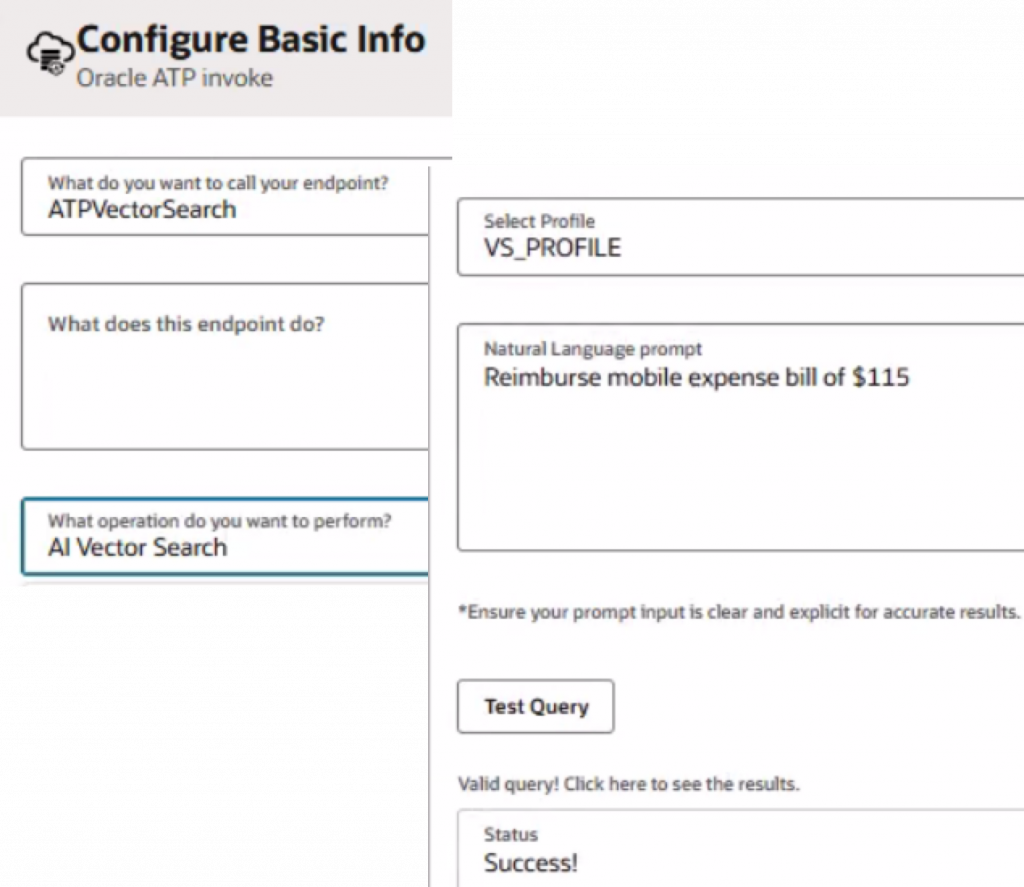
Oracle ATP Adapter Enhancement – Support for AI Vector Search
The Oracle ATP Adapter now supports an AI vector search, enabling semantic data discovery through natural language queries instead of traditional keyword-based searches. This enhancement allows integrations to retrieve information based on user intent, making data access more intuitive and context aware.
AI Vector Search is powered by Oracle-managed AI capabilities that automatically understand and process text-based data. Oracle Integration uses built-in AI profiles and large language model (LLM)–assisted intelligence to interpret natural language requests and identify relevant information stored in the Autonomous Transaction Processing (ATP) database, without requiring customers to configure or manage AI models.
For example, when a user provides a prompt such as “Reimburse my mobile expense bill of ‘X’ dollars,” the adapter intelligently identifies matching information within indexed documents stored in OCI Object Storage and returns both the response and its source.
This capability brings AI-driven search directly into Oracle Integration, enabling more intelligent and flexible data discovery within ATP-based applications. The enhancement integrates seamlessly with existing Oracle ATP Adapter operations and introduces no functional limitations
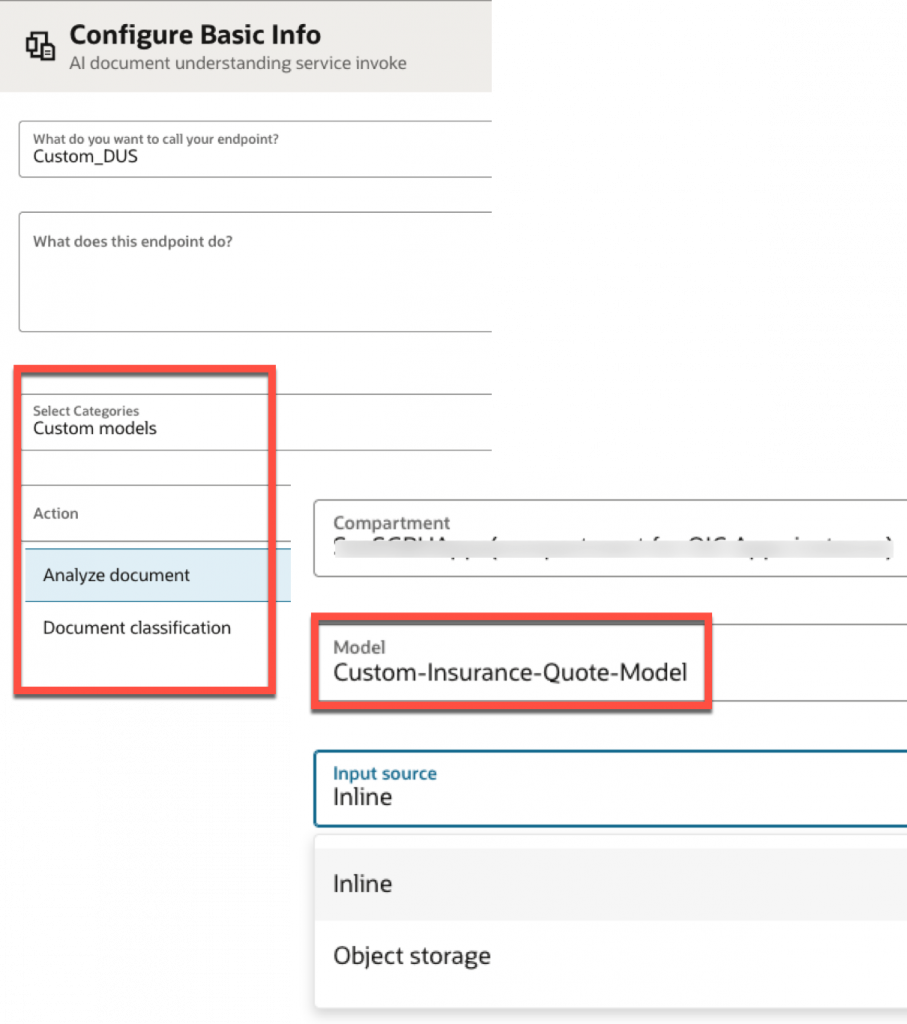
What’s New in OCI AI Native Actions
Document Understanding
- Custom model support for processor-based key/value extraction.
Example: Automatically extract invoice numbers, dates, and totals from batch invoices. - Custom model support for real-time key/value extraction.
Example: Process submitted insurance claims instantly and populate backend systems.
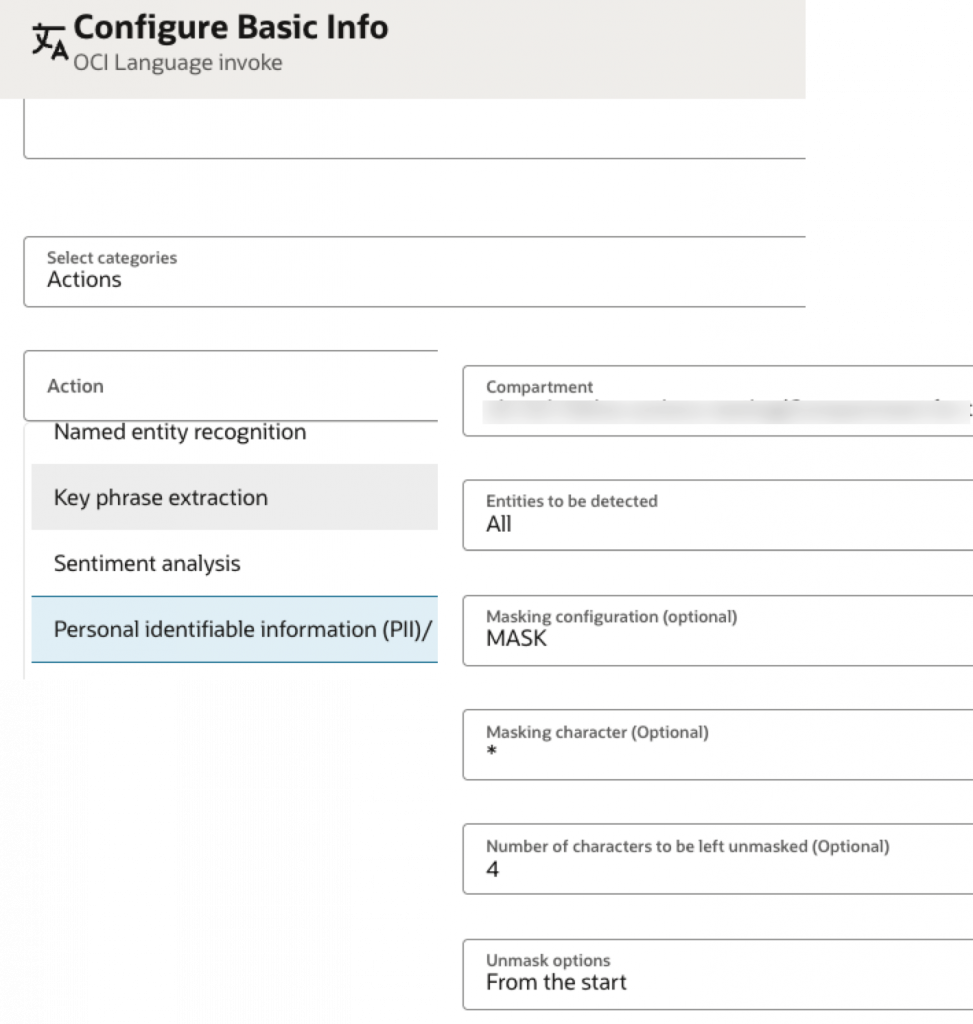
Language
- Modernized wizard pages for synchronous and asynchronous workflows.
Example: Analyze large sets of customer feedback for sentiment in batch mode.
OpenAI Adapter
- Supports uploading and extracting document content.
Example: Summarize long technical manuals or policy documents into actionable insights. - Provides expected JSON responses as prompts for improved integration with workflows.
Example: Generate structured data from natural language queries to automate API mapping.
Certification with Oracle Autonomous Database Service on Oracle Database@Azure
Oracle Integration continues to expand its multicloud integration capabilities with certification of the Autonomous Data Warehouse (ADW) and Autonomous Transaction Processing (ATP) adapters for Oracle Autonomous Database Service on Oracle Database@Azure.
This certification enables customers to seamlessly integrate with Oracle Autonomous Databases deployed on Azure while preserving the existing adapter experience and integration functionality, without requiring any changes to integration design.
Microsoft Dynamics 365 Adapter Enhancement – Return Response Header Support
Microsoft Dynamics 365 Adapter now supports the Return Response header that enhances data accuracy, runtime visibility, and record handling during Create, Update, and Query operations.
This enhancement enables the Microsoft Dynamics 365 Web API to return the full entity payload immediately after a create or update operation. It removes the need for a follow-up GET request and reduces API roundtrips, improving overall performance and integration efficiency.
Key Header enhancements
- Return Representation– Enabling this header ensures that you receive the full response after creating or updating a record.
- Upsert Support– While updating, if the record ID does not exist, the system automatically creates a new record.
- Duplicate Detection– Prevents duplicate records for both create and update operations. If you try to insert a record that already exists, the system will alert you instead of creating a duplicate.
- Max Page Size for Queries– Allows control over how many records are returned per query call, ensuring smoother pagination and efficient data fetch.
Shopify GraphQL Enhancements – Improvised query customization
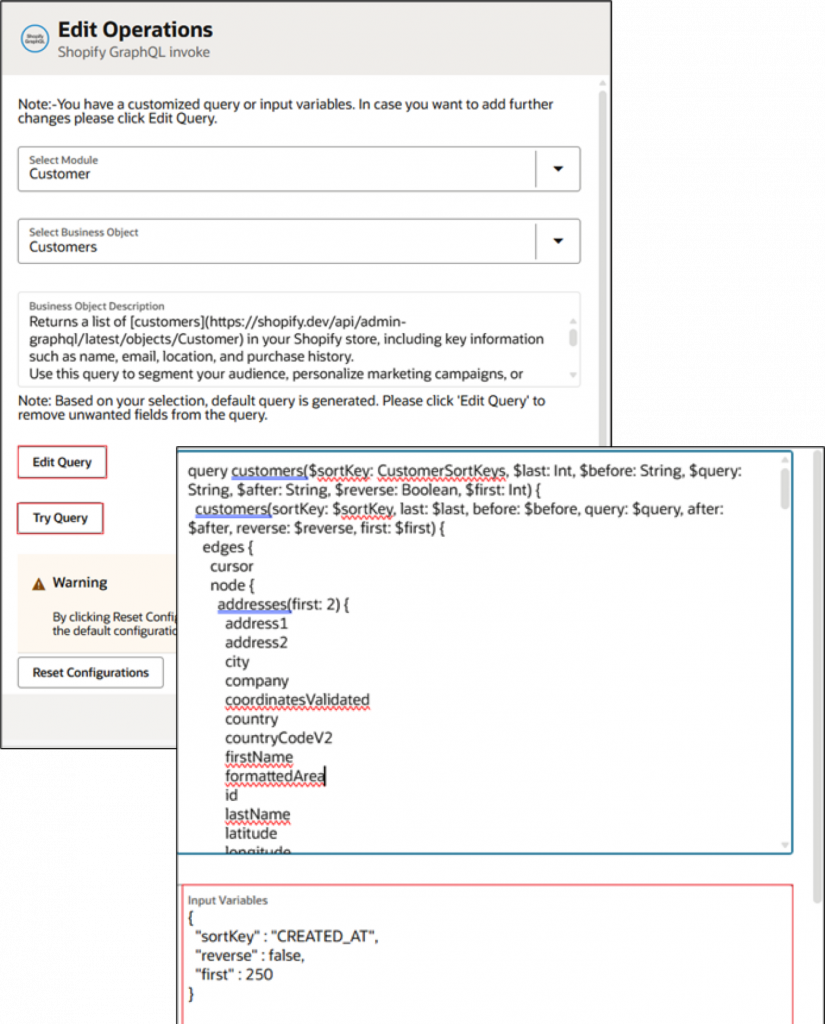
With this release, the Shopify GraphQL Adapter enhances its invoke functionality by increasing the default nesting depth for generated queries. Previously limited to a maximum depth of three for Query, Create, Update, and Delete operations, the adapter now supports up to six levels of nesting. This enhancement provides greater flexibility to retrieve related objects in a single call, making query customization more efficient and user-friendly.
Oracle Integration also now allows users to fully edit the default generated query, enabling the following improvements:
- Add new or remove existing objects
- Update the query depth up to level 17 for more complex data retrieval
- Modify or supply input variables, test the query, and update it as required
Note: The Test Query feature is available only for a Query Operation.