
Healthcare organizations generate large volumes of structured and unstructured data every day—from electronic health records (EHRs) and medical imaging systems to laboratory systems, connected devices, and research platforms. Integrating these diverse data sources into a secure analytics platform remains a significant technical challenge, particularly when regulatory requirements and data governance must also be addressed.
According to the World Economic Forum, a typical hospital generates approximately 50 petabytes of data annually, yet only about 3% of that data is used for analytics. Processing this data presents multiple challenges. Structured and unstructured data often require different ingestion, storage, and processing techniques, increasing the complexity of data integration and analytics. In addition, healthcare and life sciences data is subject to stringent global and regional regulatory requirements.
Oracle Cloud Infrastructure (OCI) provides cloud services that can be used to build secure, auditable analytics platforms for sensitive healthcare data. OCI includes services that support data integration, storage, analytics, AI, and operational governance while helping organizations address healthcare compliance requirements.
This reference architecture covers an implementation of a healthcare analytics platform deployed with Oracle Cloud Infrastructure services. The components in this diagram can be used as-is or substituted with third-party components to meet your organization’s business requirements.
Reference Architecture Overview
Deploying a healthcare and life sciences analytics platform on Oracle Cloud Infrastructure (OCI) can provide a secure foundation for integrating and analyzing data from multiple sources while supporting compliance efforts with healthcare and life sciences standards such as HIPAA and HITRUST.
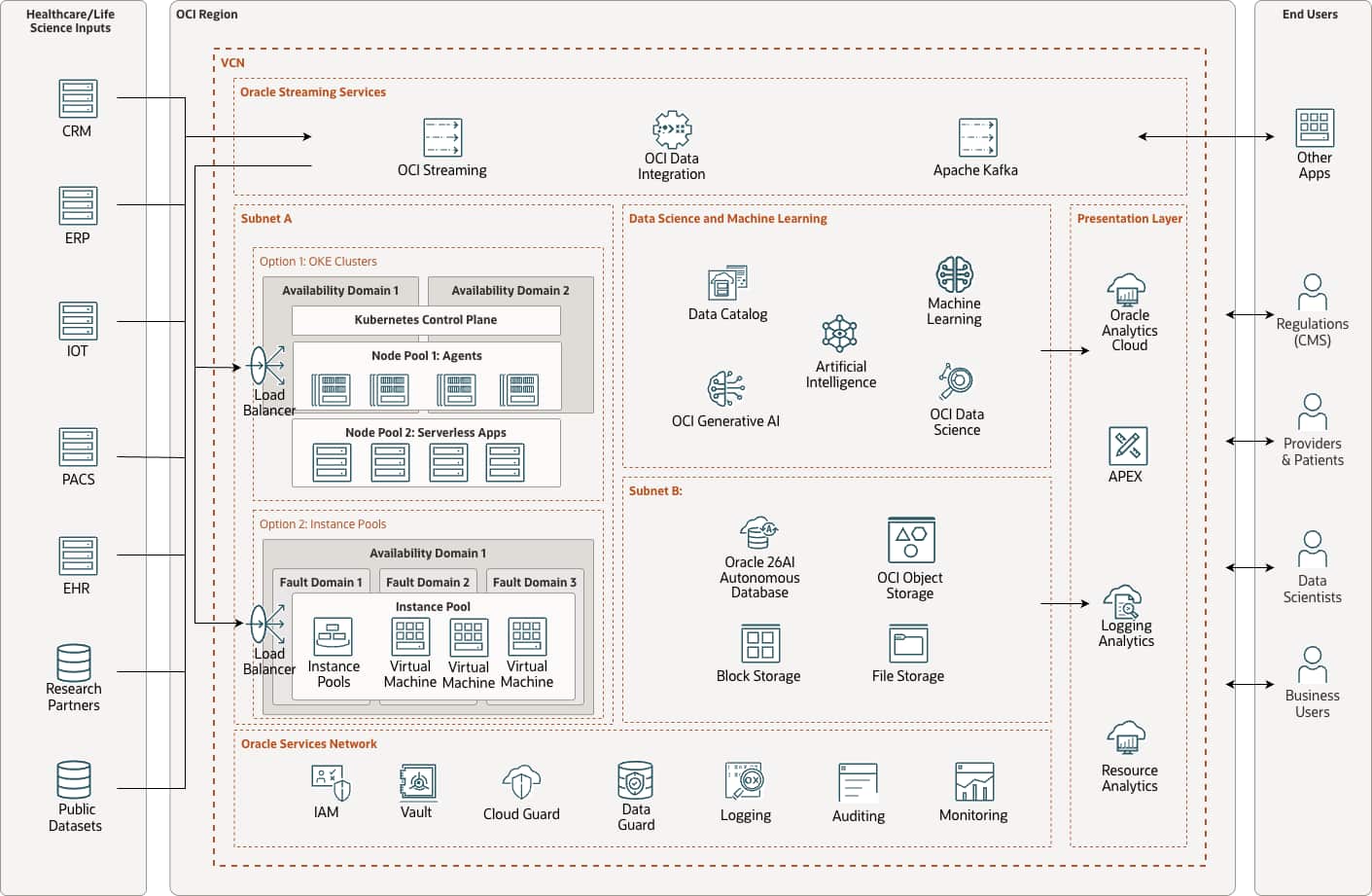
Architecture Breakdown
- Oracle Streaming and Data Integration: Oracle Streaming Services: Data can be ingested from multiple sources using OCI Streaming, OCI Data Integration, and Apache Kafka.
- Oracle Data Integration for Healthcare supports bulk data transfers with SFTP, HL7v2 over MLLP and FHIR standards. Protocols that do not support native encryption can be secured by using an OCI Site-to-Site VPN.
- Use OCI Streaming for high-volume, real-time data ingestion to efficiently collect and buffer events before they are consumed by downstream applications. OCI Streaming enables producers to batch records, improving throughput and reducing the overhead associated with individual write operations. Configure partitioning, batching, and retention settings to meet the throughput, latency, and ordering requirements of your data pipeline while maintaining data integrity and reliable message delivery.
- OCI Streaming with Apache Kafka is a fully managed OCI service that lets you create and run Kafka clusters in an OCI tenancy with all the functionalities of Apache Kafka. Collect, process, store, and move millions of events per minute in a manner that is compatible with open-source Apache Kafka. Use Apache Kafka for change data capture (CDC), real-time analytics, and additional use cases.
- Data Processing: Use Oracle streaming services to ingest real-time data and process them through Oracle Container Engine for Kubernetes (OKE) Clusters or Oracle Instance Pools, providing highly available and resilient ETL. Use a service like WarpStream, an Apache Kafka-compatible data streaming platform, which can be deployed on OCI OKE or instance pools to easily run a large-scale data pipeline.
- Option 1: Oracle Container Engine for Kubernetes (OKE) Clusters
Oracle Container Engine for Kubernetes (OKE) provides a fully managed Kubernetes service for deploying, orchestrating, and scaling containerized data processing workloads. OKE automates cluster lifecycle management, node provisioning, upgrades, and self-healing, enabling teams to focus on developing and operating data pipelines instead of managing infrastructure. OKE is an ideal platform for cloud-native, event-driven analytics architectures that require agility, resilience, and the ability to rapidly scale with changing data volumes.
- Option 2: Instance Pools
Oracle Instance Pools provide a simple, scalable, and highly available platform for running data processing workloads on groups of Oracle Compute instances. Instance Pools automatically maintain the desired number of virtual machines by replacing unhealthy instances and can dynamically scale capacity based on workload demand. This deployment model is well suited for traditional ETL applications, long-running data processing services, and existing VM-based workloads that do not require container orchestration. For organizations seeking a familiar operational model with minimal infrastructure management, Instance Pools deliver reliable performance, resilience, and predictable scalability for large-scale analytics processing.
- Option 1: Oracle Container Engine for Kubernetes (OKE) Clusters
- Oracle Storage Services: Store both raw and processed data in Oracle Storage Services to create a centralized repository for analytics, artificial intelligence (AI), and machine learning (ML) workloads. OCI storage services support structured, semi-structured, and unstructured data, enabling organizations to manage diverse healthcare and life sciences datasets, including electronic health records (EHRs), medical images, genomic data, and device telemetry. Oracle Storage Services provide the foundation for building modern data lakes and supporting advanced analytics across the enterprise.
- Oracle Autonomous Database 26ai provides a landing pad for loading structured datasets for clinicians, researchers, and analysts to perform SQL analytics, reporting, and machine learning. Autonomous Database automatically handles tuning, indexing, patching, backups, and scaling, allowing organizations to focus on deriving insights rather than administering databases. Its AI Vector Search capabilities also enable organizations to combine structured clinical data with unstructured medical documents for semantic search and retrieval-augmented generation (RAG)
- OCI Block Volume provides high-performance persistent storage for compute instances running data processing services, databases, and analytics applications. Block Volumes function as attached disks with low latency and high IOPS, making them ideal for ETL staging areas, transactional databases, temporary processing space, and application binaries.
- OCI Object storage provides highly durable, virtually unlimited storage for any type of data, allowing organizations to retain raw source data and processed datasets for downstream analytics. It is the ideal repository for electronic health records (EHRs), HL7/FHIR messages, laboratory results, DICOM medical images, genomic sequencing data, clinical notes, wearable device telemetry, and research datasets.
- OCI File Storage Service provides a shared, high-performance network file system that can be simultaneously mounted by multiple compute instances or Kubernetes pods. In healthcare analytics, FSS is well suited for applications that require POSIX-compliant shared storage, such as collaborative research environments, AI and machine learning pipelines, bioinformatics workflows, and shared application configuration or intermediate processing files. It enables distributed processing workloads to access the same datasets without copying data between systems, simplifying operations and improving collaboration.
- Data Science and Machine Learning: Leverage Oracle’s comprehensive portfolio of AI and machine learning services to help transform healthcare and life sciences data into actionable insights while benefiting from OCI’s elastic infrastructure and pay-as-you-go pricing.
- OCI Data Science provides a collaborative environment for developing, training, deploying, and managing machine learning models using popular open-source frameworks.
- OCI Generative AI offers access to managed large language models (LLMs) and embedding models that can be fine-tuned or augmented with enterprise data to power intelligent assistants, clinical document summarization, semantic search, and retrieval-augmented generation (RAG) applications.
- OCI Data Catalog enables organizations to discover, classify, and govern data assets across the analytics platform, improving data quality and lineage.
- Presentation Layer: Oracle provides a comprehensive suite of analytics, visualization, and application development services that enable organizations to deliver secure, AI-powered insights to clinicians, researchers, and business users.
- Oracle Analytics Cloud (OAC) offers interactive dashboards, self-service analytics, natural language querying, and embedded AI capabilities for enterprise reporting and decision-making.
- Oracle APEX enables rapid development of custom, data-driven web applications that securely expose analytics and operational workflows.
- OCI Logging Analytics transforms log data into actionable operational insights through machine learning–driven anomaly detection and root cause analysis.
- OCI Resource Analytics provides centralized visibility into cloud resource utilization, performance, and optimization opportunities.
- Oracle Services Network: Oracle provides a comprehensive set of security, governance, and operational services that help organizations build secure, resilient, and compliant healthcare and life sciences analytics platforms.
- Oracle Identity and Access Management (IAM) enforces fine-grained authentication and authorization.
- OCI Vault securely manages encryption keys, secrets, and certificates.
- OCI Cloud Guard continuously monitors cloud resources to detect security risks and misconfigurations.
- Oracle Data Guard protects mission-critical databases through automated replication and disaster recovery.
- OCI Logging, Audit, and Monitoring services provide centralized observability by collecting logs, tracking administrative and API activities, monitoring resource health and performance, and generating alerts to help maintain system availability, troubleshoot issues, and support compliance efforts with regulatory frameworks such as HIPAA and HITRUST.
Oracle’s Differentiators
Oracle Cloud Infrastructure (OCI) provides cloud infrastructure and managed services that support healthcare and life sciences analytics workloads. OCI supports organizations operating under regulatory frameworks such as HIPAA and GDPR and maintains certifications or attestations for programs such as HITRUST, where applicable. Organizations can evaluate capabilities such as managed Kubernetes, Kafka-compatible streaming, Autonomous Database, integrated AI services, storage options, and identity and security services based on their technical and business requirements. Additionally, OCI offers consistent pricing for OCI services across regions and high-performance networking, and enterprise-grade security features. Combined with integrated AI, autonomous database services, and a comprehensive portfolio of analytics, data management, and application development services, OCI helps organizations build scalable, secure, and cost-effective data platforms that can help accelerate innovation while helping to reduce operational complexity.
Conclusion
A modern healthcare analytics platform must integrate heterogeneous clinical data, support both real-time and batch processing, enable AI and analytics workloads, and provide data access and security controls appropriate for regulated environments. This reference architecture illustrates one approach to assembling these capabilities with OCI services while allowing organizations to adapt the design to their own operational, security, and compliance requirements.
Call to Action
Schedule a walkthrough of the reference architecture with an Oracle cloud engineer today and design a customized analytics platform that supports your healthcare and life sciences organization today.
Reference Links