
Healthcare interoperability has evolved beyond connecting systems within a single hospital. While interface engines continue to route HL7 messages between EHRs, laboratories, pharmacies, and imaging systems, today’s healthcare organizations must solve a much broader challenge. They need to deliver a consistent digital experience across multiple hospitals, support care coordination, expose FHIR APIs, integrate AI into clinical workflows, and exchange data with partners, payers, and public health agencies—all while continuing to rely on on-premises clinical systems that remain central to patient care.
Replacing these systems is rarely practical. The challenge is extending existing interoperability investments into an enterprise platform that supports modern healthcare. Oracle Cloud Infrastructure (OCI) provides a practical foundation for this hybrid approach.
Separating operational integration from enterprise interoperability
One of the most common misconceptions about cloud modernization is that every interface should move to the cloud. In healthcare, that is rarely the right design.
Operational workflows—such as EHR-to-laboratory communication, pharmacy integration, and imaging workflows—require low latency and close proximity to the systems they support. These integrations remain within each hospital and continue to be managed by local integration engines.
Enterprise interoperability addresses a different class of problems. Patient portals, care coordination platforms, analytics, AI services, and cross-hospital applications all require standardized access to clinical information regardless of where the patient received care.
The hybrid architecture separates these responsibilities. Hospitals continue to own operational integration, while OCI provides enterprise interoperability. Rather than routing every HL7 message through the cloud, only selected clinical events, FHIR resources, and enterprise data are exchanged over FastConnect. OCI becomes the shared interoperability platform for the health system, while local integration continues supporting operational care delivery.
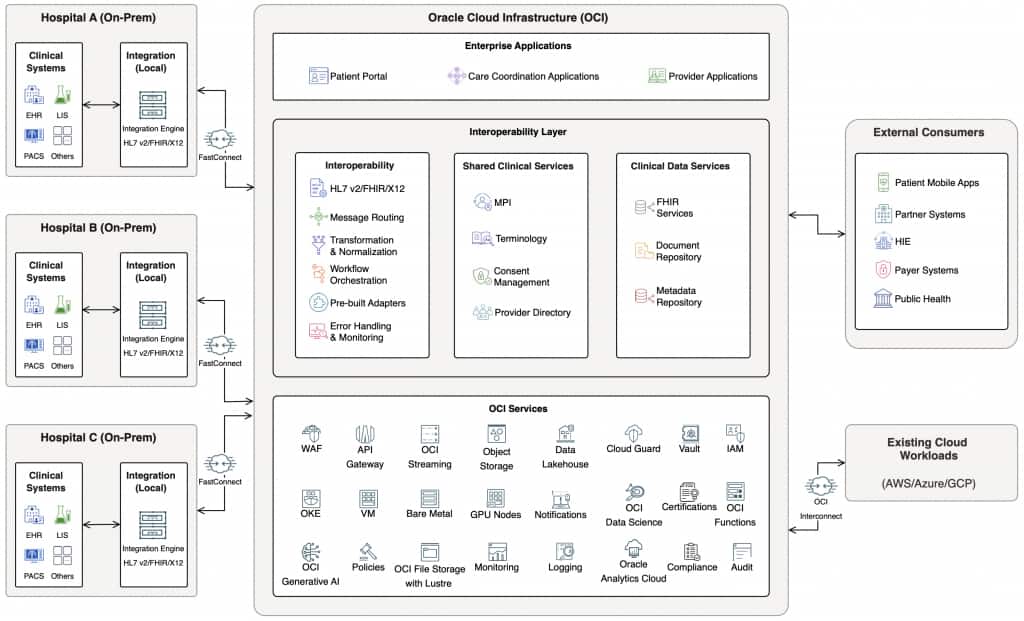
Figure 1. Hybrid Healthcare Interoperability Platform on Oracle Cloud Infrastructure
The interoperability layer standardizes healthcare messaging, routing, transformation, and workflow across hospitals while supporting HL7 v2, FHIR, and X12. Shared clinical services—including Master Patient Index (MPI), terminology management, consent management, and provider directories—are implemented once and reused across the enterprise. Clinical data services expose standardized access to FHIR resources, clinical documents, and metadata, enabling enterprise applications to integrate once with the platform rather than separately with every hospital.
Modernizing without replacing existing investments
Most healthcare organizations already operate mature interoperability platforms such as Mirth Connect, Rhapsody, or Cloverleaf. These products continue to perform the functions they were designed for: managing operational clinical integration inside the hospital.
OCI complements these investments rather than replacing them.
A hospital can continue using the existing platform to manage local HL7 interfaces while OCI provides enterprise capabilities such as shared clinical services, FHIR APIs, analytics, AI integration, and partner connectivity. Each platform operates where it delivers the greatest value.
The same philosophy applies to cloud adoption. Healthcare organizations increasingly operate across multiple cloud providers. OCI Interconnect enables existing workloads in AWS, Microsoft Azure, and other cloud environments to participate in the same enterprise architecture without requiring organizations to consolidate onto a single platform.
Why Oracle Cloud Infrastructure?
Building an enterprise interoperability platform places different demands on cloud infrastructure than running a typical business application. Healthcare organizations need predictable networking, enterprise-grade security, flexible compute, and the ability to integrate existing investments rather than replace them.
Lower network costs
Hybrid healthcare architectures continuously exchange HL7 messages, FHIR resources, AI requests, analytics data, and partner transactions between hospitals and the cloud. OCI’s competitive network egress pricing helps reduce one of the largest ongoing operational costs of hybrid deployments, making it easier to scale enterprise interoperability.
Multi-cloud connectivity
Healthcare organizations rarely operate in a single cloud. OCI Interconnect enables high-bandwidth private connectivity with other major cloud providers, while FastConnect securely connects hospital data centers to OCI. Rather than forcing workload consolidation, OCI allows organizations to integrate existing cloud investments into a unified enterprise architecture.
Flexible compute
Healthcare platforms combine many different workloads, from interface engines and FHIR APIs to AI inference and analytics. OCI Compute provides Flexible VM shapes for independently sizing CPU and memory, Bare Metal instances for performance-sensitive workloads, GPU instances for AI and medical imaging, and Confidential Computing to help protect sensitive healthcare data while it is being processed.
Enterprise platform services
OCI provides the building blocks required for a modern interoperability platform, including API Gateway, Streaming, Oracle Kubernetes Engine (OKE), Object Storage, Oracle Analytics Cloud, OCI Data Science, and OCI Generative AI. These managed services allow organizations to focus on delivering healthcare capabilities instead of managing infrastructure.
Security and governance
Healthcare data requires strong governance. OCI provides integrated services such as IAM, Vault, Cloud Guard, Web Application Firewall (WAF), Logging, Monitoring, and Audit, enabling organizations to implement consistent security, operational monitoring, and compliance across applications and infrastructure.
Open by design
Most healthcare organizations have already invested in technologies such as Mirth Connect, Oracle Health, Epic, and other commercial healthcare solutions. OCI complements these investments rather than replacing them. Existing interoperability platforms continue supporting operational clinical integration while OCI delivers enterprise interoperability, AI, analytics, and shared clinical services, allowing organizations to modernize incrementally while preserving the systems that already deliver value.
Conclusion
Healthcare modernization is no longer about moving every interface to the cloud. It is about creating a clear separation between operational integration and enterprise interoperability.
Hospitals continue to operate the systems and integration platforms that support patient care, while OCI provides the enterprise capabilities needed to connect hospitals, applications, AI services, and external partners. By embracing existing interoperability platforms and supporting open standards, hybrid connectivity, and multi-cloud architectures, OCI enables healthcare organizations to modernize incrementally while preserving the investments that already deliver value.