
Oracle’s latest Order Management (OM) release, 26A, is more than a feature drop, it’s an insight into the vision driving product direction and an expansion of AI features released previously. Order Management 26A delivers on its ongoing themes of intelligent automation, friction-free interactions, and a highly productive user experience.
Autonomous Resilience
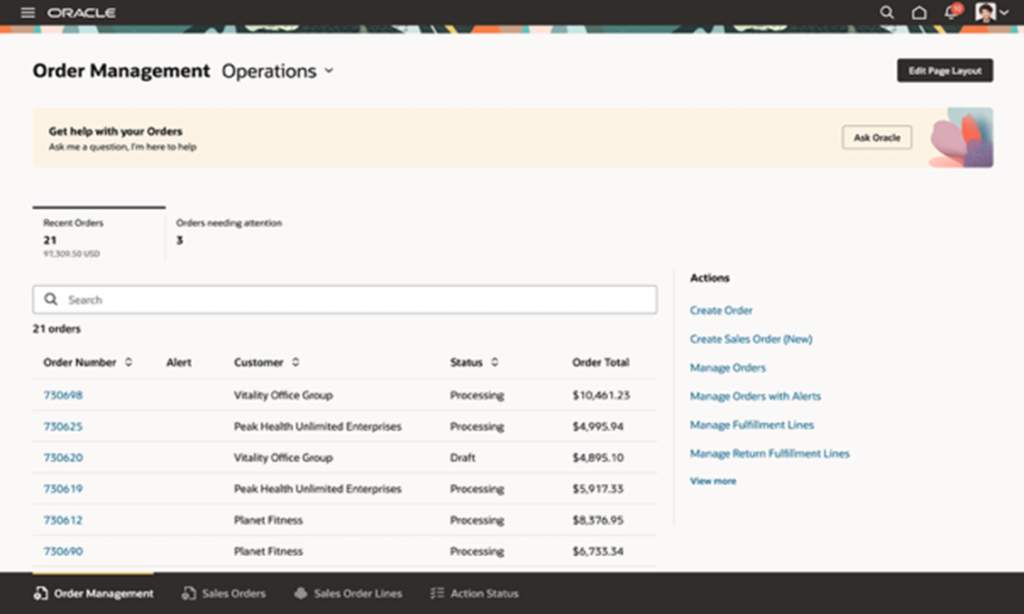
Order management has always depended on fast, accurate exception handling. Delays triggered by fulfillment errors, incorrect configurations, or system slowdowns create downstream effects that ripple through the supply chain. In the 25D release, Oracle introduced the Order Exception Agent, an AI-powered assistant that continuously monitors the OM environment, flags exception orders in real time, diagnoses root causes, and even launches pre-defined corrective actions. With the expansion in 26A, Order Exception Agent does even more. Now, customers can now process unprocessed responses from shipping and receiving; get more suggestions for optimizing order management extensions to close orders; clean up supplementary data; and resolve order exceptions. They can also stop displaying extensions in the exception report and get more details about exceptions and recover orders.
Why it matters:
• Faster resolution: By detecting anomalies immediately, the agent shrinks the time to identify and fix issues, reducing overall order processing time.
• Lower cost of exceptions: Automation replaces manual triage and ad-hoc fixes, translating into reduced labor costs and fewer revenue-impacting mistakes.
• Measurable customer impact: With fewer stalled orders, organizations can consistently meet promised delivery dates, boosting customer satisfaction scores.
Key metrics targeted by the new agent include percentage reductions in processing time and order costs, alongside a measurable uptick in satisfaction levels. The result is a more resilient order-to-cash cycle that keeps pace with market expectations without burdening operations teams.
Conversational Commerce
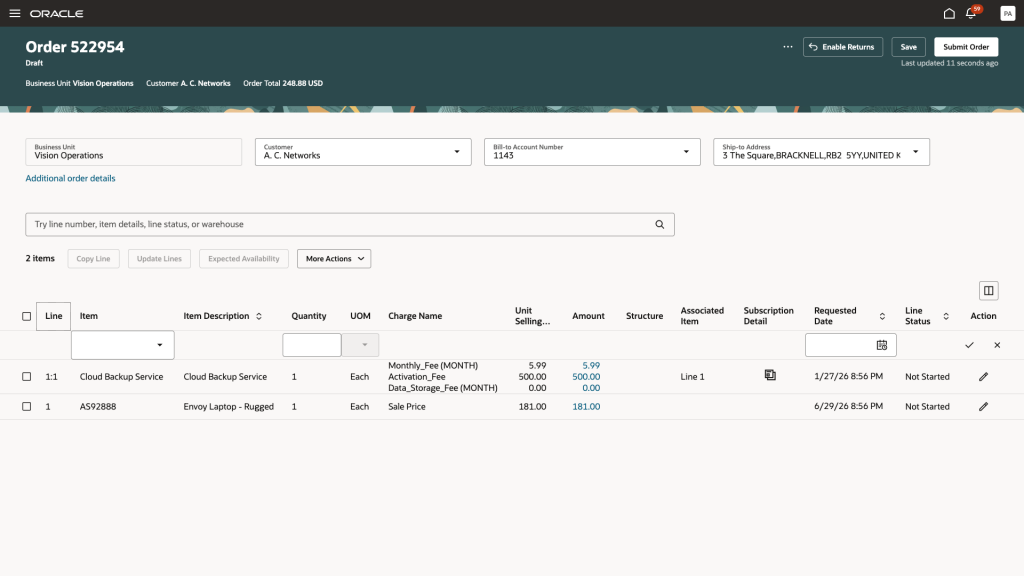
The second pillar of 26A is an intensified focus on human-like interactions. The upgraded Create Order Agent expands AI capabilities into a fully realized Sales Order Assistant. Instead of relying solely on Customer Service Representatives (CSRs) to translate phone conversations into system entries, customers can use conversational language to create sales orders more efficiently. The Sales Order Assistant uses natural language to intelligently surface items, pricing, availability, and promotions to your Order Representatives. It reduces manual searching by providing relevant product options, add-ons, cross sells, and recommendations based on customer needs, and allows you to create a draft order within the agent.
Why it matters:
• Reduced administrative overhead: Automating routine order capture frees CSR capacity for higher-value tasks and can lower administrative costs by a meaningful percentage.
• Increased upsell potential: Embedded product recommendations raise average order value without adding complexity for the customer.
• 24×7 self-service: Customers are no longer restricted to business hours or call-center queues, improving convenience and loyalty.
Autonomous Resilience and Conversational Commerce showcase Oracle’s commitment to embedding AI directly into daily workflows rather than positioning it as an add-on. They form a continuum: the same agent framework powers both exception remediation and natural-language order creation, ensuring consistent governance, security, and extensibility across use cases.
Redwood Productivity
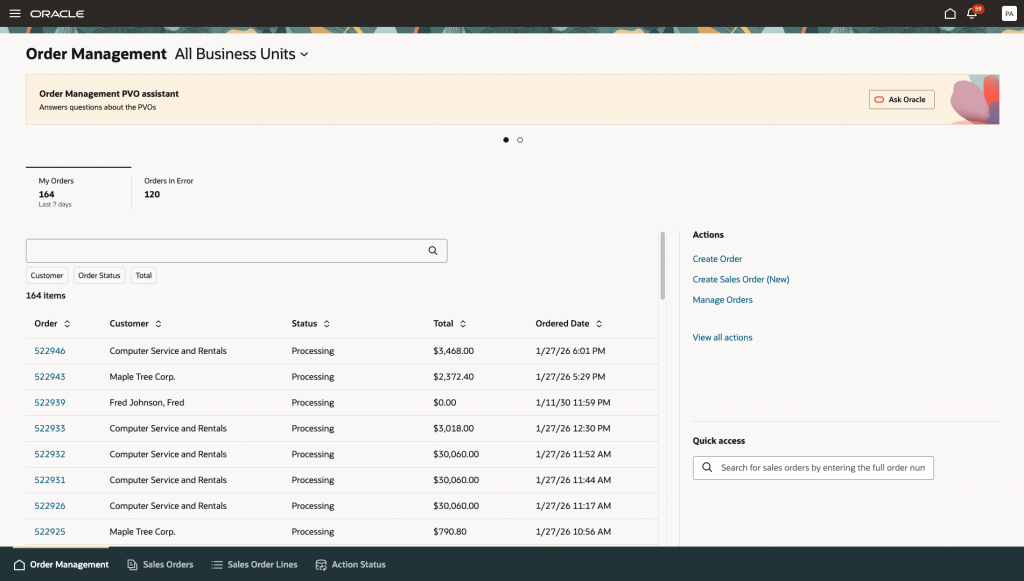
Technology is only as powerful as the experience that delivers it. Recognizing this, Oracle has rebuilt the OM user interface on its next-generation Redwood UX standard, focusing on clarity, flexibility, and speed.
The new Redwood Create Order workspace bundles a “usable set” of high-value capabilities: channel supplier rebates, coverages, project attributes, shipping-status views, deferred saves, editable scheduling attributes, mass price changes, consolidated invoices, and a full order reprice action.
Why it matters:
• Clicks turned into insight: Modern information architecture minimizes scrolling, reduces white space, and eliminates redundant navigation, enabling order managers to work faster and with fewer errors.
• Admin-friendly configurability: OM administrators can tailor the interface—adding or hiding fields, rearranging layouts, or embedding partner data—without resorting to costly PaaS projects.
• Lower TCO: Faster configuration means quicker go-lives and reduced maintenance, translating into decreased implementation costs and a better ROI story for both net-new and upgrade customers.
Early adopters report a markedly shorter learning curve, helping new hires ramp up in days rather than weeks.
Putting It All Together
Release 26A illustrates Oracle’s infusion of AI Agents to manage complexity, empowering users with intuitive interfaces, and delivering measurable financial returns. Whether an enterprise’s priority is slashing operational costs, elevating customer experience, or modernizing its technology stack, the trio of Autonomous Resilience, Conversational Commerce, and Redwood Productivity offers an actionable blueprint.
For customers already on Oracle Order Management, these features require minimal effort to adopt; they arrive as part of the continuous innovation cadence. For those considering a move, 26A represents a compelling milestone that blends AI leadership with enterprise-grade robustness.
Order Management is no longer just about “getting the order in.” It’s about orchestrating a seamless, intelligent, and delightful journey from purchase intent to product arrival. With 26A, Oracle sets a new bar and transforms order management functionality from a back-office necessity into a strategic differentiator.
Curious to learn more about what’s new in Order Management or Oracle Supply Chain and Manufacturing? Dive into the full details on the Oracle Supply Chain and Manufacturing (SCM) Release Readiness page and see the full suite in action.