
As a supply chain planner, you want your applications to remove the friction that keeps you from doing your best thinking. It sounds simple, but often gets lost in a day spent searching, filtering, navigating, and configuring.
With Oracle Supply Chain Planning Update 26A, Oracle is adding to its growing list of AI-Agents enabled by the Oracle AI Agent Studio and is introducing three new generative AI assistants. These new assistants automate everyday tasks and keep you in the flow of analysis rather than bouncing between screens.
1. Automate the Drudgery
Planning Order Release Assistant
Instead of scanning an endless grid of planned orders to release, you can now type a simple business rule in conversational language to select the ones you want:
“If releasing the order will delay any customer demand by more than seven days, hold it for review.”
Gen AI instantly evaluates every line, flags true exceptions, and stages everything else for release. During early trials, planners reported clearing 146 of 150 orders in under a minute and focusing fresh brainpower on the four that needed further attention. The result? Fewer late adjustments, faster execution, and lower stress levels. There’s only so much coffee a planner should have to drink before noon.
2. Erase the Syntax Struggle
Planning Measure Expression Assistant
Calculated measures are powerful, but you can waste valuable time debugging them. Does the parenthesis go before or after the FSum? How can I handle null values? In Update 26, you can just click the AI Assist icon, describe what you need (“Accumulate sales orders for current week plus lead-time weeks”), and the planning measure expression assistant returns a production-ready formula:
Sales Orders + FSum (Sales Orders, NVL (Lead Time, 0))
No syntax cheat sheet needed. No trial-and-error. Better yet, the assistant explains the logic so the next time you need something similar, you’ll understand why it works. In pilots, analysts cut the time to create new KPIs from hours to minutes, freeing them to ask better “what-if” questions instead of debugging bracket errors.
3. Stay in the flow
Planning Cycle Assistant
A classic sales and operations planning (S&OP) cycle forces planners to switch constantly among the plan, email or chat for status updates, and a task tracker. The Planning Cycle Assistant collapses that carousel into a single Redwood page. Need a snapshot of where the current cycle stands? Ask, and you’ll see time frames, review stages, and owners in one tidy summary. Want your personal to-do list? It appears with deep links that drop you straight into the right view, no home-page detours required. Even status updates are conversational: “Mark my forecast review task as started.” Click, done, and you’re still looking at demand curves instead of a checklist.
Three assistants, one design language
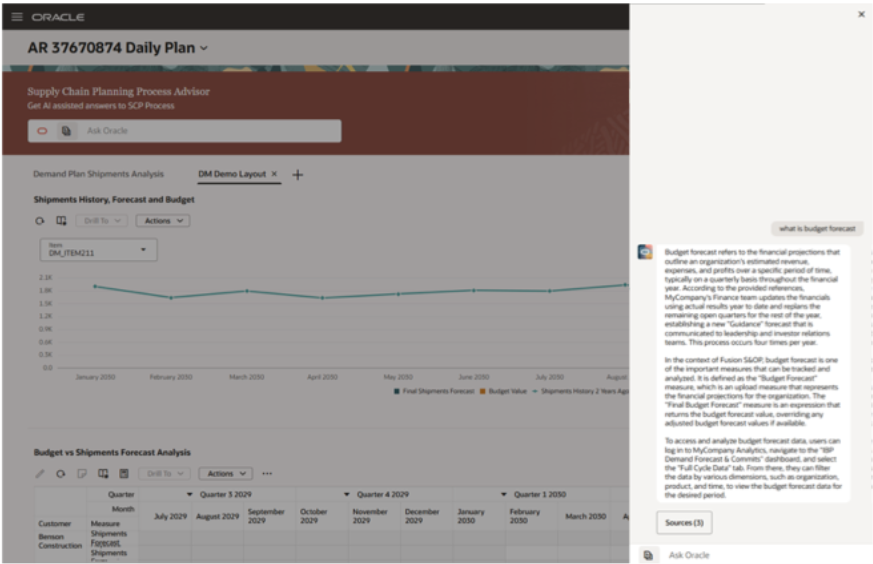
All of these assistants live in the Supply Chain Planning Advisor, your single pane of glass for AI-based guidance. Because they share Redwood UX patterns (drawers, icons, consistent shortcuts), you learn once and apply everywhere. And because they consume standard Oracle metadata, saved searches, measure definitions, planning-cycle setups, they automatically respect your existing security, auditing, and governance rules. Innovation without compliance headaches: a rarity worth celebrating.
Real-world impact you can measure
Customers who joined our early-adopter program are already seeing double-digit gains:
• Order release times cut by 60%, slashing late-delivery fire drills.
• New KPI creation time reduced from ~2 hours to under 10 minutes.
• S&OP meeting prep trimmed by nearly 30%, giving coordinators back an entire afternoon each cycle.
Those efficiencies ripple outward into higher service levels, tighter forecast accuracy, and just as important, happier planners who spend their day solving exceptions instead of wrestling with syntax.
Curious to learn more about what’s new in Supply Chain Planning or Oracle SCM? Dive into the full details on the Oracle Supply Chain and Manufacturing (SCM) Release Readiness page and get ready to plan for the future of supply chain decision making.