
The MySQL team has been working hard to foster innovation, strengthen collaboration with our community, support meaningful contributions, and grow the broader MySQL ecosystem through greater openness and transparency. We believe MySQL is at its best when everyone can see how progress is being made, where work is happening, and how issues move through the development process.
As part of this ongoing commitment to transparency, we will begin sharing bug-related statistics on a regular basis. These updates are intended to give contributors, users, and the broader MySQL community a clearer view into the bugs database, including how many bugs are opened or closed, how bugs are categorized by status, and how that information changes over time.
Bug Snapshots
As part of our Community Engagement efforts we have created some reports that we will be using to share metrics on MySQL Community bugs/issue/backlog.. These snapshots include not only the number of bugs that are opened or closed, but also a breakdown of bugs across the different statuses that make up those designations.
Here is a snapshot from a few months ago, when we first began discussing how to become more transparent in the bug reporting process.
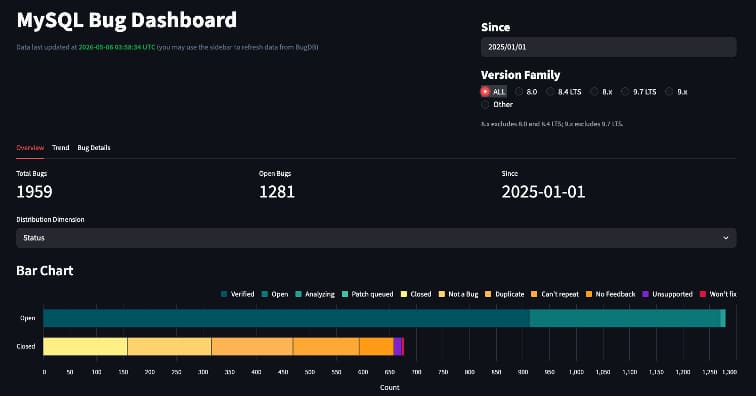
This first snapshot gives us our starting point: 1,959 total bugs filed since January 1, 2025, with 1,281 open and 678 closed. That puts us at about 65% open and 35% closed.
Most of the open bugs were still in the broader Verified/Open area, with smaller groups already showing movement into statuses like Analyzing and Patch queued. On the closed side, bugs were spread across familiar outcomes like Closed, Not a Bug, Duplicate, Can’t repeat, No Feedback, Unsupported, and Won’t fix.
More importantly, it gives us a clear baseline to compare against as we continue improving visibility into the bug process.
Here is the same snapshot from June 10, 2026.
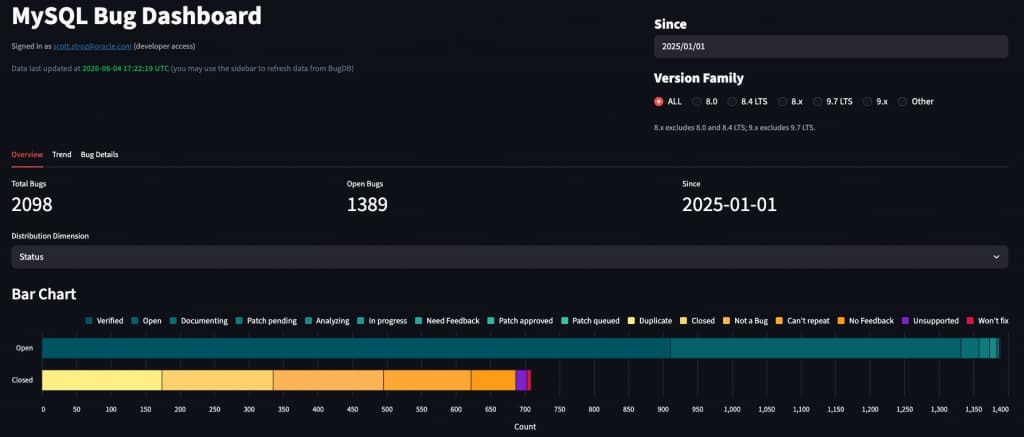
This updated snapshot shows 2,098 total bugs filed since January 1, 2025, with 1,389 open and 709 closed. That puts us at about 66% open and 34% closed.
This gives us a nice follow-up view from the same starting date. The total count has grown, but the dashboard now gives us a much clearer picture of where those bugs are sitting in the process.
Finally, here is a snapshot of the bugs filed for MySQL 9.7 LTS.
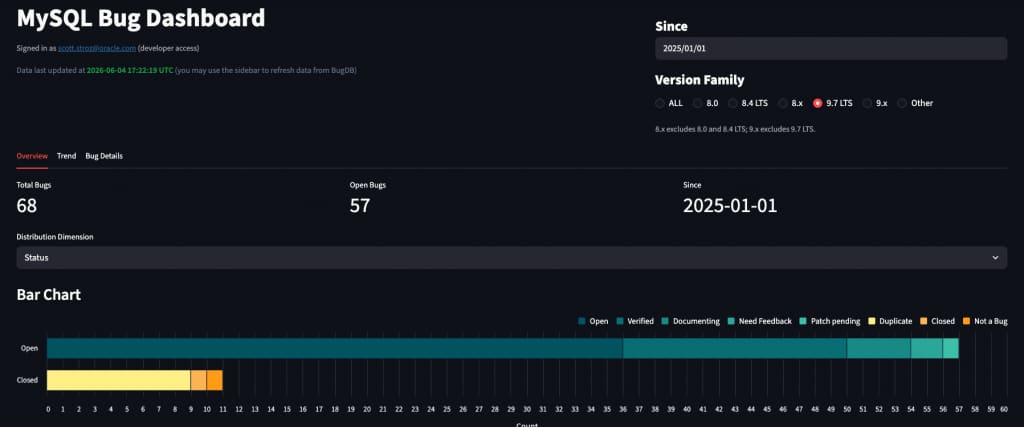
This 9.7 LTS snapshot narrows the view to just bugs filed for MySQL 9.7 LTS since January 1, 2025. It shows 68 total bugs, with 57 open and 11 closed. That puts us at about 84% open and 16% closed.
More Status Updates
In the past, when a bug was filed and verified, its status remained Verified until the bug was closed. That meant there was no public indication of where the bug was in the development process. If you have a keen eye, you may have noticed from the snapshots above that this is starting to change.
When a bug is being worked on, its status will now be reflected in the public bug tracker. This means you will be able to follow updates as a bug moves through our development process. Please keep in mind that not every internal status will be reflected externally, but the updates that matter most will be visible.
Overall, these changes are an important step toward making the MySQL bug reporting process more transparent, informative, and useful for everyone. We are excited to share more insight into how bugs move through the system, and we look forward to continuing to improve the experience for our users, contributors, and the entire MySQL community.
Growing the MySQL Community Together
As part of our broader community engagement plan, we will continue sharing these kinds of metrics on a regular cadence so the community can follow our progress over time. Our goal is sustained year-over-year growth across the areas that matter most: community contributions and contribution quality, new and core contributor growth, issues addressed, backlog reduction, response times, and patches submitted by the community. We also want to keep building momentum around innovation, leadership in roadmap projects, and stronger engagement through events, social channels, and community participation. This is another step toward growing a healthier, more collaborative MySQL ecosystem, and we are excited to keep improving together.