
What LTS, Innovation, and “latest supported” mean across MySQL Server, Shell, Router, Connectors, and Operator
MySQL has two different release models, and understanding which products follow which model makes choosing versions much simpler.
MySQL Server and MySQL NDB Cluster offer Long-Term Support (LTS) and Innovation releases.
MySQL Shell, MySQL Router, MySQL Connectors, and MySQL Operator for Kubernetes follow a Single Releasemodel: use the latest supported release.
The fact that these products share version numbers does not mean they share the same release lifecycle.
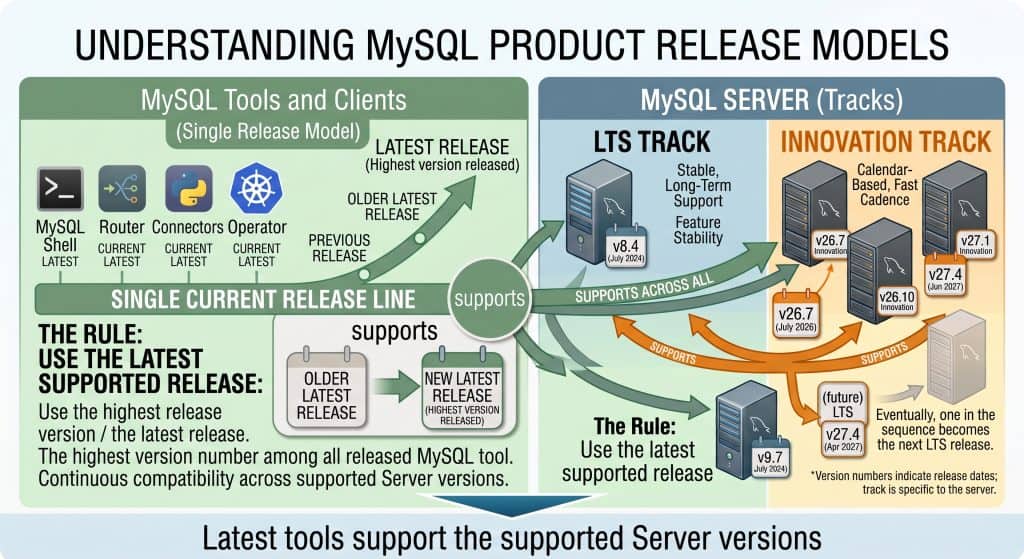
1. MySQL Server and NDB Cluster: LTS and Innovation
For MySQL Server and MySQL NDB Cluster, customers choose between two production-grade release tracks.
Long-Term Support (LTS) releases are intended for environments that want to remain on a stable feature set for a longer period.
Innovation releases deliver new capabilities on a faster cadence and move forward from one release to the next.
Today, supported Server releases include MySQL 8.4 LTS and MySQL 9.7 LTS, while MySQL 26.7 is an Innovation release.
Starting with 26.7, MySQL uses calendar versioning in a YY.M format:
26.7 → 26.10 → 27.1 → 27.4 → …
Eventually, an Innovation release becomes the next LTS release, and a new Innovation series begins.
I explained that lifecycle in more detail in my previous post, A More Predictable MySQL Release Model: Calendar Versions, LTS, and Innovation.
The important point here is that LTS and Innovation are choices you make for MySQL Server and NDB Cluster.
2. Shell, Router, Connectors, and Operator: Single Release
MySQL Shell, MySQL Router, MySQL Connectors, and MySQL Operator for Kubernetes follow a different model.
These products have one current release.
With the transition to this model, the separate 8.4 and 9.7 release series for Shell, Router, and Operator were discontinued. Connectors already followed the concept of a current release supporting multiple supported MySQL Server versions.
Beginning with the calendar-versioned releases, these products follow the same numbering cadence as the current MySQL Innovation release:
26.7 → 26.10 → 27.1 → 27.4 → …
But there is an important distinction:
MySQL Shell 26.7 is not an “Innovation release” of Shell.
MySQL Router 26.7 is not an “Innovation release” of Router.
They simply use the current MySQL release number.
When 26.10 is released, it becomes the new current release. When 27.1 arrives, it replaces 26.10 as the current release, and so on.
When the MySQL Server Innovation cycle eventually reaches the next LTS release, Shell, Router, Connectors, and Operator do not create a new LTS branch and remain there. Their Single Release model continues forward with the next current MySQL release number.
Why?
Because these products need to work across supported MySQL Server versions.
A customer may choose to keep a database on an LTS release for an extended period, while the software that connects to, administers, routes to, or manages that database continues to move forward.
That is why you should not try to match the version of Shell, Router, a Connector, or Operator to the version number of your Server.
Compatibility Across Releases
The Single Release model means that each new release of MySQL Shell, Router, Connectors, and Operator replaces the previous release as the current supported version, while continuing to support the applicable supported MySQL Server releases.
| MySQL Server version | Shell, Router, Connectors, and Operator 26.7 | Shell, Router, Connectors, and Operator 26.10 | … | Shell, Router, Connectors, and Operator 28.4 | Shell, Router, Connectors, and Operator 28.7 |
|---|---|---|---|---|---|
| 8.4 LTS | ✓ | ✓ | ✓ | ✓ | ✓ |
| 9.7 LTS | ✓ | ✓ | ✓ | ✓ | ✓ |
| 26.7 Innovation | ✓ | ✓ | ✓ | ✓ | ✓ |
| 26.10 Innovation | * | ✓ | ✓ | ✓ | ✓ |
| … | * | * | ✓ | ✓ | ✓ |
| 28.4 LTS | * | * | * | ✓ | ✓ |
| 28.7 Innovation | * | * | * | * | ✓ |
✓ = supported current combination
* = the older product may still work with the newer Server release, but support and availability of new functionality must be verified for that specific product and release.
The important pattern is simple:
Move forward with Shell, Router, Connectors, and Operator even if your MySQL Server remains on an LTS release.
The Rule to Remember
Choose the appropriate LTS or Innovation lifecycle for MySQL Server.
For MySQL Shell, Router, Connectors, and Operator, use the latest supported release.
Same version numbering.
Different release models.