
Oracle Integration 26.10 continues to expand enterprise connectivity and intelligent automation, delivering new adapters and enhancements across agent-driven workflows, AI native actions, event processing, security, data integration, and cloud connectivity.
This release enables customers to invoke Fusion agents from integration flows, work with MongoDB document data, use OCI Generative AI native actions across supported regions and environments, and connect to a wider range of OpenAI-compatible providers. It also adds enhanced authentication options for SAP SuccessFactors and other enterprise applications, expands public gateway, private endpoint, and Connectivity Agent access where supported, and provides new configuration options for database and messaging integrations.
The following highlights provide an at-a-glance summary of the new adapters, AI native action and data enhancements, adapter updates, security and connectivity enhancements, and other updates in this release.
New Adapters
- Fusion Agent AI Studio Adapter – Enables Oracle Integration to invoke Fusion AI agents using the A2A protocol.
- MongoDB Adapter – Enables MongoDB Atlas document polling and document operations.
- AMQP Adapter – Enables AMQP 1.0 queue- and topic-based messaging.
AI-Infused Workflow Enhancements
- OCI Generative AI Native Actions – Expands AI Workflows flexibility with cross-region support across commercial, government, and DRCC deployments; Gemini and OpenAI dedicated AI cluster models for the ReAct pattern; and inline document support for Gemini models.
- OpenAI Adapter – Expands AI provider flexibility with support for OpenAI-compatible endpoints across domains, such as AWS Bedrock, along with inline document support.
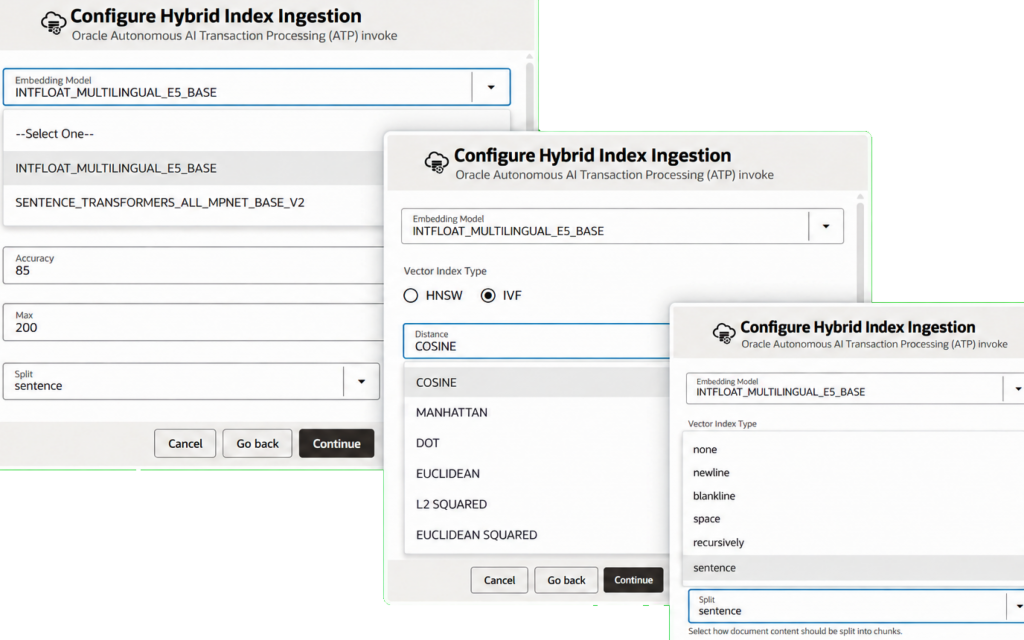
- Oracle ATP Adapter – Builds on Hybrid Index Operations with configurable ingestion parameters and scalable handling of large Hybrid Index Search responses.
Enhancements to Existing Adapters
- Oracle AI Database and Oracle ATP Adapters – Support dynamic connections for invoke operations.
- Database Adapters – Support seamless disaster recovery using a single wallet.
- Adobe Sign and Oracle NetSuite Adapters – Expand event-driven integration with new trigger capabilities.
- Microsoft SharePoint and Shopify GraphQL Adapters – Expand connectivity and business process support with cloud endpoint, private connectivity, and fulfillment order enhancements.
Security and Connectivity Enhancements
- New Security Policies – Strengthens enterprise security across a number of adapters: REST, Salesforce, Amazon S3, Confluent, SAP, and other adapters with expanded modern authentication, identity, and credential-management options.
- SOAP Adapter – Strengthens invoke security with JWT User Assertion and JWT Client Assertion policies, including user identity propagation through JWT User Assertion.
- Rapid Adapter Builder – Enables user identity propagation through OAuth using the JWT User Assertion security policy.
- Private Endpoint Support – Expands secure private connectivity to 24 adapters
New Adapters
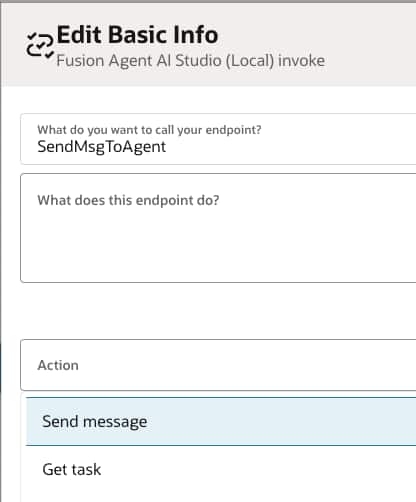
Fusion Agent AI Studio Adapter – New Adapter
Oracle Integration now includes the Fusion Agent AI Studio Adapter, enabling integrations to invoke agents in Oracle AI Agent Studio for Fusion Applications.
Use this invoke-only adapter to incorporate agent interactions into Oracle Integration orchestration. The adapter uses the Agent-to-Agent (A2A) protocol to communicate with Fusion agents and supports the following actions:
- Send Message – Invokes an agent and sends a message within an agent conversation.
- Get Task – Retrieves information about an existing task instance, including its current status and task details.
- Agent Discovery – Lets you access and select from the agents available in the Fusion Agent AI Studio instance configured for the connection.
- Secure A2A Communication – Supports standards-based communication with agents through the A2A protocol.
- OAuth Security – Supports identity propagation via JWT User Assertion for OAuth. Bearer Token Authentication is also available but deprecated.
To configure the connection, provide a connection name and identifier, select the Invoke role, and specify the base URL of the Fusion Agent AI Studio instance. For JWT User Assertion for OAuth, configure the required user, client ID, access token URL, and JWT private key alias.
This enhancement enables you to include Fusion agent interactions in Oracle Integration flows while using Oracle Integration for orchestration and downstream business processing.
MongoDB Adapter – New Adapter
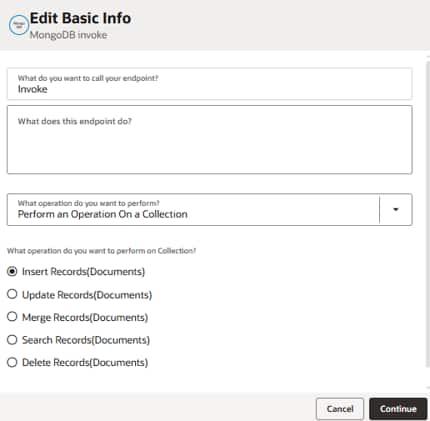
The new MongoDB Adapter provides native connectivity to MongoDB Atlas, enabling Oracle Integration to integrate document data with enterprise applications and business processes without custom code.
The adapter supports both inbound and outbound integration patterns:
- Document polling (Trigger) – Polls MongoDB collections based on configured criteria, with support for logical delete field-based polling, batch size, and polling frequency.
- Document operations (Invoke) – Supports insert, update, merge, search, and delete operations, including filters and pagination. Merge operations can update matching documents or insert new documents when no match is found.
- Flexible data formats – Supports both MongoDB Extended JSON and Normal JSON payloads.
- Connectivity and security – Supports public, private endpoint, and Connectivity Agent-based connectivity, with username and password authentication.
Together, these capabilities enable integrations to retrieve, process, and synchronize MongoDB Atlas document data across enterprise applications using both polling and request-driven integration patterns.
Advanced Message Queuing Protocol (AMQP) Adapter – New Adapter
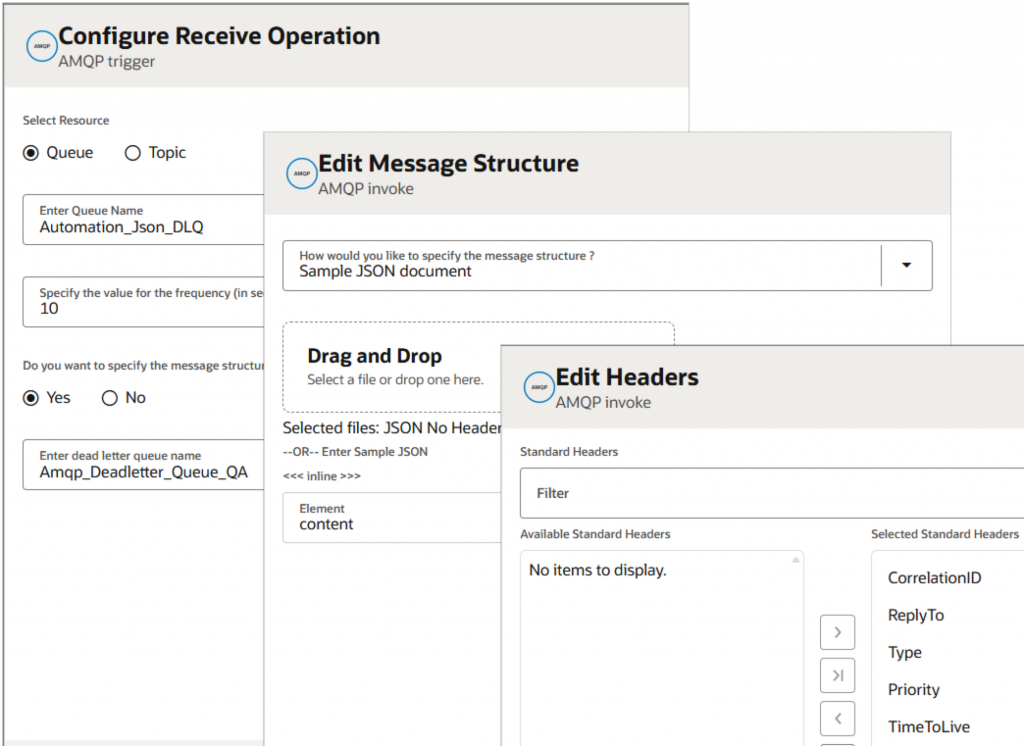
The AMQP Adapter in Oracle Integration 26.10 enables integrations to exchange messages with AMQP 1.0 brokers, including Qpid, SwiftMQ, and Solace, using queue- and topic-based messaging.
You can configure the AMQP Adapter as a trigger or invoke connection to publish messages, consume messages synchronously, or receive messages through inbound polling. The adapter also supports durable topic subscriptions for continuous and on-demand messaging scenarios.
The adapter provides flexible connectivity through cloud, connectivity agent, and private endpoints, along with basic authentication. Support for standard and custom headers, multiple payload formats, and dead-letter handling enables reliable message processing across a variety of messaging scenarios.
AI-Infused Workflow Enhancements
Oracle Integration expands its AI native actions with broader OCI Generative AI availability, additional model options, document input support, and more flexible OpenAI-compatible connectivity.
OCI Generative AI Native Action
- Regional Availability: OCI Generative AI native actions now support commercial, government, and Dedicated Region Cloud@Customer (DRCC) environments. You can also use cross-region access to invoke OCI Generative AI models available in supported service regions. When configuring an OCI Generative AI native action, Oracle Integration displays only the regions to which your tenancy is subscribed. This helps you select an available region and avoids configurations for unsupported services or regions.
- Google Gemini and OpenAI Model Support in the ReAct Pattern: The Generative AI native action now supports Google Gemini models and OpenAI models hosted on OCI Generative AI dedicated AI clusters in the ReAct pattern. This enhancement gives you additional model choices when building AI-driven orchestration flows, allowing you to select a model that aligns with your reasoning, performance, and deployment requirements.
- OCI Generative AI Native Action – Document Input Support The OCI Generative AI native action now supports document inputs for supported models. You can provide a document as Base64-encoded content or a URI, enabling use cases such as document summarization, extraction, classification, and question answering.Document input is supported for these Google Gemini models:
- Google Gemini 2.5 Pro
- Google Gemini 2.5 Flash
- Google Gemini 2.5 Flash-Lite
OpenAI Adapter – OpenAI-Compatible Endpoints and Base64 Attachments
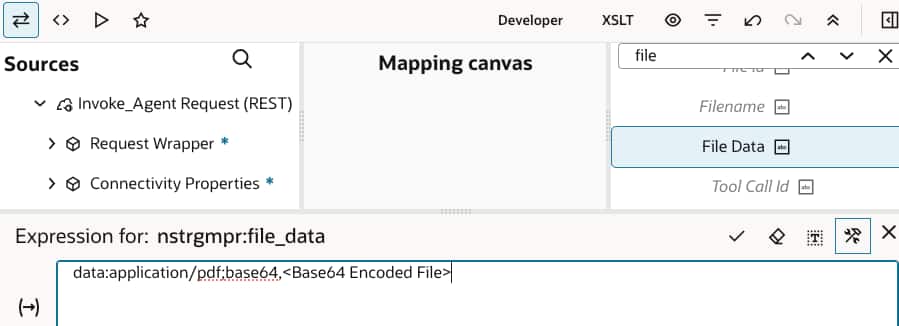
The OpenAI Adapter now supports OpenAI-compatible endpoints across different domains. You can configure the adapter to connect to compatible providers, including services such as AWS Bedrock, without being restricted to a specific OpenAI domain.
The adapter also supports sending attachments as Base64-encoded content. This enables integrations to include supported file content directly in requests when interacting with OpenAI-compatible services.
Oracle ATP Adapter Enhancements – Configurable Chunking Parameters for Hybrid Index Ingestion and Large-Payload Search Support
With this release, the Oracle Autonomous AI Transaction Processing (ATP) Adapter adds configurable chunking and vector preference parameters for Hybrid Index Ingestion and scalable large-payload processing for Hybrid Index Search responses.
These enhancements give Oracle Integration customers more control over how documents are divided and indexed for vector search while improving the processing of large search-result payloads.
Configurable Chunking Parameters for Hybrid Index Ingestion
Hybrid Index Ingestion now allows customers to configure selected chunking and vector preference parameters directly from the integration configuration wizard.
Customers can configure:
- Vector index type — Select HNSW or IVF.
- Distance metric — Select COSINE, MANHATTAN, DOT, EUCLIDEAN, L2 SQUARED, or EUCLIDEAN SQUARED.
- Accuracy — Specify a value from 1 through 100.
- Maximum chunk size — Specify a value from 10 through 1000.
- Split method — Select none, newline, blank line, space, recursively, or sentence.
Enhancements to Existing Adapters
Oracle AI Database and Oracle ATP Adapters – Dynamic Connections Support
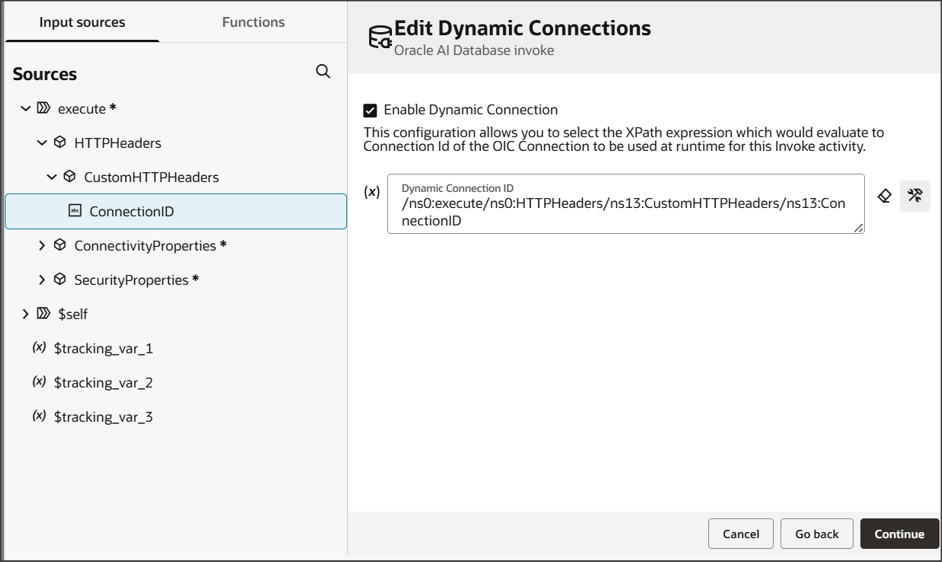
With this release, the Oracle AI Database Adapter and Oracle Autonomous AI Transaction Processing (ATP) Adapter add support for dynamically selecting a connection for invoke operations at runtime.
Previously, an integration used the database connection selected during design. With this enhancement, adapter uses the specified connection instead of the connection originally configured in the integration.
For example, an integration can be designed and activated using connection A. The identifier for Connection B is specified through the Dynamic Connection ID field. The connection identifier can be hardcoded or mapped from any supported integration input source, such as a variable, expression, or trigger payload. The invoke operation then uses connection B for that request. The integration continues to use the original design-time connection. This preserves the existing behaviour for integrations that do not require dynamic connection selection.
This enhancement helps customers reuse the same integration when the target database connection varies by request, deployment environment, business unit, or another runtime context.
Disaster Recovery Support for Oracle Database Adapters
Oracle Database adapter connections now provide seamless disaster-recovery support through wallet-based connectivity to both primary and standby database hosts. A single wallet can include multiple ADDRESS entries in the tnsnames.ora file, containing the details for both database instances.
When a primary database host is unavailable, adapter uses the configured retry and failover settings to connect to an available standby host. During a disaster-recovery switchover, failover, or failback, integrations can continue to use the same wallet without requiring customers to upload a replacement failover wallet or manually update the connection.
This capability is supported by the following adapters:
- Oracle Autonomous AI Transaction Processing (ATP) Adapter
- Oracle Autonomous AI Lakehouse (LH) Adapter
- Oracle Database Cloud Service (DBaaS) Adapter
- Oracle AI Database Adapter
Adobe Sign Adapter Enhancement: Support for Inbound Events
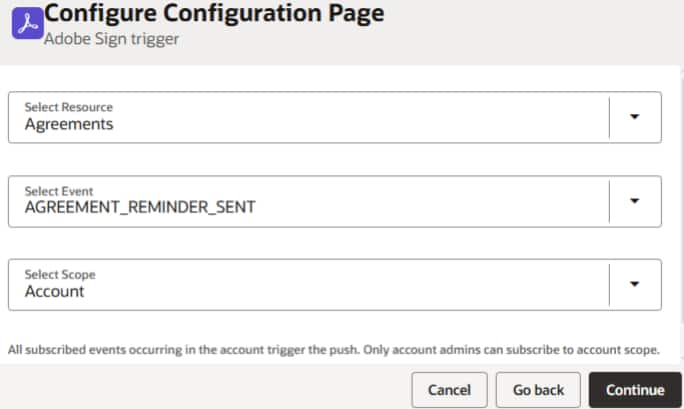
In this release, the Adobe Sign Adapter adds support for inbound operations, enabling event-driven integrations that respond to activities in Adobe Sign.
Oracle Integration can automatically receive and process Adobe Sign events such as:
- Agreement created
- Agreement rejected
- Library document created
- Reminder sent
Customers can configure integrations for specific Adobe Sign resources, scopes, and event types, providing greater control over the events that trigger their integration workflows.
Oracle NetSuite Adapter Enhancement – Support for Inbound Events
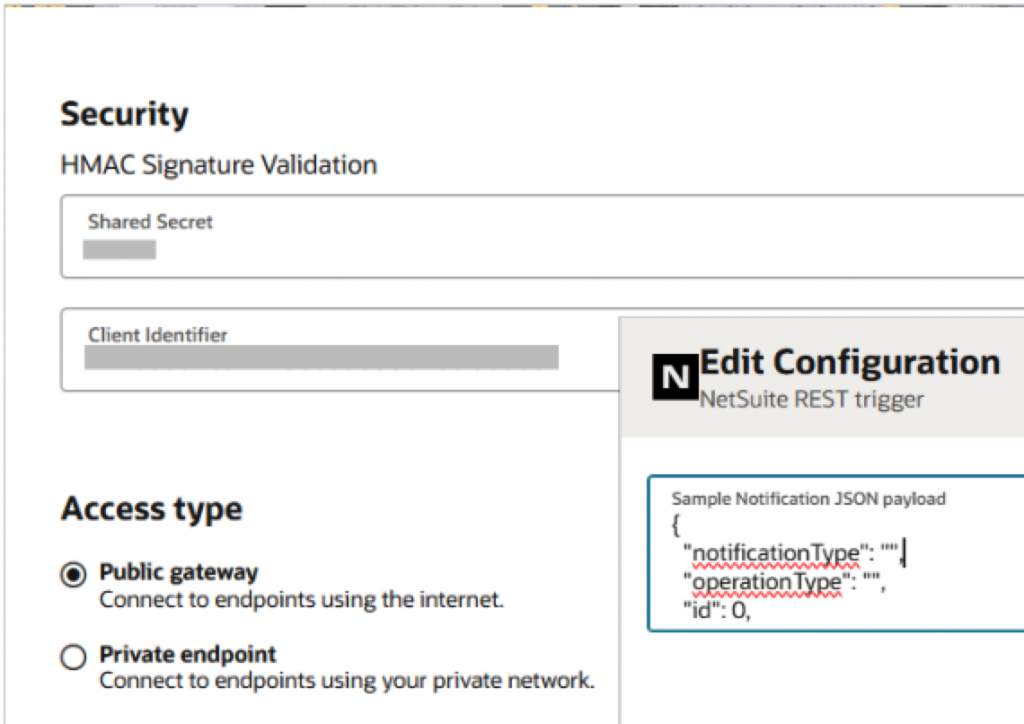
With this release, the Oracle NetSuite Adapter adds support for trigger connections, enabling event-driven integrations that receive notifications when configured NetSuite records are created, updated, or deleted.
Customers can define the notification structure using a sample JSON payload, with the selected fields automatically made available in the mapper. This provides flexibility to receive and process only the information required for the integration flow.
Customers can configure the relevant NetSuite record types, events, and notification fields, enabling integrations to respond directly to business events in NetSuite and initiate downstream processes.
For secure inbound communication, trigger connections support the HMAC Signature Validation security policy. The adapter also supports private endpoint connectivity for invoke connections, enabling secure access to NetSuite endpoints through private network connectivity.
Microsoft SharePoint Adapter Enhancement: Support for Noncommercial Microsoft Cloud Regions
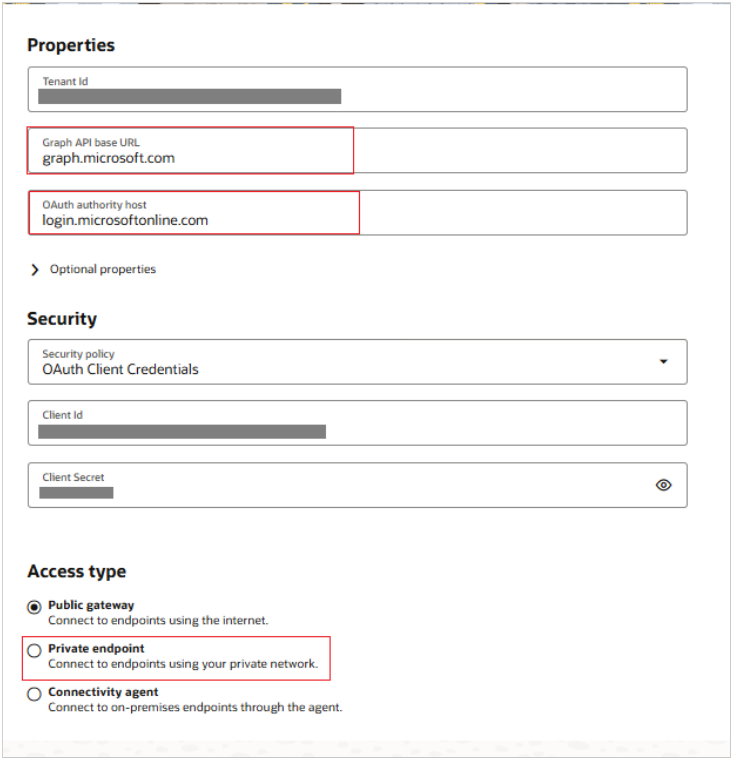
The Microsoft SharePoint Adapter expands connectivity to support Microsoft commercial, U.S. Government, and other sovereign cloud environments through configurable Microsoft Graph and authentication endpoints.
This release introduces Graph API Base URL and OAuth Authority Host fields on the adapter connection page, enabling customers to configure the Microsoft Graph API and OAuth authentication hosts appropriate for their Microsoft 365 environment.
Previously, the adapter used the default Microsoft Graph and authentication endpoints for commercial Microsoft 365 environments. With this enhancement, organizations operating in U.S. Government or other sovereign cloud environments can configure the corresponding Microsoft Graph and OAuth endpoints for their deployment.
Default values continue to be provided for commercial environments, allowing existing connections to work without configuration changes. This enhancement extends the same SharePoint Adapter experience across commercial and sovereign Microsoft cloud environments while accommodating their distinct API and authentication endpoints.
Security and Identity Enhancements
New Security Policies
The following table summarizes the security-policy enhancements across supported adapters:
| Adapter | New Security Policy | How it helps? |
| REST | Resource Principal Signature Trust (RPST) | Secures inbound requests from supported OCI services by using OCI-signed requests and IAM authorization. |
| SOAP | JWT user Assertion & Client Assertion | Enables JWT-based authentication for invoke connections, with user identity propagation for downstream authorization and user-level auditing. |
| Microsoft Dynamics 365 CRM | Authorization Code Credentials (PKCE) | Adds PKCE support for stronger authorization-code authentication. |
| Salesforce REST | Authorization Code Credentials (PKCE) | Adds PKCE-based authorization-code authentication. |
| Amazon S3 | STS-based Signature Version 4 authentication | Enables the adapter to assume an AWS role and use temporary credentials. |
| Confluent | SASL OAuth (Client Credentials) | Enables OAuth-based authentication to Confluent messaging systems. |
| SAP SuccessFactors | SAP OpenID Connect; SAML with SAP Identity Authentication Service | Adds authentication options for SAP SuccessFactors integrations. |
| ActiveMQ | Basic Auth Mutual TLS | Combines username/password authentication with mutual TLS certificates. |
| SAP Ariba | cXML Shared Secret | Simplifies cXML-specific authentication for buyer and supplier purchase-order flows. |
Rapid Adapter Builder infrastructure – Supports User Identity Propagation
The Rapid Adapter Builder (RAB) infrastructure now supports user identity propagation through OAuth using the JWT User Assertion security policy. This policy enables an integration to obtain an OAuth access token and invoke a downstream service on behalf of a user.
This preserves the user’s identity across services, enabling the downstream application to enforce user-specific permissions and maintain user-level audit records, rather than treating every request as coming from a shared integration account.
Expanded Private Endpoint Support
This release expands private endpoint support to more 24 adapters, continuing to broaden the portfolio of adapters available for secure private connectivity. These adapters can connect securely to private resources within an OCI Virtual Cloud Network (VCN), as well as publicly accessible resources over the internet. This enhancement strengthens security and enables seamless integration with applications and services deployed across private and public networks.
| ActiveMQ Adapter | Amazon Simple Queue Service (SQS) Adapter | Coupa Procurement Adapter | Oracle AI Database Adapter | Snowflake Adapter |
| ArcGIS (ESRI) Adapter | Azure Event Grid Adapter | Coupa Sourcing Adapter | Microsoft Entra ID Adapter | Zuora Adapter |
| Asana Adapter | Azure Service Bus Adapter | GCP Pub Sub Adapter | PostgreSQL Adapter | Microsoft SQL Server Adapter |
| Amazon Simple Storage Service (S3) Adapter | Azure Storage Adapter | GCP Storage Adapter | Salesforce Marketing Cloud Adapter | Oracle NetSuite REST Adapter |
| Amazon Simple Notification Service (SNS) Adapter | BigQuery Adapter | GitHub Adapter | Microsoft SharePoint Adapter |
Public Gateway Support
The ActiveMQ, Databricks, and Oracle AI Database adapters now support public gateway connectivity in addition to connectivity agent support. This enhancement enables these adapters to connect to endpoints that are accessible over the public internet.
| ActiveMQ Adapter | Supports public gateway connectivity to ActiveMQ Artemis. |
| Databricks Adapter | Supports connectivity to a Databricks database through a public gateway. |
| Oracle AI Database Adapter | Supports connectivity to endpoints accessible over the public internet through a public gateway. |