

Introduction
In our previous post, Well-Architecting Enterprise Multi-Cloud Solutions with OCI, we explored the principles of designing effective multi-cloud architectures and the importance of aligning cloud decisions with business outcomes rather than technology preferences alone. Today, multi-cloud is no longer a future-state aspiration—it is the operational reality for most enterprises.
Research from Oracle and Accenture, documented in To the Multi-Cloud and Beyond, shows that organizations increasingly leverage multiple cloud providers to meet diverse business, regulatory, performance, and innovation requirements. The research highlights that leading enterprises are not pursuing multi-cloud solely to avoid vendor lock-in; they are strategically combining the strengths of different providers to accelerate innovation, improve resilience, and optimize costs.
A key finding from the report is that interoperability—not merely coexistence—is becoming the defining factor of successful multi-cloud strategies. Organizations achieve the greatest value when cloud environments are connected, secured, and managed as a unified ecosystem rather than isolated silos.
For CIOs, CTOs, and Chief Architects, the challenge is no longer whether to adopt multi-cloud, but how to architect it effectively.
This article explores three common multi-cloud architecture patterns and demonstrates how Oracle Cloud Infrastructure (OCI) can play a strategic role in each.
Pattern 1: Independent Workloads across different Clouds
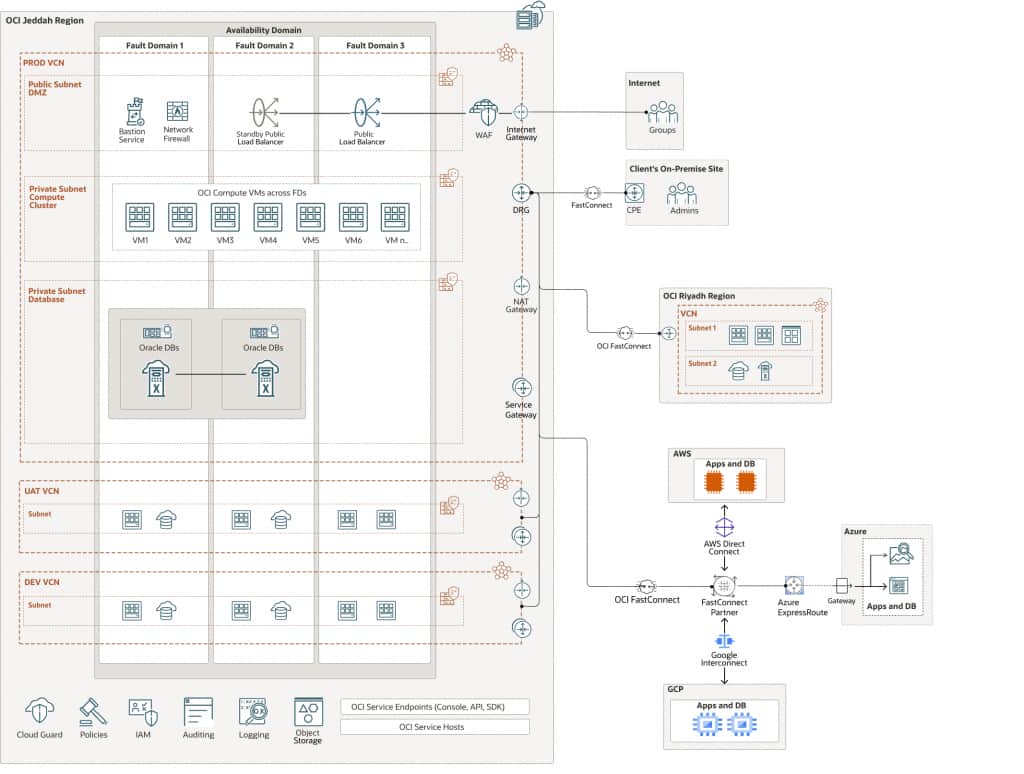
The simplest and most common multi-cloud pattern is workload separation.
In this model, different business applications run on different cloud providers based on organizational requirements, existing investments, or service preferences.
For example, one company can choose to run the following applications:
- Fusions SaaS or any enterprise-scale applications running on OCI
- Productivity and collaboration services running on other hyper-scalers
In this architecture, each workload largely operates independently, with only limited integration between clouds.
Why organizations choose this model
- Business-unit autonomy
- Mergers and acquisitions
- Existing cloud commitments
- Best-of-breed service selection
- Regulatory or geographic requirements
Architectural considerations
Although workloads remain largely independent, organizations should standardize key operational capabilities across clouds:
- Identity and access management
- Security policies
- Infrastructure as Code
- Monitoring and observability
- Cost governance
- Compliance reporting
The biggest risk in this model is operational fragmentation. Different teams, tools, and governance processes can quickly create complexity and increase operational costs.
For CIOs, this pattern often serves as the starting point of a broader multi-cloud journey.
Pattern 2: Split-Stack Architecture leveraging OCI Multi-Cloud Capabilities
The second pattern is where multi-cloud begins to deliver strategic business value.
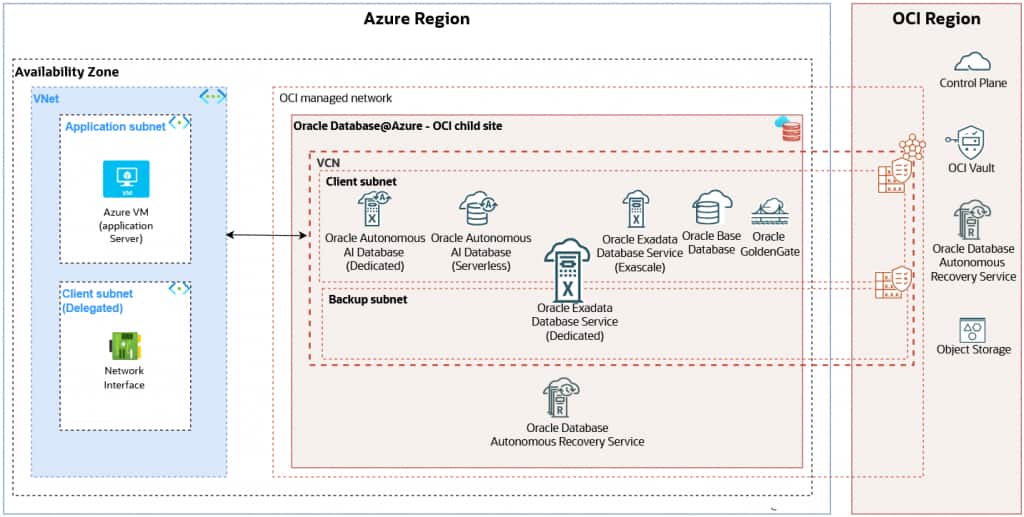
In a split-stack architecture, application tiers are deliberately distributed across cloud providers while functioning as a single logical solution.
A common example is:
- Application services running in Azure, AWS, or Google Cloud
- Oracle Database services running on OCI
Historically, this architecture introduced latency, operational complexity, and networking challenges. However, OCI’s growing portfolio of multi-cloud capabilities has significantly reduced these barriers.
Organizations can now combine Oracle Database services with cloud-native services from hyper-scalers while maintaining low-latency connectivity and operational simplicity
OCI supports this model through dedicated multi-cloud capabilities including Oracle Database@Azure, Oracle Database@Google Cloud, and the broader OCI Multicloud portfolio. These services enable organizations to combine Oracle’s enterprise database platform with cloud-native services from hyperscale providers while maintaining low-latency connectivity and operational consistency.
Example;
A retailer may choose to:
- Build customer engagement applications using Azure-native services
- Use Azure AI and analytics services
- Store and process transactional data on Oracle Database running on OCI
This approach allows teams to leverage familiar cloud-native development environments while continuing to benefit from Oracle’s enterprise-grade database platform.
Why organizations choose this model
- Preserve existing Oracle investments
- Accelerate cloud-native application modernization
- Reduce data migration risk
- Enable AI and analytics innovation close to enterprise data
Architectural considerations
Ultimate success depends on:
- Low-latency network connectivity
- Unified identity and security models
- Data governance across cloud boundaries
- Consistent observability and operational tooling
For many enterprises, this pattern represents the most practical and fastest path toward realizing multi-cloud benefits.
Another reference example;
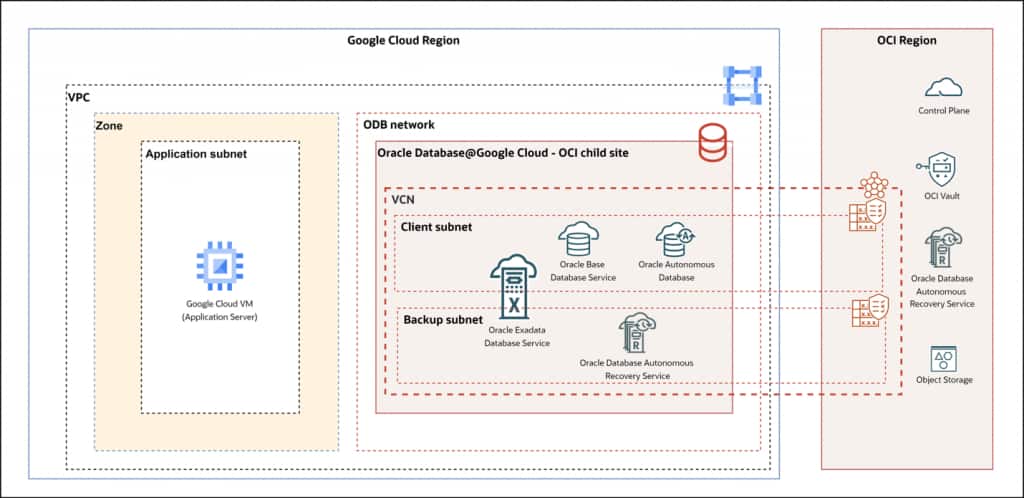
A similar pattern applies when application ecosystems are built on Google Cloud:
- Application tier on Google Cloud (compute, containers, or any platform services)
- Oracle Database Services via Database@Google Cloud
- Controlled cross-environment routing and security
- Integration with enterprise observability and governance processes
The Ultimate benefit is that organizations can standardize application platforms on Google Cloud where appropriate, while retaining Oracle database capabilities in a proximity optimized model.
Please note: availability, regions, and supported configurations may vary by offering and location, hence service coverage and constraints should be validated during the design phase.
Pattern 3: Cross-Cloud Disaster Recovery
The third pattern is the most advanced and often the most strategically important one.
In this model, production workloads operate on one cloud provider while disaster recovery (DR) environments run on another.
Example scenarios include:
- Production on Azure, DR on OCI
- Production on Google Cloud, DR on OCI
- Production on OCI, DR on another hyper-scaler
This architecture protects organizations against large-scale provider outages, regional failures, and cloud concentration risks.
Unlike traditional DR strategies that rely on secondary regions within the same provider, cross-cloud DR introduces true provider-level resilience.
Example:
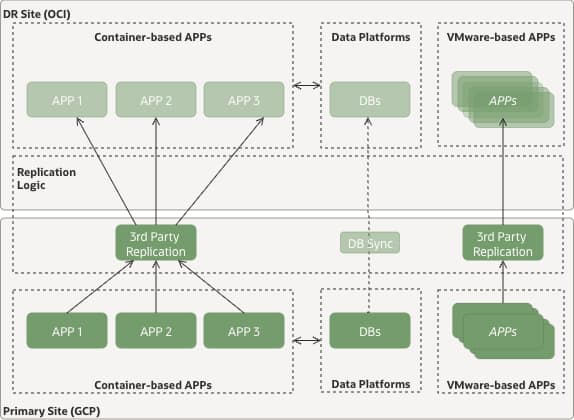
In this example, the solution is based on a 3rd party tool to replicate virtual machines, whether native virtual machines or Vmware apps, from GCP production site to OCI which represents the DR site. Note that Database replication and sync will be configured with native database mechanisms to provide smooth transition experience during disastrous events.
OCI provides several capabilities that support cross-cloud resilience, including OCI Object Storage, and the architecture guidance available through the OCI Architecture Center. Together, these services help organizations design and automate disaster recovery strategies that extend beyond a single cloud provider that we have explored in detail in our previous blogpost.
Why do organizations choose this model?
- Business continuity requirements
- Regulatory resilience mandates
- Reduced concentration risk
- Executive-level risk management objectives
Architectural considerations
Cross-cloud DR introduces additional complexity that architects must address:
- 3rd Party Replication Tooling
- Data replication strategies
- Recovery Point Objectives (RPO)
- Recovery Time Objectives (RTO)
- Network failover procedures
- Security policy synchronization
- Automated testing and validation
The goal is not simply to maintain a backup environment, but to ensure that failover processes can be executed predictably and repeatedly.
For critical workloads, this pattern often delivers the strongest business justification for a multi-cloud investment.
Key Takeaways for CIOs, CTOs, and Chief Architects
As multi-cloud adoption matures, successful organizations are shifting their focus from cloud selection to cloud interoperability.
Three practical recommendations stand out:
1. Architect for business outcomes
Do not adopt multi-cloud simply to diversify providers. Every multi-cloud decision should support a clear objective such as resilience, modernization, compliance, performance, or innovation.
2. Standardize operational foundations
Identity, security, observability, governance, and automation should be consistent across cloud environments. The OCI Well-Architected Framework provides useful guidance for establishing these foundational capabilities across complex cloud estates.
3. Start simple and evolve deliberately
Most organizations begin with independent workloads, evolve toward split-stack architectures, and ultimately implement cross-cloud resilience for mission-critical systems. Not every workload requires the most sophisticated architecture.
The most effective multi-cloud strategy is the one that balances business value with operational simplicity.
OCI’s growing ecosystem of multi-cloud services, interconnect capabilities, and database offerings provides organizations with the flexibility to adopt each of these patterns while maintaining performance, governance, and resilience across cloud boundaries.