
Healthcare transaction volumes are highly unpredictable. A claims intake workflow or a FHIR-based data exchange might handle a steady stream of requests during standard hours, only to face large, sudden spikes from provider portals, clearinghouses, automated batch submissions, or pharmacy networks. Whether you are managing prior authorizations, eligibility verifications (EDI 270/271), claims intake (EDI 837), or lab routing, processing delays can directly impact eligibility decisions, reimbursement cycles, and the patient experience.
To handle these bursty, mission-critical workloads without overspending on idle cloud capacity, architects need a decoupled, event-driven framework. This blog introduces a reference architecture built on Oracle Cloud Infrastructure (OCI) designed to improve throughput while reducing avoidable compute, storage, and data movement costs.
Beyond the architecture pattern, this blog highlights OCI capabilities that improve performance, resilience, and cost efficiency:
- Flexible VM shapes help right-size worker capacity
- Oracle Acceleron and bare metal instances support specialized high-throughput processing workloads
- Preemptible worker nodes can provide cost-optimized burst capacity for interruption-tolerant workloads
- OCI networking and storage services help reduce avoidable data movement and storage costs
- Off-box virtualization strengthens infrastructure isolation
Reference Architecture Overview
To absorb traffic spikes, acknowledge submissions quickly, and scale backend processing independently, this architecture decouples your transaction intake layer from your downstream processing engines.
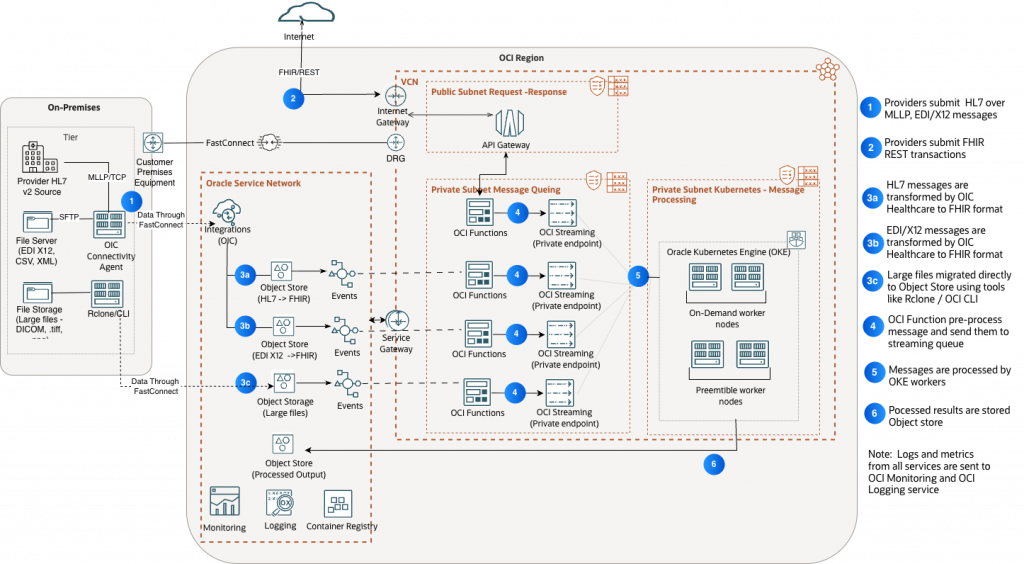
Pipeline Architecture Breakdown:
- Ingestion The architecture separates real-time APIs, HL7 messaging, batch files, and large-file intake into distinct paths.
- FHIR REST clients send messages through OCI API Gateway
- Real-time HL7 v2 messages from provider systems are received by Oracle Integration for Healthcare through the MLLP (Minimal Lower Layer Protocol) adapter running in the Oracle Integration Connectivity Agent, deployed in the provider network. Oracle Integration for Healthcare parses the HL7 payload, validates and routes the message, and uses configured mappings to transform it into FHIR or a canonical healthcare format. The transformed payload is written to the corresponding OCI Object Storage.
- Batch files—including X12 EDI, CSV, and XML formats—are processed via Oracle Integration (OIC) SFTP adapters, routing to the Healthcare extension for validation, FHIR transformation, and final delivery to Object Storage.
- Large binary and bulk files are migrated directly to OCI Object Storage using OCI CLI, SDKs, or file migration tools such as Rclone.
The traffic from on-premises travels over a private OCI FastConnect link, routing through the Dynamic Routing Gateway and Service Gateway to reach supported Oracle services without traversing the public internet.
- Serverless Orchestration File uploads to Object Storage initiate OCI Events, which trigger serverless OCI Functions. Object events must be enabled on the bucket for object-created events to be emitted. For latency-sensitive intake functions, provisioned concurrency can be configured to reduce initial invocation latency by keeping execution infrastructure available. These OCI Functions scale on demand during traffic spikes, subject to configured service limits and downstream capacity.
- Event Buffering OCI Functions publish normalized messages to OCI Streaming. For large payloads, the stream message contains metadata, correlation identifiers, and a reference to the payload stored in OCI Object Storage. This decoupled buffer helps protect downstream processing applications from being overwhelmed during traffic spikes.
- Stateless Processing OCI Kubernetes Engine (OKE) hosts containerized workers that consume from OCI Streaming. Worker pods can scale through HPA, KEDA or custom metrics based on stream lag and backlog, while the Kubernetes Cluster Autoscaler expands or contracts managed node pools when additional worker capacity is required.
- Durable Persistence Raw, transformed, and processed transaction payloads can be securely persisted in OCI Object Storage for auditable record-keeping, replay, and downstream analytics.
- Security & Monitoring Backend workloads run in private subnets. Access to supported regional Oracle services can be provided through OCI Service Gateway. Alternatively, private paths can use service-specific private endpoints depending on the target service. Telemetry is natively tracked using OCI Monitoring, OCI Logging, and OCI Events for proactive operational visibility.
How OCI Differentiated Capabilities Drive Performance and Cost Efficiency
The reference architecture uses several OCI capabilities that are especially valuable for high-volume, data-heavy healthcare transaction workloads. These capabilities help the platform scale with demand, preserve performance under bursty traffic, improve infrastructure isolation, and reduce avoidable cost.
Flexible VM Shapes for Right-Sized Compute
On OCI, compute resource allocation is measured in Oracle CPUs (where 1 OCPU equals 2 vCPUs on x86 hardware). Instead of relying only on fixed “t-shirt size” instance choices, such as small, medium, or large, OCI Flexible VM shapes allow engineering teams to customize OCPU and memory allocations within the limits of the selected shape.
This granular control is highly beneficial for healthcare pipelines because different processing stages exhibit highly distinct resource profiles. For instance, data enrichment and transformation tasks require massive memory to hold uncompressed patient records but don’t require heavy processor power. Using OCI Flexible VMs, you can configure a custom shape with exactly 2 OCPUs and a massive 64 GB of RAM. This allows you to give the application required memory capacity without paying for unneeded CPU cores. By tailoring your OCI infrastructure directly to these specific requirements, you eliminate the waste of over-provisioning and optimize your cloud spend.
Oracle Acceleron and Bare Metal Instances
Oracle Acceleron is a foundational piece of OCI’s high-throughput infrastructure fabric. It brings together network fabric, fabric accelerators, and host network accelerators to help offload key infrastructure functions from the compute host.
As a healthcare pipeline scales past basic ingestion into demanding operations—such as real-time fraud detection or large-scale HL7-to-FHIR data transformations—underlying hardware efficiency becomes critical. By handling core infrastructure tasks on the Oracle Acceleron SmartNIC, the architecture helps reduce host CPU overhead, leaving your compute resources available for healthcare workloads.
OCI Bare Metal Instances provide a dedicated, high-performance compute tier running directly on raw physical hardware. Because they run directly on dedicated hardware without a hypervisor virtualization layer, they avoid compute oversubscription and reduce noisy-neighbor risk for specialized workloads. This hardware tier is well suited for the heavy analytical stages of a healthcare pipeline. Engineers can start the pipeline with flexible OKE workers and later introduce a bare metal tier for specialized data engines, without redesigning the core intake and streaming flow.
Preemptible Instances for Cost-Optimized Burst Capacity
To manage compute costs during traffic peaks, OCI Kubernetes Engine (OKE) can utilize a hybrid node pool strategy. While standard on-demand worker nodes handle baseline traffic, lower-cost preemptible instances absorb temporary processing bursts.
Preemptible Instances behave like regular compute resources for supported workloads, but the capacity can be reclaimed and the instance terminated when OCI needs it elsewhere. They are best suited for stateless, idempotent, checkpointed, and interruption-tolerant consumers that can safely retry messages from OCI Streaming or a dead-letter path.
For implementation details, see the blog on Reducing your Kubernetes costs with preemptible nodes.
Reducing Data Movement Costs for Healthcare Pipelines
Healthcare pipelines move massive amounts of data: original payloads, processed records, status updates, metadata, and compliance logs. OCI’s network pricing model can help reduce data movement expenses:
- Free Intra-Region Movement: There is zero charge for moving data across availability domains or between services within the same region.
- Fixed Private Connectivity Cost: For FastConnect private virtual circuits, OCI does not apply separate inbound or outbound data-transfer charges. FastConnect port charges and any partner/provider charges may still apply.
Efficient Storage, Retention, and Volume Performance
Storing millions of historical medical transactions requires a balanced storage lifecycle. This pipeline leverages OCI Object Storage and OCI Block Volume to scale efficiently:
- Automated Lifecycle Policies: Move historical transaction records automatically from high-performance Standard Storage to low-cost Archive Storage tier for long-term retention. OCI Archive Storage provides the lowest-cost Object Storage tier and no retrieval fee; however, archived objects are offline, must be restored before access, and are subject to the applicable Archive Storage minimum retention policy.
- Elastic Block Volume Performance: If your nodes require high-performance persistent volumes, OCI’s Block Volume service lets you tune performance (Volume Performance Unit settings) independently of disk capacity. You can scale up performance during massive batch reconciliation runs and turn it down afterward, paying only for the performance you need when you need it. This elasticity allows you to scale up performance on demand, helping you only pay for high-throughput capacity when it is actively required.
Off-Box Virtualization and Isolated Network Virtualization
OCI’s off-box virtualization helps improve performance isolation and latency predictability. Traditional cloud architectures consume host CPU cycles to manage networking and storage virtualization overhead. OCI offloads key networking and infrastructure functions from the compute host to dedicated hardware.
In this reference pipeline, your OKE worker nodes can dedicate more host resources to application processing because OCI’s architecture offloads key virtualization functions from the host. This helps improve performance isolation and latency predictability under load.
Conclusion
Building a production-grade healthcare transaction pipeline requires balancing high responsiveness, infrastructure isolation, and strict cost control. By deploying a decoupled, event-driven worker architecture on OCI, organizations can absorb unpredictable transaction spikes while reducing the need to maintain large amounts of idle compute capacity.
Note: Production workloads that process Protected Health Information (PHI) must apply your organization’s specific controls for encryption, access governance, audit logging, and compliance. OCI provides the secure infrastructure foundation, while operations depend on how you implement and run those governance controls.
Reference links
- OCI Compute Shapes / Flexible VM shapes
- Private Access to Oracle Services
- Using Oracle Integration for Healthcare in Oracle Integration 3
- Use Migration Tools to Move Data into OCI Cloud Storage Services
- OCI Kubernetes Engine (OKE)
- Introducing the Next Generation of OCI Compute Shapes
- Bare metal instances with Oracle Acceleron