

Introduction
GPU workloads are becoming central to modern AI, machine learning, and high-performance computing environments. As teams scale training, inference, simulations, and shared GPU platforms, the orchestration layer becomes a critical design decision.
On Oracle Cloud Infrastructure, organizations often evaluate two approaches:
Oracle Kubernetes Engine (OKE) for Kubernetes-native AI platforms and application-centric GPU workloads.
Slurm for HPC-style scheduling, batch jobs, shared queues, and research-driven GPU clusters.
Why this topic matters
GPU infrastructure is expensive, highly utilized, and often shared across multiple teams. Choosing the right orchestration model affects:
- GPU utilization and Platform scalability
- Developer and researcher productivity
- Operational complexity
- Job scheduling and prioritization
- Integration with existing cloud services
- Support for production AI workloads
The decision is not only about running containers or submitting jobs. It is about selecting the operating model that best supports the organization’s AI and HPC strategy.
OKE overview
Oracle Kubernetes Engine is OCI’s managed Kubernetes service. It enables teams to deploy, manage, and scale containerized workloads using Kubernetes-native APIs and tooling.
For GPU workloads, OKE is well suited for:
- AI and ML platforms
- Model training and fine-tuning pipelines
- Inference services
- MLOps workflows
- Multi-tenant developer platforms
- Cloud-native applications that require GPU acceleration
OKE is a strong fit when teams want to standardize GPU workloads using Kubernetes, CI/CD pipelines, observability, autoscaling, and OCI service integrations.
Slurm overview
Slurm is a widely used workload manager and scheduler in HPC environments. It is designed for batch scheduling, shared compute clusters, job queues, reservations, and resource allocation policies.
For GPU workloads, Slurm is well suited for:
- Traditional HPC clusters
- Research workloads
- Large batch training jobs
- Multi-node simulations
- MPI workloads
- Queue-based GPU sharing
- Environments with established scheduler policies
Slurm is a strong fit when users primarily submit jobs to a shared GPU pool and rely on scheduling policies to manage access, priority, and utilization.
OKE vs. Slurm decision guide
OKE vs. Slurm GPU Deployment Decision Guide
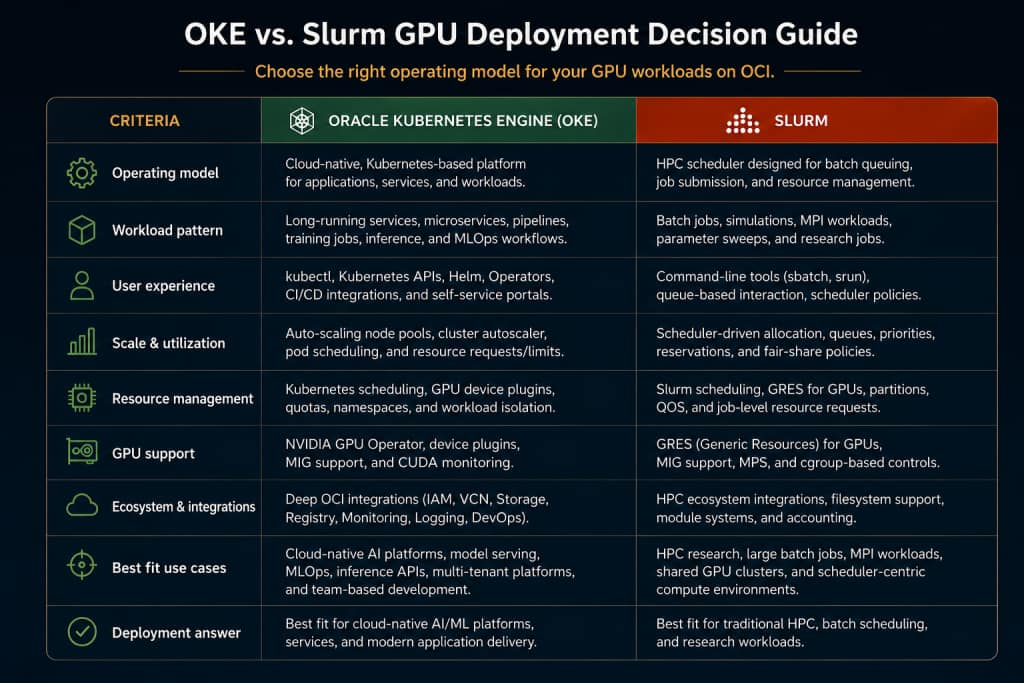
OKE is best for cloud-native AI platforms, persistent services, model serving, and Kubernetes-based workflows.
Slurm is best for HPC-style batch scheduling, research clusters, shared queues, and scheduler-driven GPU allocation.
When to choose OKE
Choose OKE when the GPU platform needs to support application-centric and cloud-native workflows.
OKE is the better option when:
- Teams already use Kubernetes
- GPU workloads are containerized
- AI workloads include APIs, services, pipelines, or inference endpoints
- Platform teams need integration with OCI services
- CI/CD and GitOps are part of the operating model
- The environment must support both long-running services and jobs
- Developers need self-service access to GPU-backed environments
- Workloads benefit from Kubernetes-native scaling and lifecycle management
OKE is especially valuable when AI workloads are moving from experimentation into production.
When to choose Slurm
Choose Slurm when the environment is centered around batch scheduling and shared research compute.
Slurm is the better option when:
- Users submit jobs through a scheduler
- Workloads are queue-based
- GPU access depends on partitions, priorities, and reservations
- The organization already has HPC workflows and job scripts
- Research teams need predictable batch execution
- MPI, simulations, and large scheduled jobs are common
- Scheduler policy is more important than application lifecycle management
Can OKE and Slurm coexist?
For many organizations, OKE and Slurm are not mutually exclusive.
A combined model can support different user groups and workload patterns:
- Slurm for research, simulations, and batch training
- OKE for AI platforms, inference services, pipelines, and production applications
This approach allows organizations to preserve existing workflows while building modern Kubernetes-native AI platforms on OCI.
From Architecture Decision to Production

As part of Oracle’s GPU engagements, Oracle GPU cloud architects work with AI platform teams, HPC teams, and infrastructure leaders to assess workload patterns, user personas, scheduling requirements, data flows, networking, storage, security, and operational maturity—helping customers determine whether an OKE-based, Slurm-based, or hybrid GPU operating model is the right fit. Oracle can then validate that decision through architecture reviews and proof-of-concept deployments using the OCI HPC OKE Stack for OKE-based GPU and HPC environments or the OCI HPC Stack for Slurm-based HPC and GPU clusters, evaluating representative workloads, GPU consumption, sizing, scheduling behavior, observability, and the path to production.
The goal is to give customers confidence that the platform they choose is not only technically correct, but sustainable for the teams that will build, operate, and consume it.
Conclusion
OKE and Slurm support different GPU operating models on OCI: OKE for Kubernetes-native AI platforms, production inference, MLOps, and cloud-native applications; Slurm for HPC-style scheduling, shared queues, reservations, and batch-oriented research or simulation workloads. The right choice depends on how customers operate their GPU platform—whether they prioritize self-service APIs, notebooks, pipelines, model-serving endpoints, CI/CD, and GitOps, or shared GPU pools governed by partitions, fair-share policies, and predictable batch scheduling. For many larger organizations, a hybrid model is the best fit: Slurm for research, simulation, and batch training, and OKE for production AI services, MLOps pipelines, inference platforms, and application teams. Oracle provides practical starting points for both approaches through the OCI HPC OKE Stack for Kubernetes-based GPU and HPC environments and the OCI HPC Stack for Slurm-based HPC and GPU clusters.
In the end, OKE versus Slurm is not a one-size-fits-all decision. It is an architecture decision shaped by workload behavior, user experience, scheduling policy, operational model, and long-term platform strategy. With OCI, Oracle’s reference stacks, and Oracle’s GPU architecture expertise, customers can choose the model that best fits their current workloads while maintaining the flexibility to evolve as their AI and HPC environments mature.