
Build Standards-Based Healthcare Applications for Connected Devices
Medical device manufacturers and digital health developers are expanding connected device ecosystems that span medical devices, remote monitoring systems, and companion applications. Turning data from these varied sources into interoperable healthcare information, however, can require teams to build and maintain custom integration layers, Fast Healthcare Interoperability Resources (FHIR) servers, and supporting infrastructure before they can focus on delivering differentiated device and software experiences.
Today, we’re pleased to announce Oracle Cloud Infrastructure (OCI) Device Data FHIR Service, a fully managed FHIR service that helps developers build standards-based applications for connected medical devices and AI-enabled healthcare workflows using versioned FHIR R4 and FHIR R6 REST APIs. Built on OCI and Oracle Autonomous AI Database, the service provides a managed foundation for storing, searching, and managing supported healthcare resources while integrating with the security, networking, monitoring, and operational services of OCI.
Whether you’re developing remote patient monitoring solutions, device connectivity platforms, medical device gateways, or digital health applications, OCI Device Data FHIR Service helps you limit time managing infrastructure and focus on building connected healthcare solutions.
Simplify healthcare interoperability
Connected device ecosystems generate data from many sources, including medical devices, gateways, mobile applications, and third-party platforms. Bringing this information together typically requires teams to deploy and operate their own FHIR infrastructure and keep it aligned with evolving interoperability standards.
OCI Device Data FHIR Service provides a managed FHIR server that supports healthcare applications through versioned FHIR R4 and R6 APIs. Developers can create, read, update, delete, and search supported FHIR resources, while administrators retain centralized control through OCI Identity and Access Management (IAM), networking, logging, metrics, events, and service operations.
This foundation provides a standards-based platform designed to help simplify the management of healthcare device data without requiring teams to operate their own FHIR server infrastructure.
Designed for modern healthcare applications
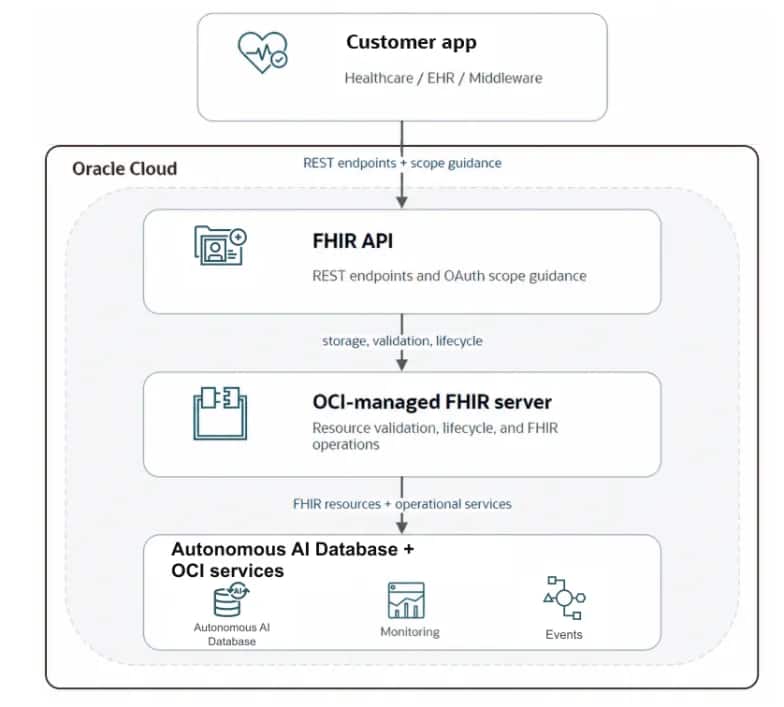
OCI Device Data FHIR Service provides the managed data layer for healthcare applications after source data has been mapped into supported FHIR resources.
A typical workflow includes:
- Mapping device or application data into supported FHIR resources such as patient, device, observation, encounter, location, or provenance
- Validating requests against FHIR requirements and enforcing resource- and operation-level authorization
- Storing and managing healthcare resources with lifecycle capabilities including version history, logical deletion, and controlled purge operations
- Searching data through supported FHIR search capabilities and, where supported, enabling FHIR R6 subscriptions for authorized Hypertext Transfer Protocol Secure (HTTPS) notifications
By managing these capabilities, the service can help development teams focus on application logic, integrations, and clinical workflows instead of maintaining FHIR infrastructure.
Why choose OCI Device Data FHIR Service?
Build for multiple FHIR versions
Healthcare interoperability continues to evolve, and organizations often need to support multiple FHIR versions. OCI Device Data FHIR Service provides separate FHIR R4 and FHIR R6 endpoints within a single OCI service, enabling developers to build version-aware applications while relying on published capability statements to understand supported resources, interactions, search parameters, and operations.
Limit operational overhead
Instead of deploying and maintaining FHIR servers, organizations can leverage a managed service built on OCI and Oracle Autonomous AI Database. Native OCI monitoring, work requests, logging, and service operations help simplify administration while enabling engineering teams to focus on delivering healthcare applications.
Support analytics and AI workflows
OCI Device Data FHIR Service is built on Oracle AI Database 26ai, which supports relational, JavaScript Object Notation (JSON), graph, vector, Internet of Things (IoT), and streaming data within a single converged database platform.
Because healthcare data is stored using standards-based FHIR APIs, organizations can use that data to support analytics and AI workflows, helping limit the need to maintain separate FHIR repositories or extract, transform, and load (ETL) pipelines.
Control healthcare data access
The service integrates with OCI security capabilities, including OCI IAM policies for infrastructure-level access control and OCI Identity Domains OAuth scopes for authorizing FHIR resource operations. OCI Networking and OCI Vault provide additional capabilities that organizations can use to control service access and protect credentials used for outbound notifications.
Build event-driven healthcare workflows
Healthcare applications often require timely access to changing information. Developers can retrieve data using supported FHIR search capabilities, including search parameters, pagination, version history, and versioned reads. For supported FHIR R6 deployments, SubscriptionTopic and Subscription resources enable authorized notifications that support near real-time healthcare workflows.
Use cases across connected healthcare
OCI Device Data FHIR Service supports a broad range of healthcare and medical device scenarios, including:
- Connected patient data to help deliver device observations to authorized care teams
- Connected clinical devices and gateways that capture measurements while preserving data provenance and helping limit duplicate observations
- Medical device manufacturer integrations that expose device inventory and patient observations to authorized applications through standards-based APIs
- Clinical orders, specimens, and laboratory workflows using interoperable FHIR resources
- Patient and equipment location workflows that help healthcare organizations track operational activity across clinical environments
These cases help healthcare developers to build interoperable applications using industry-standard FHIR APIs.
Get started today
Healthcare innovation increasingly depends on interoperable, standards-based data. OCI Device Data FHIR Service provides developers with a managed foundation for building standards-based healthcare applications that connect medical devices, clinical systems, and modern cloud services, helping organizations advance digital health initiatives while limiting operational complexity associated with managing FHIR infrastructure.
Administrators can get started by configuring OCI IAM policies, networking, service dependencies, and OAuth scopes, then creating an OCI Device Data FHIR Service instance in the Oracle Cloud Console. Once deployed, developers can begin working with versioned FHIR R4 or R6 endpoints to build healthcare applications using supported FHIR resources.
To learn more, explore the documentation, FHIR capability statements, REST API reference, security guidance, and sample code available with the service.
Resources
- OCI Device Data FHIR Service
- OCI Device Data FHIR Service documentation
Oracle does not endorse any specific product or solution built using Oracle Cloud Infrastructure services described on this page. OCI services are general-purpose platforms and are not intended to provide diagnostic or treatment recommendations. Customers are responsible for validating their products and solutions and ensuring compliance with any applicable regulatory requirements.