
Streaming Doubled the Operational Burden
The economics of both linear television and streaming continue to come under pressure. Media companies face pressure to reduce costs, simplify operations, and scale digital distribution without over-investing in infrastructure. At the same time, they are effectively being asked to run two businesses: a legacy, production-heavy media operation and a software-driven technology business built on an increasingly complex vendor ecosystem. All while producing more content and supporting more live events. Large broadcasters struggle with this challenge. For smaller Tier 2 and Tier 3 content owners, it’s even harder. This is why adding more vendors rarely works. It doesn’t reduce complexity, it creates more fragmentation.
Rather than replacing traditional broadcast workflows, streaming added a second operational stack that must be managed, monitored, and scaled alongside existing infrastructure. Supporting both traditional broadcast and an expanding streaming footprint is complex; it requires managing multi-partner workflows while handling rising content and distribution costs. The challenge is not only maintaining reliability but also evolving infrastructure and operations without introducing new layers of complexity or risk.
Oracle and Uplynk address this challenge with a unified on-prem and cloud architecture that gives content owners operational confidence without forcing a disruptive migration.
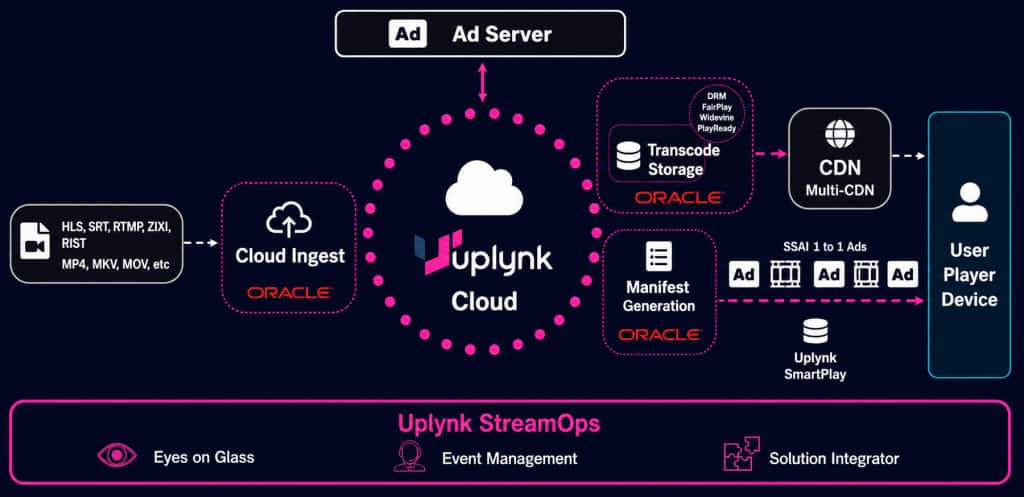
Core video workflows — encoding, storage, playout — run on Oracle Cloud Infrastructure (OCI), either on-prem or in-cloud, depending on organizational needs. Uplynk sits on top as the orchestration layer for live event streaming, VOD, and partner distribution, providing a single control plane regardless of where workloads run.
When combined with StreamOps, a fully managed streaming operations service, organizations gain the expertise and hands-on event support needed to deliver high-profile live events without building a large internal team.
Uplynk and Oracle help organizations:
- Stream live events with confidence through managed operations and real-time monitoring
- Reduce vendor coordination across complex, multi-partner workflows
- Operate streaming as a managed service rather than stitching together tools
- Modernize infrastructure incrementally — starting on-prem and expanding to cloud as demand grows, without re-architecture or retraining
The result is a more resilient and efficient streaming operation where teams focus on content and audience growth, not day-to-day platform management.
Use Case:
Problem: A regional news network needed to launch a direct-to-consumer streaming offering supporting live games and VOD, but had limited internal resources and existing on-prem encoding infrastructure tied to their broadcast operations. Building a fully cloud-native stack from scratch was too risky and expensive, but staying entirely on-prem couldn’t scale for digital distribution or planned FAST expansion.
Solution: Oracle and Uplynk delivered a unified on-prem and cloud architecture — keeping latency-sensitive encoding and playout workloads running locally on OCI while using Uplynk as the cloud orchestration layer for ingest, playback, and partner workflows. A single control plane across both environments meant no re-architecture or staff retraining. StreamOps provided fully managed live event operations with real-time monitoring and hands-on event support, eliminating the need to build a large internal streaming team.
Result: The customer launched on schedule without ripping out existing infrastructure or managing a multi-vendor stack. They launched using existing on-prem infrastructure, then incrementally shifted more capacity to the cloud as audience demand grew, reducing upfront capital spend while building a scalable foundation for live sports, on-demand content, and future FAST channels.
Authors:
Brendan Hourihan
Senior Product Manager, Uplynk

Ray Festa
Director of Solutions Engineering, Uplynk