


We are pleased to announce that Oracle Autonomous AI Database Serverless (ADB-S) is now generally available as part of Oracle AI Database@AWS, enabling customers to provision fully self-managing Oracle AI Databases directly from the AWS Console and pay using their AWS commitment.
This means teams can now run Oracle’s automated database service, one that handles its own patching, tuning, scaling, and security updates, natively inside AWS, with access to the AWS services they already use. ADB-S on Oracle AI Database@AWS is available today in U.S. East (N. Virginia) and U.S. West (Oregon), with support for Oracle AI Database 26ai and 19c.
The business case for autonomous database operations is well established. According to a 2025 IDC business value study of Oracle Autonomous AI Database customers, organizations achieved a 436% three-year return on investment with a payback period of just five months, driven by a 66% improvement in database administration team efficiency, a 48% gain in IT infrastructure team efficiency, and a 91% reduction in unplanned downtime. ADB-S on Oracle AI Database@AWS brings those same outcomes to teams running Oracle workloads in AWS.
Oracle Autonomous AI Database Serverless Key Use Cases and Benefits
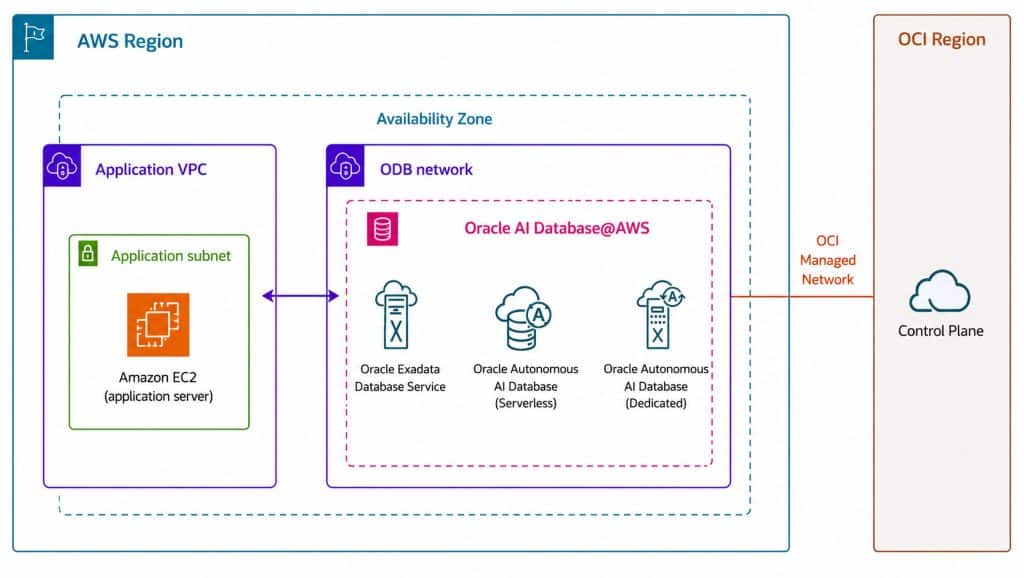
1. Oracle database migration to AWS with minimal friction. ADB-S gives organizations a direct path to bring Oracle workloads into AWS environments without re-architecting applications or retraining database teams. Because ADB-S runs the same Oracle AI Database that customers operate on-premises, existing PL/SQL code, applications and tooling will work with minimal modifications.
With ADB-S, customers can move from planning to deployment faster using AWS-native purchasing and provisioning options, secure connectivity models, and Oracle migration tooling.
- Provision ADB-S instances from the AWS Console, AWS APIs, or AWS CloudFormation using a Private or Public Offer (with support for Bring Your Own License (BYOL) and License Included options) and apply AWS credits toward usage;
- Secure ADB-S connectivity with flexible network access choices, including private endpoint, secure access from anywhere, or secure access from allowed IPs;
- Clone existing ADB-S instances or restore from backup to accelerate migration and testing timelines;
- Use Oracle Database Migration service to move on-premises Oracle databases to ADB-S with no production disruption;
2. Autonomous operations that free DBA teams from routine work. ADB-S automatically patches, tunes, and scales without downtime or human intervention. The IDC study found that DBA teams using Oracle Autonomous AI Database became 66% more efficient, with each DBA able to manage 8.7 more databases than before — freeing staff to focus on data architecture, modeling, and strategic work rather than maintenance.
- Automatic patching and upgrades apply without downtime or manual scheduling windows
- Automatic indexing and query tuning continuously optimize performance without DBA involvement
- Elastic autoscaling adjusts compute and storage independently in response to workload demand, so teams pay only for what they use
3. Four workload types, one managed service. ADB-S on Oracle AI Database@AWS supports four general workload types within a single service, eliminating the need to manage separate databases for different use cases. The IDC study found that organizations using Oracle Autonomous AI Database saw an 18% boost in developer productivity and 20% gain for analytics teams, with query execution times improving by 39%.
- Autonomous AI Transaction Processing: for OLTP applications, ecommerce platforms, booking systems, and mixed transactional and analytical workloads;
- Autonomous AI Lakehouse: for data warehousing, analytics, data lakes, and AI workloads, including open Apache Iceberg table access across clouds;
- Autonomous AI JSON Database: for document-oriented applications with MongoDB-compatible APIs and full SQL access;
- Oracle APEX Application Development: for rapid low-code application development, including applications with built-in AI functionality;
4. Enterprise-grade availability and disaster recovery. ADB-S on Oracle AI Database@AWS is built for mission-critical workloads that require continuous uptime. Oracle Autonomous AI Database delivers a 99.995% availability SLA, and the IDC study found a 91% reduction in unplanned downtime for organizations that adopted it, with mean time to recovery improving by 70%.
- Cross-region disaster recovery using Oracle Autonomous Data Guard, with manual switchover and failover across AWS regions
- In-region standby and automatic failover using local Autonomous Data Guard for cross-availability-zone resilience
- Automated backups are managed by the ADB-S service in AWS cloud
5. Real-time data access for AI and analytics workloads. ADB-S on Oracle AI Database@AWS enables customers to transform enterprise data into AI-ready insight with native vector search, agentic AI, and multi-modal capabilities, without custom integration or data movement.
- Oracle’s built-in AI Vector Search for retrieval-augmented generation (RAG) enables teams to search across both structured and unstructured data by semantics or meaning, to deliver more accurate and contextually relevant results
- Oracle’s built-in MCP Server enables AI applications to directly interact with the database using the MCP standard, eliminating the need for custom integration
- Select AI enables natural language queries on all your data and Select AI Agent makes it simple for organizations to develop, deploy, and use agentics workflows in the database
- Live AI Hub enables usage of AI on all your data across all your systems without data movement
- Oracle’s built-in, native support for JSON, graph, spatial, and vector data types allows teams to build multi-modal applications within a single managed database service
AWS Integration and Connectivity
ADB-S on Oracle AI Database@AWS connects directly with the AWS services and tools that operations and engineering teams rely on daily. Oracle AI Database@AWS runs on Oracle Cloud Infrastructure (OCI) inside AWS data centers, delivering low-latency connectivity to AWS services across the same region without data egress fees between Oracle and AWS services.
At general availability, ADB-S integrates with the following AWS services:
- Amazon S3: Automated database backups are stored in Amazon S3 by default, with support for immutable backups and configurable retention periods
- AWS Key Management Service (KMS): Customers can encrypt ADB-S instances using their own AWS KMS keys to meet data sovereignty and compliance requirements
- Amazon Zero-ETL: Change data capture streams database changes directly to Amazon Redshift for near real-time analytics without manual pipeline management
- Amazon CloudWatch: ADB-S metrics are available natively in CloudWatch for unified monitoring alongside other AWS workloads
- Amazon EventBridge: Oracle AI Database@AWS events surface in EventBridge, enabling automated operations workflows and alerting
- AWS Console, APIs, and CloudFormation: ADB-S instances are created and deleted through standard AWS interfaces; usage qualifies for existing AWS commitments and Oracle license benefits including Oracle Support Rewards
ADB-S instances can be co-located on existing Oracle Database Network (ODBN) infrastructure alongside Oracle Exadata Database Service deployments, sharing network resources across services.
Summary
Teams running Oracle databases today can now bring Oracle Autonomous AI Database Serverless — Oracle’s most automated, self-managing database service — directly into their AWS environment. ADB-S on Oracle AI Database@AWS eliminates routine database administration overhead for DBA and IT infrastructure teams, supports four workload types within a single managed service, and connects natively with AWS analytics and AI services including Amazon Redshift, Amazon S3, AWS KMS, Amazon CloudWatch, and Amazon EventBridge. According to IDC’s 2025 business value study, organizations running Oracle Autonomous AI Database achieved $4.9 million in average annual benefits per organization, a 436% three-year ROI, and a five-month payback period. ADB-S on Oracle AI Database@AWS is available today in U.S. East (N. Virginia) and U.S. West (Oregon).
Want to learn more?