




Karthik Gopalakrishnan
Senior Product Manager, Tech at Amazon Web Services
Oracle AI Database@AWS continues to evolve as a strategic multicloud platform for enterprise applications that demand both performance and resiliency. Oracle AI Database@AWS has now earned Platinum MAA certification and delivers application-to-database round trip latency (RTT) as low as 165 microseconds. In this blog, we will discuss the networking and performance improvements that enable sub-200 microsecond latency, share deployment recommendations for achieving optimal performance, and explain what Platinum MAA certification means for your mission-critical workloads.
Improved Application Performance with AWS High Performance Networking
For latency-sensitive workloads, application placement is one of the most important architectural decisions. Oracle MAA testing continues to show that network placement, operating system configuration, and application instance sizing all directly impact application response times.
The latest Oracle MAA evaluation incorporated Oracle AI Database 26ai availability enhancements, AWS High Performance Networking (EC2 placement groups), additional Oracle Database@AWS networking infrastructure enhancements, and updated Oracle MAA deployment guidance.
The evaluation also validated Oracle Database@AWS for Oracle MAA Platinum tier certification, reflecting disaster recovery RTO < 30 secs and RPO=0 or near zero for most applications. For the current certification status and scope, see the Oracle MAA Multicloud Certification Matrix
Together, these improvements delivered improved application-to-database latency characteristics (as low as 165 microseconds for RTT) while maintaining the availability and resiliency expected of Oracle MAA architectures. Oracle MAA testing was conducted using Amazon Linux 2023 on EC2 instances placed in the same Availability Zone as the Exadata VM Cluster, using AWS High Performance networking. The following table summarizes the observed results. Results reflect Oracle MAA validation testing conditions. Actual cross-region latency and throughput will vary based on Availability Zone placement, VM sizing, operating system configuration, network topology, and workload characteristics.

For the complete set of latest Oracle MAA validation results, including cross-Database cross-region tenancy, deployment recommendations, latency observations, and networking guidance, see Oracle Maximum Availability Architecture for Oracle Database@AWS.
Oracle MAA Recommendations for Low-Latency and High Availability Deployments
Based on Oracle MAA testing, customers seeking the lowest application latency should:
- Place application servers in the same Availability Zone as the database whenever possible.
- Use AWS High Performance Networking (EC2 placement groups) to optimize placement.
- Use direct ODB peering for application-to-database connectivity to minimize network hops
- Validate RTT latency against application service-level objectives before production deployment.
- Deploy multiple application VMs as required for high availability while ensuring placement continues to meet latency requirements.
- Enable Oracle Continuous Availability capabilities to minimize application interruption during planned maintenance and unplanned outages.
For customers deploying multiple application VMs across AWS accounts, AWS also supports sharing placement groups across AWS accounts, helping preserve optimized placement strategies for low-latency application tiers.
Why These Improvements Matter
Low application-to-database latency is critical for many enterprise workloads, including OLTP systems, ERP applications, financial services platforms, customer-facing digital services, and AI-enabled operational applications. The combination of improved networking performance, higher throughput Oracle Exadata performance and Oracle MAA best practices enable customers to to achieve these latency targets while maintaining the availability guarantees of MAA Platinum-tier architectures.
Oracle Exadata Database Service on Oracle AI Database@AWS Achieves Oracle MAA Platinum Certification
In addition to the networking improvements, Oracle Exadata Database Service on Oracle AI Database@AWS is now certified across the Oracle MAA Bronze, Silver, Gold, and Platinum tiers.
Platinum MAA certification validates that Oracle AI Database@AWS meets Oracle’s rigorous mission-critical availability architecture standards, delivering the automated recovery, application continuity, and operational discipline required for the most demanding enterprise deployments. For certification details, see the Oracle MAA Multicloud Certification Matrix.
Oracle MAA Certification Levels for Oracle Exadata Database Service on Oracle AI Database@AWS
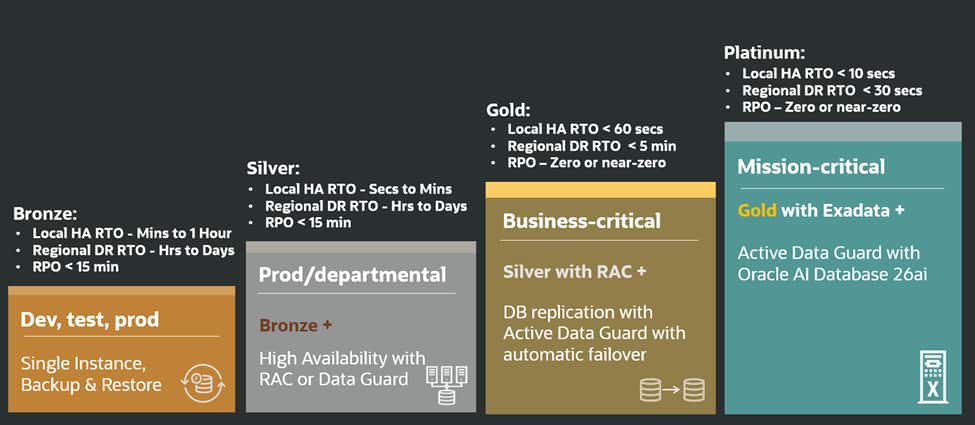
Note: Platinum tier builds upon the Gold tier architecture – it does not change the recovery time objective (RTO < 30 seconds) or recovery point objective (RPO = 0) established at the Gold tier. What Platinum adds is validated automation and operational best practices – such as Fast-Start Failover, Continuous Availability technologies, and end-to-end recovery testing – that help organizations consistently achieve those objectives without manual intervention.
What Platinum Tier Adds on Top of the Gold Tier
The Platinum MAA tier includes everything in the Gold MAA tier architecture, plus a stronger focus on Oracle AI Database 26ai, validation of Oracle AI Database 26ai availability enhancements, automation, and end-to-end recovery behavior.
Automated Disaster Recovery
Oracle Data Guard Fast-Start Failover (FSFO) enables automated failover for qualifying outages without manual DBA intervention. When configured with an Observer – a lightweight process that monitors primary and standby databases – FSFO detects failures and initiates failover within seconds, achieving recovery times of seconds to minutes depending on workload and transaction volume.
For Oracle AI Database@AWS deployments, FSFO supports both same-region (cross-AZ) and cross-region disaster recovery topologies. In cross-AZ configurations, the Observer can run on a separate EC2 instance in a third Availability Zone for maximum resilience. This automated approach eliminates the need for on-call DBA intervention during outages and provides predictable, consistent recovery behavior.
Continuous Availability for Applications
Platinum emphasizes the application layer as well as the database layer. Oracle technologies such as:
- Transparent Application Continuity
- Application Continuity
- Fast Application Notification (FAN)
- Runtime Load Balancing (RLB)
help applications continue through outages, maintenance operations, and role transitions with minimal disruption. When properly configured, in-flight transactions are automatically replayed on the surviving or new primary database, and end users experience no application errors or session drops.
Validated End-to-End Business Continuity
Platinum certification reflects Oracle MAA validation of the operational flow across the database, network, and application layers, including the behaviors needed for mission-critical business continuity.
Resources
- Oracle MAA Multicloud Certification Matrix
- Oracle Maximum Availability Architecture for Oracle AI Database@AWS
- AWS High Performance Networking for Oracle AI Database@AWS
- Oracle MAA Reference Architectures
- High Availability Overview and Best Practices
- Oracle Exadata Database Service on Oracle AI Database@AWS Achieves Gold MAA Certification
- Getting Started with Oracle AI Database@AWS
- Oracle Data Guard Concepts and Administration
To get started with Oracle AI Database@AWS, see Getting Started with Oracle AI Database@AWS. To configure high-performance networking and achieve sub-200 microsecond application-to-database latency, follow the steps in AWS High Performance Networking for Oracle AI Database@AWS. For detailed MAA architecture guidance including Data Guard configuration and disaster recovery setup, see Oracle Maximum Availability Architecture for Oracle AI Database@AWS.

Karthik Gopalakrishnan
Senior Product Manager – Tech at Amazon Web Services
Karthik leads product management for Oracle AI Database@AWS. He works with customers to run Oracle workloads on AWS with optimal performance and availability.