




Part 3 — Value and Sustainability
Series Navigation
- Part 3: Value and Sustainability (You are here)
Introduction
This article is Part 3 of a three-part series exploring how enterprises evaluate Oracle Cloud Infrastructure (OCI). If you would like to read the earlier parts, you can read Part1 and Part 2. Cloud platforms today are evaluated not only for infrastructure capabilities but also for their ability to support innovation and emerging technologies.
Organizations want to understand how their cloud platform will enable:
- Artificial intelligence and generative AI workloads
- Advanced data analytics
- Large-scale enterprise applications
- Integration with a broader ecosystem of tools and services
Enterprises are increasingly choosing platforms that allow them to innovate quickly while maintaining enterprise-grade security, reliability, and operational control. In this final part of the series, we explore the forward-looking questions enterprises ask when evaluating OCI’s ability to support AI, advanced data platforms, and future technology innovation.
FinOps / Cost Management
Q1: What native and third‑party tools do Oracle cloud Infrastructure (OCI) propose for?
- Q1a: Rightsizing (to address over‑provisioned compute and storage)?
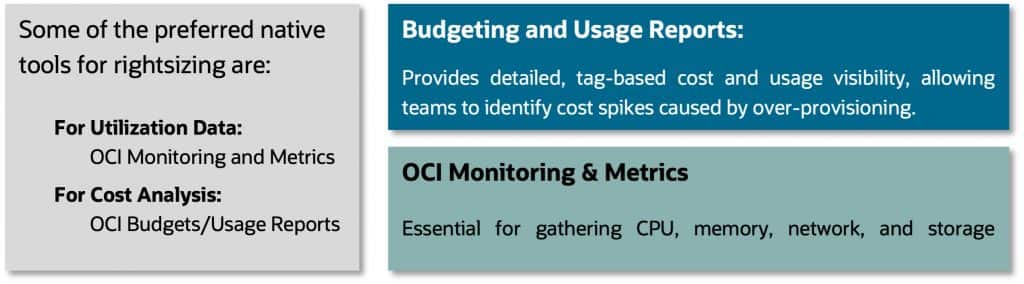
For compute rightsizing, OCI provides flexible and intelligent options to align resources with actual workload demand. Services like OCI Monitoring and Metrics and Cloud Advisor help identify underutilized instances by analyzing CPU, memory, and network usage over time, while Cost Analysis and Budgets highlight inefficiencies from a financial perspective. OCI’s flexible VM shapes allow independent adjustment of OCPU and memory, enabling precise tuning instead of over-provisioning fixed sizes. Features such as autoscaling with instance pools, burstable instances, and preemptible instances further ensure that compute capacity dynamically matches demand, reducing idle resources while maintaining performance.
For storage rightsizing, OCI offers multiple mechanisms to optimize both capacity and performance. Monitoring and Cloud Advisor can detect unused or underutilized block volumes and recommend cleanup or resizing actions. With Block Volume performance tuning, users can adjust performance levels (VPUs) independently of storage size, avoiding unnecessary cost. Object Storage lifecycle policies enable automatic tiering of data to lower-cost options like Infrequent Access or Archive tiers based on access patterns. Additionally, File Storage’s elastic scaling ensures that capacity grows only as needed, helping organizations avoid over-provisioning while maintaining efficient and cost-effective storage utilization.
Moreover, Cloud Marketplace offers preconfigured templates to optimize and deploy infrastructure.
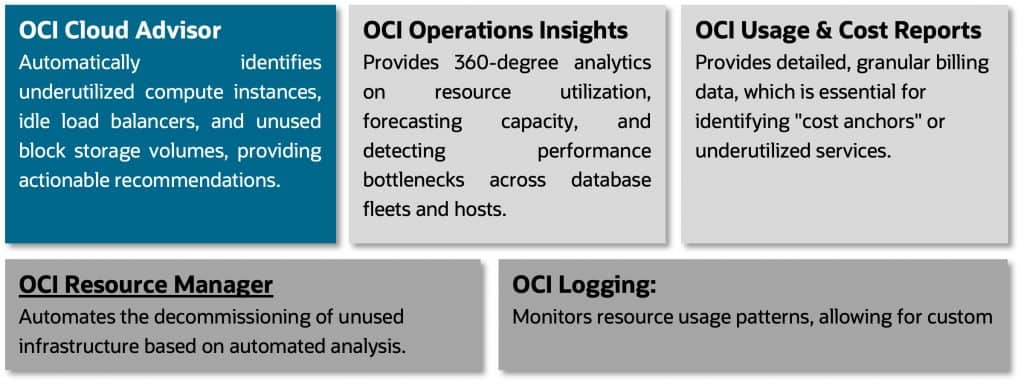
- Q1b: Identifying and eliminating idle or underutilised resources?
Native OCI Tools (Preferred for Native Integration & Cost) are given below.
- Q1c: Scheduling non‑production environments ?
For scheduling non-production environments in Oracle Cloud Infrastructure (OCI) to reduce costs, the preferred approach combines native OCI Resource Scheduler for simplicity with Infrastructure as Code (IaC) tools like Terraform for automation, supplemented by third-party optimization platforms for complex multi-cloud environments.
Q2: How do Oracle cloud Infrastructure (OCI) support ongoing FinOps practices to sustain cost reduction?
OCI supports a FinOps framework through continuous reporting, anomaly detection, and optimization dashboards. Alerts notify teams of budget breaches or unusual usage patterns. By combining tagging, usage monitoring, and automated recommendations, teams can implement a continuous improvement loop to sustain cost reductions over time (FinOps on OCI).
To effectively understand, analyze, and manage your costs, use Oracle Cloud Infrastructure (OCI) resources such as billing tools, the Cost Analysis visualization tool, and budgets.
Oracle Solution Playbooks and Oracle University courses also provide tips to manage your costs. In the Solutions Playbook Best practices for optimizing the performance and cost of cloud resources, see Understand and Optimize your Spending and Track and Manage Usage and Cost. The OCI Foundations course, available through Oracle University, includes short videos about pricing, cost management, and a demonstration of Cloud Advisor and cost management tools.
Q3: What reporting will Oracle cloud Infrastructure (OCI) provide (frequency, format, audiences) to track cloud spend, savings, and optimization opportunities at executive levels?
OCI provides comprehensive reporting to track cloud spend, savings, and optimization opportunities at both executive and operational levels. All visibility and insights are available through the Billing & Cost Management section of the OCI Console.
Key reporting areas include:
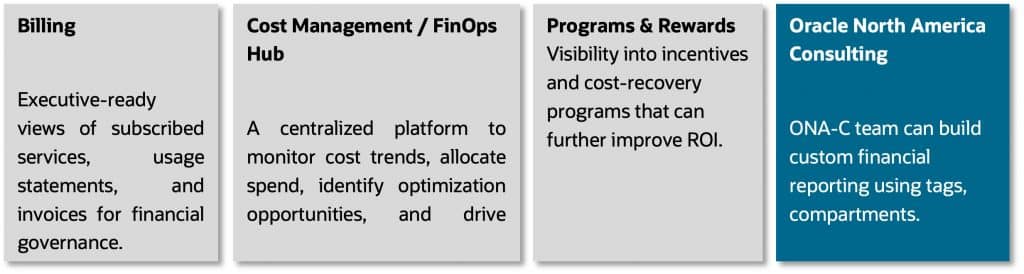
For more info on Programs and Rewards, please refer https://www.oracle.com/cloud/rewards/
Estimating Your Costs
Before you commit to an amount, it’s important to estimate how much it will cost to run your workloads on OCI. Use the Cost Estimator to help figure out your monthly usage and costs for Oracle services. You can also preload Reference Architectures to see the costs of a particular architecture.
Monitoring Your Cloud Spending
After your workloads are running on OCI, validate your cost estimates and monitor your cloud spending. Cost Analysis is an easy-to-use visualization tool to help you track and optimize your Oracle Cloud Infrastructure spending. The cost and usage reports can be used to obtain a breakdown of your invoice line items at resource-level granularity. The OCI Cost Governance and Performance Insights Solution, available through Oracle Cloud Marketplace, takes advantage of cost reports, Autonomous AI Lakehouse, and Analytics Cloud to provide a platform where you can develop your own reports.
Forecasting Usage and Costs
You can use Cost Analysis to estimate future usage and consumption information, based on past usage data.
Note: Forecasted values are just estimates based on past usage trends, and likely will differ from actual usage.
Controlling Costs
With a consumption based model, it’s critical for businesses to control their spending. Use a budget to set soft limits on your Oracle Cloud Infrastructure spending, and use compartment quotas to set hard limits on resource consumption.
Cloud Advisor finds potential inefficiencies in your tenancy and offers guided solutions that explain how to address them. Cost management recommendations are based on historical usage and can help you to maximize cost savings.
You can also find tips to manage your costs in the following blog posts:
- Use Quotas for Better Control and More Effective Cost Management in the Cloud
- Enforced budgets on OCI using functions and quotas
- How to be in control of your Oracle Cloud Infrastructure costs
Skills, Enablement and Ways of Working
Q1: What enablement program can Oracle cloud Infrastructure (OCI) offer to help customers through Plan, Design & Build, Move, and Operationalize phases, and how do OCI measure its effectiveness?
Oracle supports workforce enablement across the Plan, Design & Build, Move, and Operationalize phases through a structured, outcome-driven program anchored in the OCI Cloud Adoption Framework (CAF), which provides prescriptive guidance, reference architectures, governance models, and operating practices aligned to each phase of cloud transformation; this framework is complemented by free, role-based enablement and learning paths that upskill architects, platform engineers, security teams, and operators on OCI-specific implementation and operational best practices, with optional certifications to validate proficiency; effectiveness is measured through clear adoption metrics, including time-to-first-workload, migration velocity, reduction in architecture rework, operational stability (incident trends and automation coverage), and the degree to which teams independently operate and optimize OCI environments over time, ensuring skills transfer translates into sustained operational maturity rather than short-term dependency on external resources.
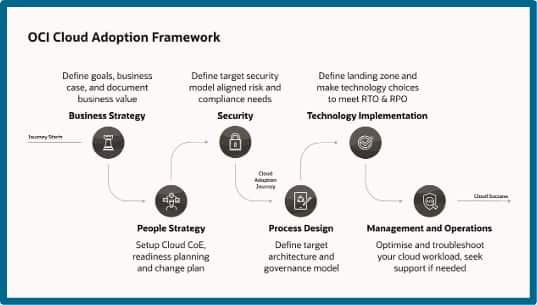
Fig. 2– OCI Cloud Adoption Framework
Q2: What training, certifications, labs and sandboxes can Oracle cloud Infrastructure (OCI) provide or fund for customer teams (architecture, DevOps, security, operations)?
Oracle provides a comprehensive, role-based enablement ecosystem spanning architecture, DevOps, security, and operations, including free, self-paced OCI training mapped to real-world job functions, with optional associate- and professional-level certifications to validate hands-on proficiency and accelerate skills transfer(Oracle MyLearn); this is complemented by OCI LiveLabs (LiveLabs), which offer free, guided, hands-on labs and sandbox environments that allow teams to work directly with real OCI services using production-representative scenarios across networking, compute, Kubernetes, security, automation, and data services—without requiring pre-provisioned customer accounts or long-lived resources. In addition, the Day and Beyond program extends this enablement journey by providing structured, outcome-driven engagements that guide customers from initial onboarding (“Day 1”) through optimization and scale (“Day 2 and beyond”), helping teams apply best practices, adopt well-architected frameworks, and operationalize workloads with confidence. Together, these programs have consistently helped enterprise customers reduce onboarding time, standardize architectures earlier in the migration lifecycle, lower dependency on external integrators, and achieve faster time-to-first workload and operational readiness, particularly in phased, multi-cloud transformations where teams must build confidence and autonomy incrementally.
| Discover | Build & Migrate | Run & Operate | |
| People | * Oracle Account Team | * Oracle Account Team * Cloud Engineering Services – a.k.a., CLS * Technical Program Management * Partners – Accenture | Wipro | TCS | * Technical Account Mgmt. – TAM/CSS * Cloud Success Services – Doc * 24/7 Support |
| Processes | * Cloud Migrations Services – Doc | Design * Cloud Adoption Framework – Doc * Architecture Center – Doc * New tenancy checklist – Doc | Security * Maturity Acceleration Program Optimize * OCI and ExaCS health checks |
| Technology | Compute * VMware virtual machines – RVTools * Matilda – Tech Brief Database * Automatic Workload Repository – AWR * Estate Explorer – Doc OCI * ShowOCI – GitHub | Security OCI Landing Zone – Doc Compute * VMware Migrations – HCX * Partners – Rackware | ZConverter| Commvault Databases * Zero Down Time Migration – ZDM On Premise / Cloud * Migration Hub – Doc * Cloud Deployment Design Deliverable – CD3 DevOps * DevOps Services – Doc | Security * Cloud Advisor – Doc * Compliance checking script – GitHub FinOps * Cloud Advisor – Doc * FinOps Hub – Doc * Usage2ASW – GitHub Fleet Management * Apps Perform Monitoring – APM * Operations Insights – Doc * OS Management Hub – Doc * License Manager- Doc * Network Command Center – Doc |
Q3: How do Oracle cloud Infrastructure (OCI) support the development of a cloud‑native culture (e.g. communities of practice, coaching, co‑delivery, embedding engineers) within client organisations?
Oracle supports the development of a sustainable cloud-native culture through a combination of community engagement, practitioner-led collaboration, and engineering-first co-delivery models, rather than one-time training interventions. At the grassroots level, teams are encouraged to participate in the Oracle Developer Community (Dev Community), where architects and engineers exchange patterns, operational practices, and real-world learnings with Oracle practitioners and peers, complemented by regular OCI community and customer events that facilitate cross-customer knowledge sharing and exposure to emerging capabilities(OCI events); at the organizational level, Oracle Cloud Customer Success Services (CSS) provides structured coaching, co-delivery, and—where appropriate—embedded engineering support during critical phases of migration and operationalization, enabling joint execution, tacit knowledge transfer, and the establishment of internal communities of practice that persist beyond the engagement. This combination of peer networks, engineering-led collaboration, and outcome-aligned delivery helps customers institutionalize cloud-native ways of working, rather than relying on transient external expertise.
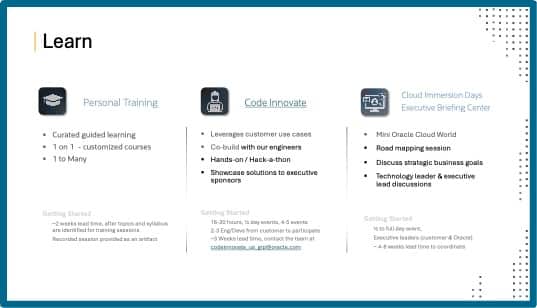
Fig. 3– OCI Learn
Data & Analytics
Q1: How will Oracle cloud Infrastructure (OCI) platform and services support customers data management and analytics strategy, including data governance, data lakes, warehouses, and AI/ML workloads?
Oracle Cloud Infrastructure supports enterprise data management and analytics strategies through an integrated but open platform spanning data lakes, governance, analytics, and AI/ML, designed to operate effectively in multi-cloud and phased-migration environments: OCI Object Storage provides highly durable (11 nines) and scalable, low-cost storage for building enterprise data lakes that can ingest and retain structured and unstructured data without capacity constraints (OCI Object Storage). OCI Data Catalog delivers centralized metadata management, data discovery, lineage, and governance to help organizations establish consistent data controls and trust across analytical and operational datasets (OCI Data Catalog); for analytics and AI-assisted decision making, Oracle Analytics offers a complete platform supporting business users through advanced analysts, with embedded AI/ML to accelerate insight generation and reduce time to value (Oracle Analytics); for modern lakehouse and AI workloads, the Oracle Autonomous AI Lakehouse combines Oracle Autonomous Database with open, vendor-independent Apache Iceberg, enabling interoperable data access and analytics across OCI, AWS, Azure, Google Cloud, and Exadata Cloud@Customer—supporting long-term portability and avoiding data lock-in (Autonomous AI Lakehouse); and at the core, Oracle AI Database 23ai/26ai (depending on deployment timing) brings AI directly to enterprise data through built-in vector search, ML, and generative AI capabilities, allowing customers to run analytics and AI workloads close to their data with enterprise-grade security and performance (Oracle Database). Together, these services provide a governed, open, and AI-ready data foundation that supports incremental adoption while preserving multi-cloud flexibility and future choice.
Q2: What cloud‑native analytics and AI services do Oracle cloud Infrastructure (OCI) recommend for customer use cases, and can OCI share customer examples with measurable business outcomes?
Oracle recommends a cloud-native analytics and AI architecture that combines open data foundations, managed analytics, and enterprise-grade AI services, selected through a joint architecture review to ensure alignment with cost, performance, and phased multi-cloud objectives: OCI Object Storage and the Oracle Autonomous AI Lakehouse provide a governed, Apache Iceberg–based lakehouse foundation for large-scale telemetry, event streams, and customer interaction data, enabling analytics and AI workloads to operate across OCI and other hyperscalers without data lock-in (Autonomous AI Lakehouse). Oracle Analytics delivers self-service analytics, embedded dashboards, and AI-assisted insight generation for product, operations, and executive teams, reducing time-to-insight and dependence on custom BI pipelines (Oracle Analytics); and for advanced ML and generative AI use cases—such as behavior modeling, anomaly detection, personalization, and developer productivity—OCI Data Science and OCI Generative AI provide managed notebooks, MLOps, GPU-backed training, and secure model serving close to enterprise data Data Science and Oracle Generative AI. Customers adopting this architecture have achieved measurable outcomes, including double-digit reductions in analytics infrastructure costs, materially faster model development and deployment cycles, improved operational reliability through real-time anomaly detection, and reduced cross-cloud data movement costs, with validated examples across SaaS, digital services, and large enterprises documented in Oracle customer success stories.
How OCI Delivers AI Innovation
Oracle’s AI Bet
In 2020, we had a couple of individuals from the “Attention is All You Need” paper test OCI and informed us that OCI’s GPU infrastructure was more performant for training a large language model than any system they had used before. We learned that because of OCI’s bare metal server design and network optimizations of our A100 GPUs, OCI’s clusters had four times the network throughput of AWS and sixteen times the network throughput of GCP’s clusters. We quickly built a rapid growth AI infrastructure business with the likes of Character AI, Adept, and MosaicML as early customers.
To achieve scale, we approached NVIDIA with an idea to expand their “AI foundry” business to offer an NVIDIA-supported “cloud service” to end customers, and after several meetings with Jensen, NVIDIA Supercloud was born, now called DGX Cloud. We provided NVIDIA with the same services that we had the initial AI startups, except we began to achieve real scale with twelve thousand GPUs in a single cluster. Prior to that, cluster sizes in 2020 and early 2021 were limited to 512 GPUs in a single RDMA fabric.
The scale up continued, with public customers like Cohere and NVIDIA signing up for massive clusters with OCI. At our Cloud World conference in 2024, OCI announced our ability to scale our cluster networks to more than one hundred thousand GPUs on a single spine. On the same day, we announced OpenAI as a marquee customer.
From the periphery, OCI’s AI bet is simple: use Oracle’s engineering depth to provide the best-performing AI infrastructure in the world, and the top AI companies will gravitate towards OCI. However, there have been half a dozen critical bets made along the way:
| 1. Max performance, no shortcuts: | Every design decision we make is grounded by a maximum performance principle. Our network designs on both the front end and back-end network are fully non-blocking. Our server designs do not maximize for Oracle’s profit but instead maximize for total GPU performance – a great example is rack density. For example, instead of prioritizing rack density at the expense of compute capability, we avoid power-capping GPUs—preserving full performance during large-scale training workloads.Our customers consistently share that OCI outperforms other providers on pure performance. |
| 2. Commit top engineers to on-going support: | Running any performant AI infrastructure is hard; running thousands of GPUs on a single ethernet spine is near impossible without unwavering commitment to engineering and support. OCI’s engineers have seen every type of model and every training stack. We dedicate this engineering team to learn our customer’s workloads and to optimize our infrastructure to meet performance. A recent example is thermal monitoring. We discovered in one data center that having humans in hot aisles could drop model performance (MFU) by 5-10%, and we only found this because we built a tool with our customer to constantly monitor their MFU. OCI’s top executives engage in the day-to-day of OCI’s GPU business, frequently meeting with customers on current and future technical requirements. |
| 3. Prioritize a sustainable AI infrastructure business: | Not only are GPU clusters difficult to manage and to achieve acceptable performance, but they are also expensive. Most providers use a five- or six-year depreciation cycle for hardware. Combine this with NVIDIA’s 12–24-month release cycle of new hardware that regularly doubles performance and it is easy to lose money on GPUs. 98% of OCI’s GPUs are in three, four, or five-year reservations. Creating a sustainable infrastructure business in 2023 allowed OCI to aggressively secure additional power and space that arrived in 2025. Now, OCI has some of the most liquid-capable megawattage for 2026, enabling us to deploy the latest generation of compute from NVIDIA. |
| 4. Collaborate with the best: | OCI has made a habit of building alongside those at the forefront of AI. NVIDIA is a great engineering partner, often helping steer OCI’s future roadmap of services like a managed high performance storage system. However, just partnering with NVIDIA is not enough. NVIDIA has an infamous “NVIDIA reference design” that many boast to follow, but there is not a single “reference design” but thousands of different configurations, ranging from low performance to maximum performance. Having an ecosystem of innovative AI customers like xAI, OpenAI, and Cohere helps OCI make the right design decisions. |
| 5. Small ecosystem of amazing customers: | OCI’s mission is not to have thousands of customers using A100s. We intentionally have a customer base in the low hundreds and do not have a “one to many” business model. We provide better, dedicated support and ultimately better performance by maintaining a small, highly skilled set of customers. |
| 6. Preference for open vs. proprietary: | OCI has been optimizing network infrastructure for more than two decades. We were one of the biggest customers of InfiniBand. However, we were opinionated about building RoCEv2 ethernet GPU clusters for the past several years and our bet has turned out to be successful. Now, we can support both InfiniBand and RoCE, but the principle of open vs proprietary systems prevails within OCI. We support any of the open frameworks on our AI infrastructure. All the “proprietary” services we have at OCI are built using open-source tooling, so you can port workloads somewhere else if you can get better performance elsewhere. |
These bets solidified OCI as a market-leader for AI infrastructure, and it is the success of our customers that continue to propel this business forward. This is a small industry. Treating our customers right has always been a priority. We can put you on the phone blindly with any of our customers and receive a good recommendation about OCI and the engineers our customers partner with daily.
This next phase of AI infrastructure is going to be much more difficult than the last. NVIDIA’s Grace Blackwell GPUs are an entirely new architecture, the hardware racks are ten times denser than the previous generation, and liquid cooling is a requirement for max-performance builds. OCI will be solving for all these new technologies, but each presents a new risk. There are an increasing number of newcomers seeking to provide AI infrastructure. If you are going to bet a business on an infrastructure partner, bet on OCI. Oracle has invested billions in AI infrastructure, pushed into new frontiers of scalability, hired top engineering talent, and consistently driven success for all our customers.
Q3: How will Oracle cloud Infrastructure (OCI) help customer manage data classification, retention and lifecycle in a multi‑cloud context while staying compliant with data protection regulations?
Oracle supports data classification, retention, and lifecycle management in multi-cloud environments through a policy-driven, standards-aligned approach that embeds governance directly into platform services while preserving portability: Oracle Data Safe provides automated discovery and classification of sensitive data, continuous risk monitoring, auditing, masking, and security assessments for Oracle databases, forming the control plane for regulated data regardless of where workloads are incrementally migrated (Data Safe); for unstructured and lake-based data, OCI Object Storage Lifecycle Management enables rule-based tiering, archival, and deletion aligned to retention policies and cost targets (Lifecycle Policy),while Object Storage Retention Rules deliver immutable, WORM-compliant controls to satisfy regulatory retention and legal hold requirements (Retention Rules); to safely synchronize and protect data moving across clouds, OCI Data Integration orchestrates governed data pipelines and transformations (Data Integration ), and Autonomous Data Guard provides automated replication, backup, and failover with built-in security and compliance controls (Autonomous Data Guard ). Together, these capabilities enable customers to enforce consistent data governance and regulatory compliance across OCI and other hyperscalers, while maintaining clear data lineage, lifecycle automation, and auditable controls throughout a phased, multi-cloud adoption.
Sustainability
Q1: What are Oracle cloud Infrastructure (OCI)’s current and target commitments around renewable energy, carbon neutrality/net‑zero, and how do these apply to the regions and data centres customer would use?
Oracle is committed to delivering a clean and energy-efficient cloud across all OCI regions. Our global strategy focuses on expanding renewable-energy use, reducing carbon emissions, and operating highly efficient data centres — benefits that extend directly to the regions and facilities you would consume.
Oracle’s renewable-energy strategy and clean-cloud approach are detailed here:
Our carbon-neutrality framework, including how emissions are calculated and reduced across OCI operations, is documented here:
In summary, OCI regions operate under consistent global sustainability standards, ensuring your workloads run on an infrastructure built with strong renewable-energy commitments and a clear path toward carbon-neutral and net-zero goals.
Q2: Can Oracle cloud Infrastructure (OCI) provide tooling and reports that show the carbon footprint and energy efficiency of customer workloads, and how OCI platform compares to typical on‑premises baselines?
OCI provides built-in Emissions Management tooling that gives you clear visibility into the carbon footprint and energy efficiency of your workloads, along with comparisons against typical on-premises baselines. These reports are accessible directly from the OCI Console under:
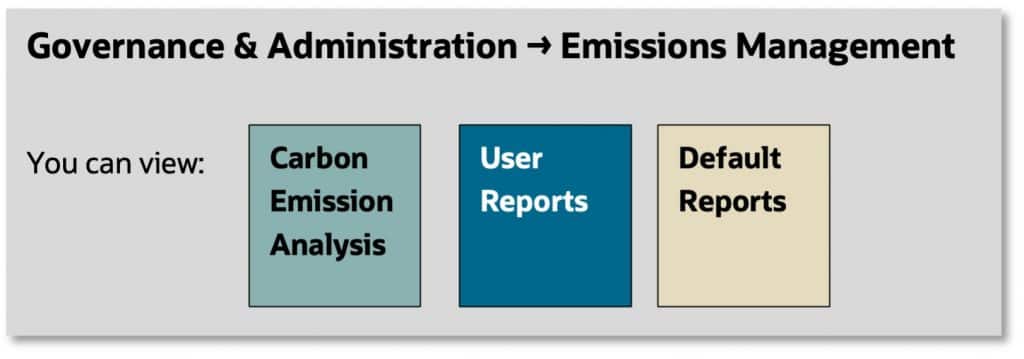
These insights help you understand workload efficiency, track cloud-related emissions, and benchmark against traditional on-prem environments. More details are available here
Q3: What concrete features or practices (e.g. carbon‑aware computing, energy‑efficient hardware, optimised cooling, e‑waste programmes) can Oracle cloud Infrastructure (OCI offer that help customer reduce their environmental impact while optimising cost?
OCI is built with sustainability and cost efficiency at its core. Oracle incorporates several concrete practices that help customers reduce environmental impact while optimising cloud spend, including:
Oracle’s detailed technical guidance on how OCI emissions are calculated can be found here
Q4: How have Oracle cloud Infrastructure (OCI) supported customers in meeting their sustainability targets through cloud migration and optimisation, and can OCI provide case studies with metrics?
Oracle has supported customers in meeting sustainability targets through cloud migration and optimization by helping organizations significantly reduce their carbon footprint and resource usage compared to traditional on-premises deployments.
A third-party use case conducted according to ISO 14064-1 standards showed that migrating enterprise workloads to Oracle Cloud Infrastructure resulted in up to a 93% reduction in greenhouse gas emissions compared to a customer’s hosted environment—driven by higher utilization, more efficient infrastructure, and reduced embodied emissions from hardware lifecycle impacts.
In addition, industry research reflects measurable sustainability benefits when organizations move to modern cloud platforms like OCI, including reductions in Scope 1, Scope 2, and Scope 3 emissions as part of broader cloud migrations.
Oracle also collaborates with partners such as Equinix to accelerate responsible digital transformation, combining efficient cloud delivery with infrastructure connectivity that supports sustainability goals.
For more context on how Oracle measures and reports environmental performance, refer to the technical guidance here
Here is a blog that show how Oracle along with one of its partners helping to meet their sustainability targets:
Conclusion
Selecting a cloud platform is one of the most important strategic decisions an organization makes. Beyond infrastructure, enterprises are looking for a foundation that supports innovation, scalability, and long-term digital transformation.
Across this three-part series, we explored common enterprise questions around:
- Strategic and commercial considerations
- Architecture and operational design
- Value and Sustainability
These discussions highlight that cloud adoption is not just about migration. It is an opportunity to rethink architecture, optimize economics, and unlock new possibilities with technologies such as AI and advanced data platforms.
If you missed the earlier parts of the series, you can read them here:
Part 1 of 3 — Strategic and Commercial Considerations
Part 2 of 3 — Architecture and Operational Design
Together, these articles provide a comprehensive look at how organizations evaluate and build their cloud strategy using Oracle Cloud Infrastructure.