

Oracle Access Governance: Latest Updates (Oct ’25)
Oracle Access Governance remains committed to delivering best-in-class identity governance with continuous enhancements. With its latest updates, Oracle Access Governance furthers its mission to empower business and security owners to configure and maintain robust identity governance, reduce risk, and streamline compliance.
Approval and Revision Management for High-Impact Updates
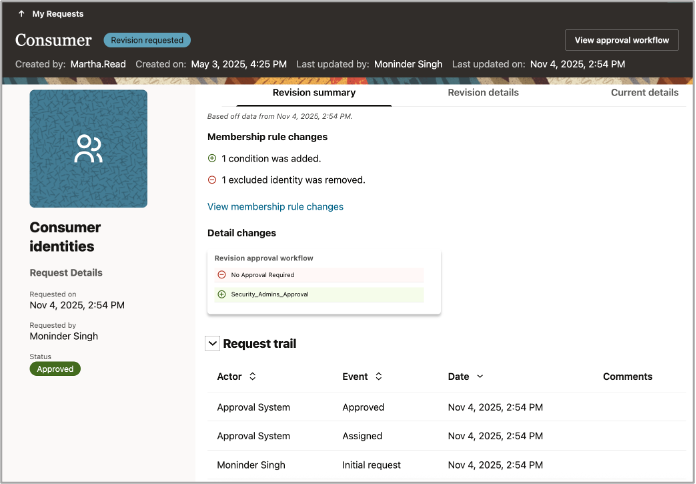
Oracle Access Governance brings organizational security discipline by safeguarding critical constructs—such as Organizations, Identity Collections, and license rules—against unintended changes. Through a controlled change process, every modification to these sensitive constructs must be explicitly approved before it takes effect, ensuring that updates are fully authorized.
Owners can update the constructs and submit request for approvals. Approvers are empowered to approve, reassign, or reject change requests, while requesters and proposers maintain full visibility into the status and progress of their requests. In addition, comprehensive revision trails enable owners to view previous versions, track detailed revision histories, and audit approval actions to support compliance and traceability needs.
Benefits:
- Brings in discipline with at least 4-eyes authorizing changes to avoid unauthorized and accidental changes to high-impact constructs
- Provides full auditability and transparency for compliance
Product documentation: Revision Management in Oracle Access Governance.
Circuit Breaker for Accidental Deletion
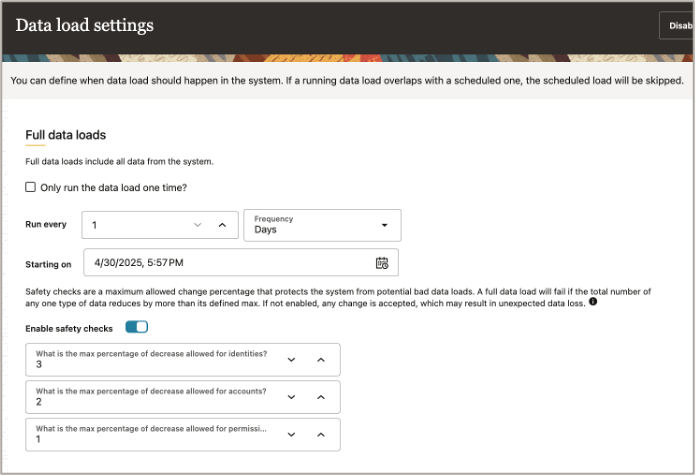
Oracle Access Governance introduces a robust circuit breaker feature to protect against accidental data loss when synchronizing identity and access data from integrated systems. This safeguard enables administrators to set precise thresholds for allowable changes to identities, accounts, and permissions during data loads.
For instance, if there is an unintentional or excessive deletion of identities in an authoritative source, Access Governance automatically halts the data load process when the reduction in identities from the authoritative source exceeds the configured safety threshold, thereby preventing identities from losing access to managed systems integrated with Access Governance. Additionally, if the changes are intentional, but the volume is high, this feature helps in splitting the changes in multiple batches to be handled across managed systems in a controlled fashion.
Benefits:
- Acts as a safety net to prevent accidental mass deletion or loss of identities
- Control the number of changes being pushed to managed systems
- Ensures data integrity and minimizes operational risk
Product documentation: Configure Safety Checks for Orchestrated Systems.
Self-Service Enablement via Access Governance APIs
Oracle Access Governance enhances enterprise flexibility by providing APIs that enable seamless integration with popular third-party solutions such as ITSM tools (e.g. ServiceNow), home-grown dashboards, custom apps etc. These APIs allow organizations to access the Access Catalog directly, giving users the convenience of submitting access requests and obtaining approvals directly from a familiar platform or corporate portal.
Throughout the entire process, critical controls such as Separation of Duties (SOD) checks are enforced by Access Governance guardrails to ensure compliance. Once a request is approved, the application can make API calls for Access Governance to perform the provisioning or fulfilment actions, thus, externalizing workflows. Furthermore, end-to-end visibility is assured, as request status updates are synchronized back keeping users and administrators informed.
Using Access Governance console is the recommended approach for self-service as it provides insights and modernized user experience.
Benefits:
- Centralizes and streamlines access request process
- Maintains full visibility and access request trails across platforms
Product documentation: AG REST Endpoints
Organization-Based Access Control
Organization-Based Access Control in Oracle Access Governance enables organizations to strengthen security and operational efficiency by tying access permissions and request visibility to a user’s organizational membership. With granular settings, application teams can restrict the availability of sensitive access bundles so that only users within designated departments or organizational units can view or request them. This ensures that employees, contractors, or designated proxies can only submit self-service or delegated access requests for bundles that are expressly allowed for their or the target user’s organization. For example, if certain access bundles are intended solely for the Finance department, only members of the Finance organization will have permission to see and request those access bundles, thereby preventing users from other departments from accessing sensitive resources inappropriately.
Benefits:
- Supports organization-specific security policies
- Minimizes risk of unauthorized access requests
Product documentation: Request Access
Access Guardrails for Identity Collections
Access Guardrails for Identity Collections in Oracle Access Governance empower organizations to dynamically enforce policies for identity collection memberships. Administrators can establish flexible constraints based on a variety of criteria, such as specific identity attributes (for example, requiring users to have completed certain training before being granting membership to specific identity collection). These guardrails apply comprehensively to both new and existing members of identity collections, as membership evolves. In addition, the risk management capabilities allow organizations to automatically block identity collection memberships that pose high-risk access concerns or raise violations for low-risk scenarios requiring further review.
Benefits:
- Reduces security risks related to attribute-based and policy-based access control
- Preventive and detective violation scans ensuring continuous compliance
Product documentation: Access Guardrails- Enforcing preventive access control
Expanded Identity Orchestrations and Integrations
A major enhancement in this release is the introduction of Virtual Systems for orchestrated integrations. This powerful feature enables organizations to represent and manage multiple resources or domains as logical subsystems within a single orchestrated system. With Virtual Systems, administrators can group several resources together for unified provisioning and policy governance, while also maintaining the flexibility to map, review, and manage each resource individually within a cohesive governance framework. Currently, Virtual Systems support is available for flat-file-based integrations. For example, if your enterprise has three disconnected applications – App-1, App-2, and App-3 – without virtual systems, each application requires a separate flat-file integration. With virtual systems, you can configure a single flat-file integration, enabling centralized management for all three applications.
In addition, Oracle Access Governance continues to broaden its integration capabilities to streamline identity management across the enterprise. The latest updates introduce new out-of-the-box integrations with multiple applications and systems, including Oracle EPM, OTM, GTM, Unity, Infinity, CPQ, and APEX—enabling organizations to seamlessly extend governance and compliance controls to a wider range of platforms.
Benefits:
- Efficient onboarding and comprehensive oversight of complex application environment
- Expands out-of-the-box integration to key Oracle and third-party platforms
Product documentation: Understanding Virtual Systems
To learn more about how Access Governance can strengthen your identity governance and compliance programs, explore the resources below or reach out to your Oracle team for a tailored walkthrough
- Oracle Access Governance product tour
- Oracle Access Governance datasheet
- Introduction to Oracle Access Governance (Oracle University)
- What’s New in Oracle Access Governance
- Oracle Access Governance introduces next-gen access dashboard and more integrations (blog post)
- Oracle Access Governance optimizes identity orchestration and enables unlimited integrations with generic connectors (blog post)
- Oracle Access Governance adds support for OCI group membership reviews, orphan account management, and more integrations (blog post)
- Oracle Access Governance adds identity lifecycle management and expanded targets (blog post)