
Building something useful with AI is getting easier. Managing everything that gets built is getting harder. Across the business, people are writing prompts, automations, and agents for their own work, often without knowing whether the same capability already exists.
The next phase of AI adoption isn’t just about creating more. It’s about deciding what should stay personal, what should be reused, and what needs to be governed so teams can avoid duplicating effort and scale AI more efficiently.
That matters for cost as well as productivity. Every duplicated integration, workflow, or agent takes time to build and maintain, while growing AI usage can make the underlying costs harder to understand and manage.
A more efficient approach starts with understanding the role of agents, tools, and skills, where each one fits.
One-Off AI Projects Don’t Scale
A data scientist may build a workflow to prepare training data, compare model outputs, or evaluate model performance. An AI developer may build an agent that needs to retrieve open invoices from ERP, pull account details from CRM, or fetch metrics from an analytics system. A data leader may use AI to surface data quality issues, trace lineage, or monitor operational and governance metrics.
The challenge is that these efforts often happen independently. Different teams may recreate similar logic, connect to the same systems, or build overlapping capabilities without knowing what already exists.
At the same time, IT and AI leaders may have limited visibility into what’s been built, what data it uses, who owns it, and whether it’s safe to scale. As AI use expands, duplicated integrations, infrastructure, and development effort can also make costs harder to understand and manage.
Deciding Which AI Components to Reuse
Not every useful AI interaction needs to become an agent. A chat or prompt may be enough for a one-time task. But when people across teams carry out the same task or workflow, rely on the same enterprise systems or data, or repeat the process regularly, it may be worth turning that work into a reusable capability.
The key question is what should stay personal, what should become reusable, and what should become a governed agent.
Agents, Tools, and Skills: What’s the Difference?
Agents, tools, and skills play different roles, and understanding those differences helps teams decide what to build and what to reuse.
Agents
An agent is designed to carry out a defined, repeatable task or workflow. It interprets a request, uses context, and can call other capabilities to complete the work. Use an agent when the work requires reasoning or coordination across multiple steps.
Tools
A tool performs a specific action for an agent, such as retrieving customer information from another system, converting a file to PDF or sending an email. In many cases, tools can be exposed through MCP servers, which provide a standard way for agents to access external capabilities.
Skills
A skill captures reusable know-how for handling a type of task well. It can include guidance, rules, checks, and steps that help an agent decide how to approach the work, and it may use one or more tools along the way. For example, a report-writing skill could define how to structure the report, what information to include, which checks to perform, and what tone or format to use.
Example: Following Up on an Overdue Invoice
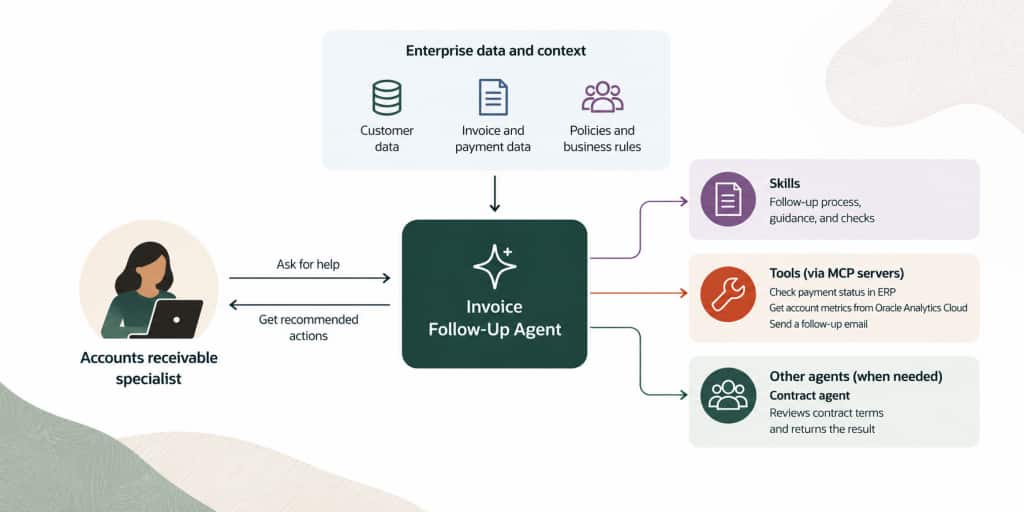
Consider an accounts receivable specialist who sees that an invoice is overdue and needs to decide what to do next. The specialist can ask an invoice follow-up agent for help.
The agent can use customer, invoice, and payment data from relevant applications, together with business context such as account history and company policies. It could then call a collections skill to apply the company’s follow-up process and use tools exposed through MCP servers to check the latest payment status in ERP, retrieve account metrics from Oracle Analytics Cloud, or send a follow-up email.
If the next step requires approval, the agent can bring the specialist back into the process before taking action, such as sending a customer communication.
If the invoice is overdue because of a contract dispute, the invoice follow-up agent could use Agent2Agent (A2A) to work with a specialized contract agent that reviews the relevant terms and returns the result. The invoice follow-up agent can then use that result to decide the next step without taking on contract analysis itself.
Define a Clear Scope for Each Agent
A useful principle is to give each agent a clear, bounded responsibility. If an agent is too broad, it can become difficult to govern, test, route, and improve. If it’s too narrow, teams can end up creating unnecessary agent sprawl.
Each agent should be focused on delivering a clear business outcome and can use multiple tools and skills to support that work. There’s no need to create a new agent for every step in a workflow.
Separate agents make more sense when the work requires different business context, permissions, systems, ownership, or evaluation criteria. A finance agent and a sales agent, for example, may use some of the same tools or skills, but they don’t need to be combined simply because they share supporting capabilities.
When several agents need the same functionality, teams can make that functionality reusable. A customer-data lookup or email action could be exposed as a shared tool, while common process guidance or business rules could be packaged as a shared skill.
As agentic workflows become more complex, managing AI costs also becomes increasingly important. New agents may be able to build on existing data, integrations, tools, and skills rather than requiring every part of the solution to be recreated from scratch. That doesn’t eliminate the incremental cost of new workloads, but it can help organizations avoid unnecessary duplication as AI use expands.
Govern What Gets Shared
Reuse only works at enterprise scale if organizations can see what exists, control who can use it, and understand how it’s being applied.
Reuse at enterprise scale requires clear ownership, metadata, access controls, and review. A governed catalog or registry can provide that structure by helping teams track approved capabilities, manage access, and decide when something is ready for broader reuse.
Building an Efficient AI Enterprise
As AI adoption grows, enterprises need a consistent way to organize approved capabilities, control access, and make the right AI available to the right users.
Oracle AI Data Platform provides a foundation for this approach by bringing together trusted enterprise data, business context, AI development, and access controls for data, agents, and other AI assets. It helps organizations build reusable AI capabilities and apply them across real business workflows.
Efficiency comes from knowing what to reuse, what to govern, and what not to rebuild.
Explore more about building and scaling enterprise AI with Oracle AI Data Platform: