
Most enterprise AI agents never make it out of the demo. The agent prototype looks great on paper , then stalls for months in security reviews, integration work, and re-platforming on the way to production. The gap was never the model, it’s everything around it: governance, identity, deployment, and data access.
Today that gap closes. Agents in Oracle AI Data Platform are Generally Available, and the entire path from first prototype to production deployment now lives on one platform, next to the data agents actually need.
Why Enterprise Agents Stall
Teams building enterprise agents hit the same three walls.
First, the skills wall: agent frameworks assume everyone is a Python engineer, locking out the analysts and domain experts closest to the business problem.
Second, the integration wall: every tool an agent needs, a SQL query, a knowledge base, an external API, becomes a bespoke engineering project.
Third, the production wall: even a working agent still needs hosting, scaling, authentication, and controls before anyone can assign it real work and stitching that together from separate products is where most projects die.
One Platform, Two Ways to Build
Agents in AI Data Platform remove all three walls at once.
Teams build, deploy, and govern agents two ways — through the drag-and-drop canvas in Agent Studio, or through high code using AI Data Platform’s Python SDK and utils directly in notebooks. Both paths share the same tools, the same MCP connectivity, and the same path to production, so teams pick the approach that fits their skills and move from prototype to production without switching platforms.
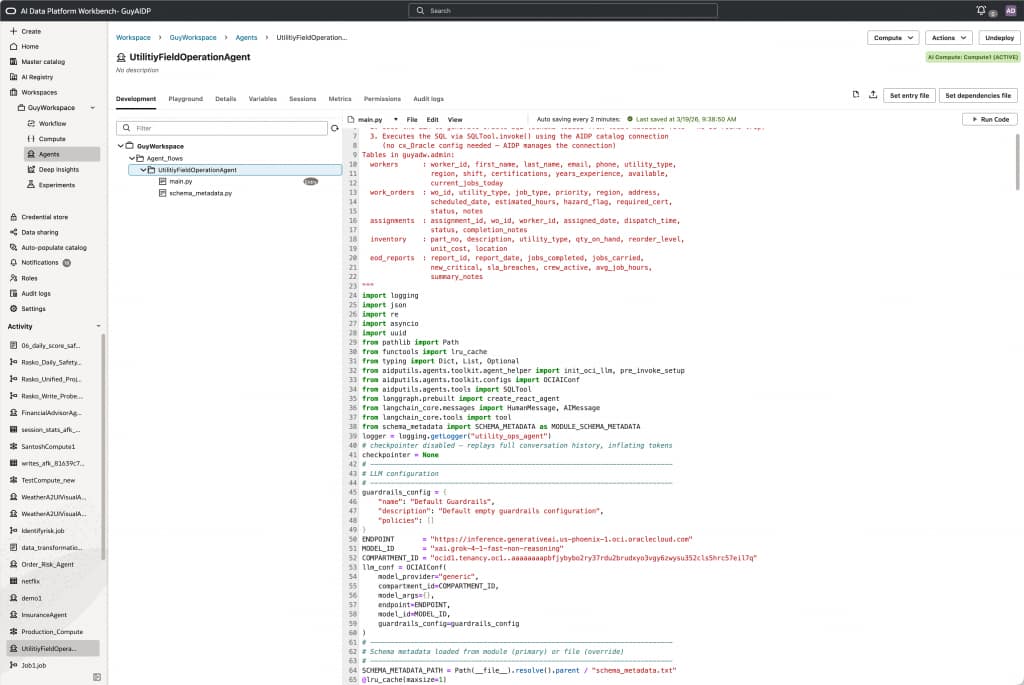
Developers get a third on-ramp as well: skills that let you connect via OpenAI’s Codex (or any other LLM provider) and build agents from prompts, plus the IDE plugin now available in the Visual Studio Code marketplace, so Agents in the AI Data Platform are available for everyone in their workflows and their experience level.
What We Heard from Early Access Teams
Agents in AI Data Platform have been in selected customers’ hands, and three themes come up again and again in early access feedback. Teams tell us time to a first working agent dropped from weeks to hours, because the built-in tool templates removed the integration work that used to gate every project. They tell us security reviews moved faster, because agent invocation runs through the RBAC and OAuth controls their organizations already trust. And they tell us the low-code versus pro-code debate simply went away, because analysts building in the canvas and engineers building in notebooks end up with the same agent underneath.
Five tool templates out of the box
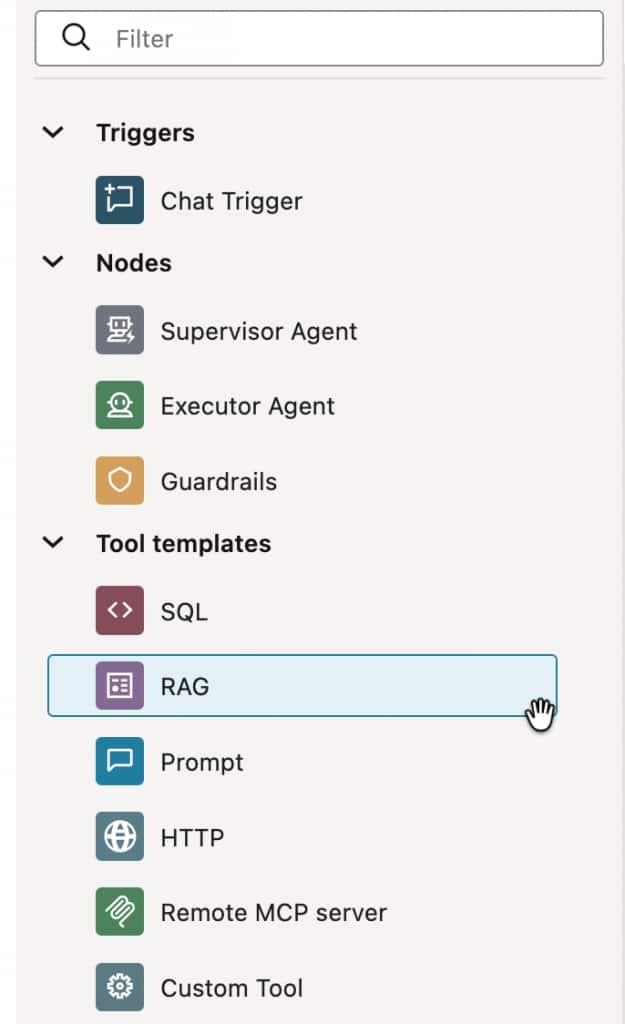
No integration project required to get started: SQL Tool parametrizes custom queries against catalog schemas. Retrieval Augmented Generation (RAG) connects agents to knowledge bases and files in AI Data Platform volumes. Prompt provides templates for tasks like email, notifications, and summarization. Custom Code handles bespoke Python logic. And HTTP tool, new in this release, lets agents call external APIs directly with configurable methods and parameters.
Connect to thousands of MCP servers (GA)
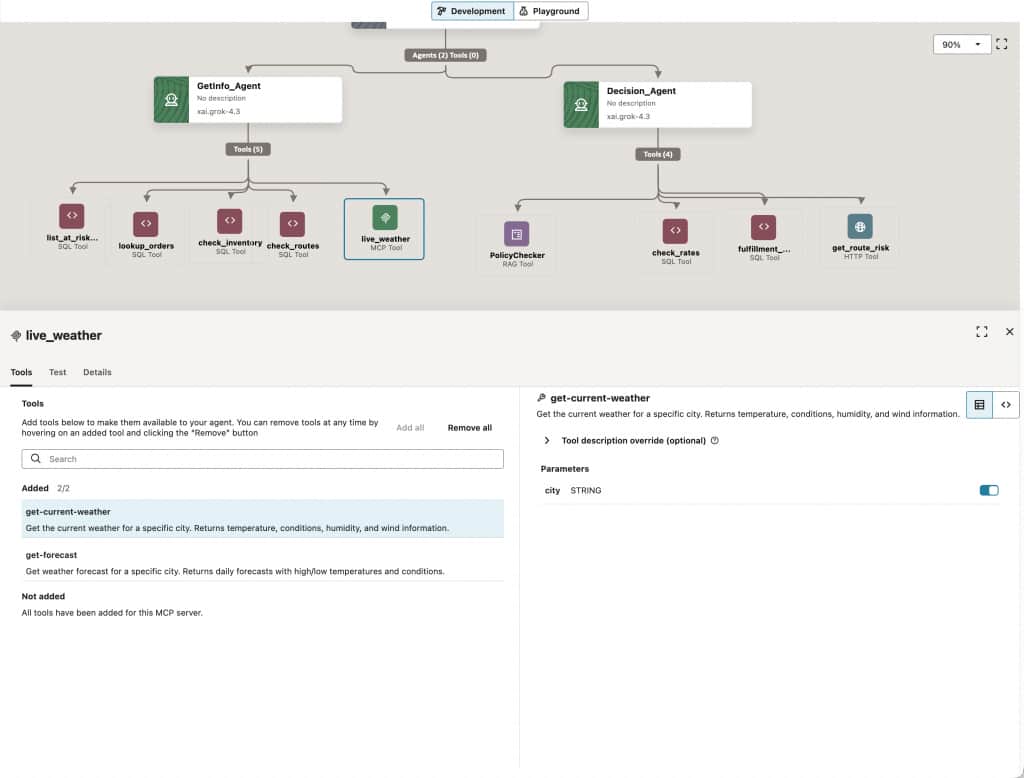
Agent flows connect to remote Model Context Protocol (MCP) servers including Oracle Analytics Cloud (OAC), Oracle Integration Cloud (OIC), Oracle AI Database, MySQL, and thousands of third-party servers such as GitHub, Atlassian, Slack, Figma, and Snowflake. Workflows that span multiple products and services no longer need custom integration work.
MCP is also how the platform extends into your existing automation investments. For example, you can register an Oracle Integration Cloud project that includes human-in-the-loop steps, and your agent can invoke that project to run governed workflows in OIC — approvals and all — as just another tool in its toolbox.
Multi-Agent Systems
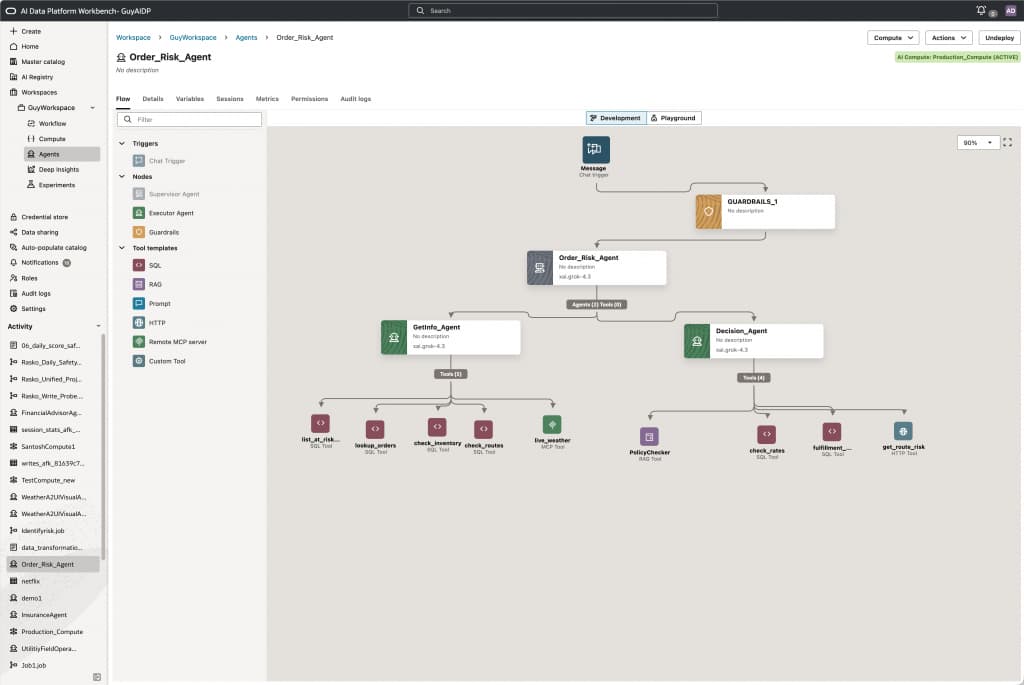
This release also includes multi-agent systems that let teams build and test multiple agents on one canvas, a central agent and tools supporting MCP and Agent-2-Agent (A2A) so agents can be controlled and reused across the enterprise, and A2A support for agent-to-agent communication.
One Click from Flow to Production
Deploy any agent flow as a web application on scalable AI compute. Monitor traffic and utilization, scale replicas in and out, and expose a /chat endpoint compatible with the OpenAI responses API. A2A communication is also supported, so deployed agents can call and be called by other agents. Authentication and authorization run through native AI Data Platform RBAC or OAuth flows — the same access controls enterprises already use.
curl https://<your-deployment>/chat \
  -H "Authorization: Bearer $TOKEN" \
  -H "Content-Type: application/json" \
  -d '{"input": "Summarize yesterday's pipeline failures"}'
Plus: MLOps (GA) and Notebook Assistant (Preview)
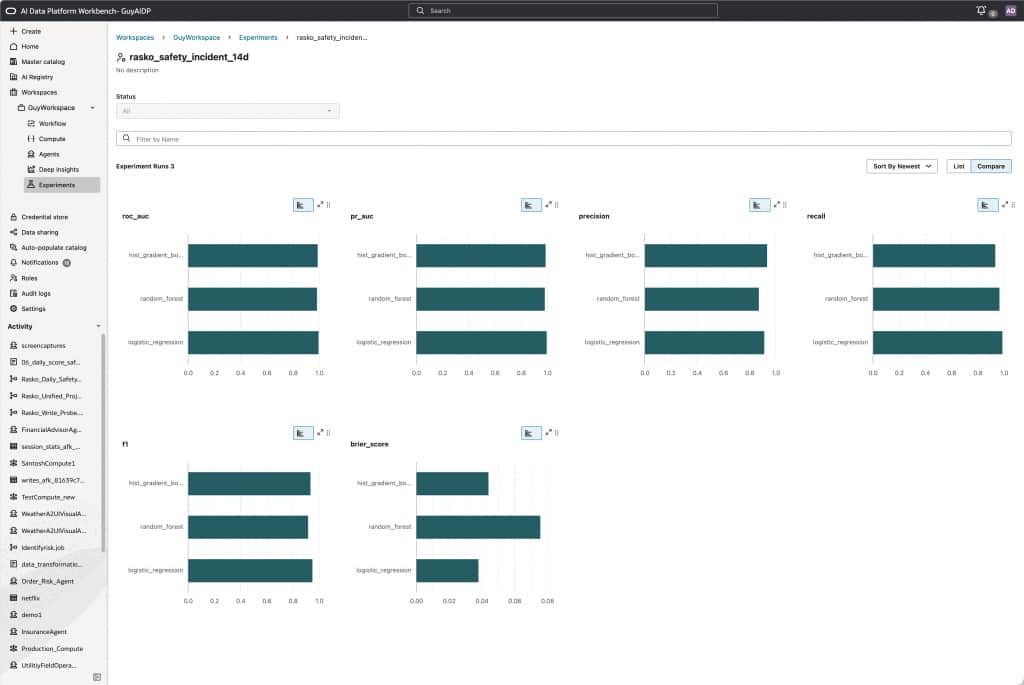
Rounding out the release: teams can now run experiments, compare runs, and promote models directly in AI Data Platform, with models as first-class catalog assets with full lineage and integrated data governance. And the new AI Data Platform Notebook Assistant (Preview) can generate code from plain-English prompts, fixes code with a side-by-side diff and explains code for reviews and onboarding — contact your Cloud Account representative for access.
Get Started Today
AI Data Platform Agents are Generally Available now. Open your AI Data Platform instance and create your first agent flow in Agent Studio, or start from the Python SDK in a notebook — both paths lead to production.
Visit the AI Data Platform product page to learn more, or contact your Cloud Account representative for a guided walkthrough and access to Limited Availability features like the Notebook Assistant.
What’s Next
Looking ahead, we’re working on richer memory management for agents, and a new class of out-of-the-box agents called System Agents that let you run agents with almost zero clicks and get insights in seconds. We’ll share more as these become available.
The GA of agents in AI Data Platform gives teams a direct path from idea to production, whether they build visually or in code. We can’t wait to see what you build.
For more information