
AI agents can reason over enterprise data, use tools, and take action. But doing a business task well also requires knowing how an organization expects the work to be done.
Oracle AI Data Platform supports skills for high-code agents that follow the Open Agent Skills standard. These skills can work alongside enterprise data and tools to help agents handle specialized tasks.
Skills provide task-specific guidance that agents can use when relevant. They capture domain knowledge, business rules, best practices, procedures, and other supporting resources.
Tools give an agent capabilities. For example: Query a database, call a web search tool, or use an email API to send notifications.
Data gives that agent context. For example: Sales record, customer history, incident logs, or policy documents.
Skills give that agent expertise. For example: Investigate a failed payment, review a contract against company rules, or follow a structured escalation process.
Let’s see this in practice with an on-call incident triage agent.
Building an On-call Incident Triage Skill
Consider an e-commerce company investigating timeouts during order confirmation. For this example, we use Oracle Customer Orders sample data with an illustrative incident-response policy.
Incident: INC-48271
Service: Order Processing
Reported symptom: Upstream timeouts during order confirmation
Error: UPSTREAM_TIMEOUT
Status: Investigating
The on-call engineer wants to know:
“Triage INC-48271 and tell me whether this incident needs to be escalated.”
The agent can assess the incident and retrieve the relevant business facts. What it doesn’t have yet are the organization-specific rules for severity, ownership, response, and escalation.
We can provide that through an On-Call Incident Triage Skill.
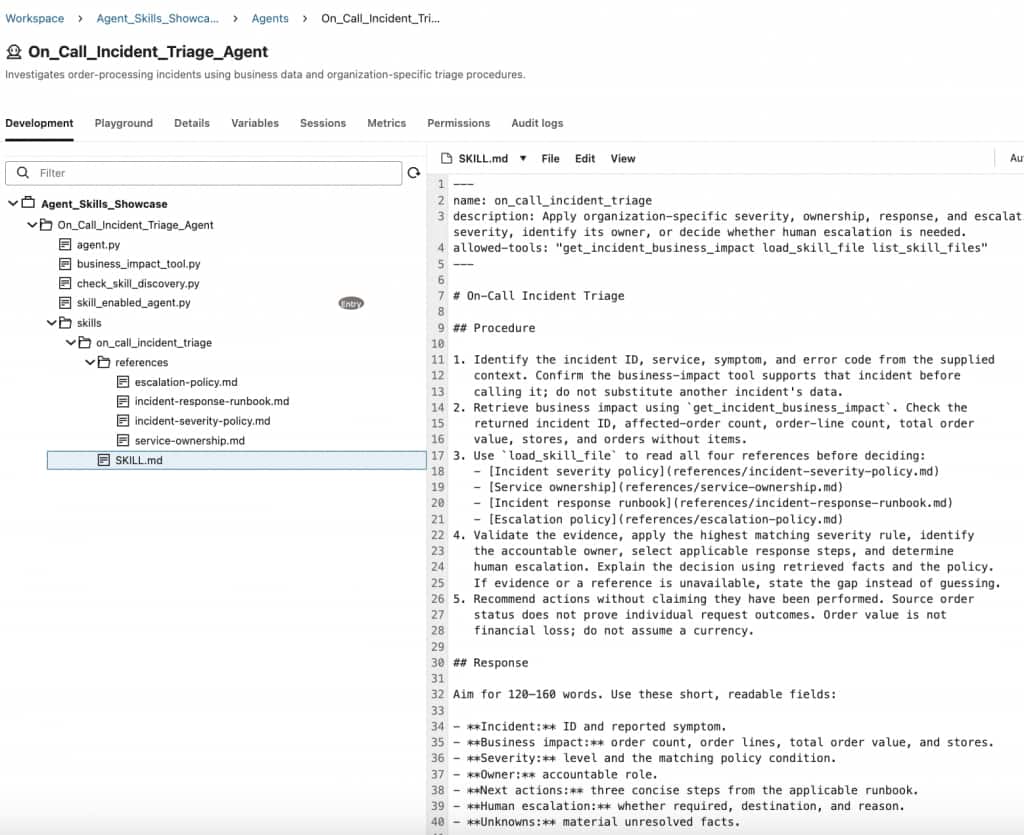
Our Skill contains a small set of operational resources:
skills/
  on_call_incident_triage/
    SKILL.md
    references/
      incident-severity-policy.md
      incident-response-runbook.md
      escalation-policy.md
      service-ownership.md
SKILL.md describes when the Skill should be used and how the agent should approach incident triage, while the supporting files provide the severity, response, ownership, and escalation rules the agent can apply.
Add Business Context
The incident tells the agent what is going wrong, while the business data helps it understand the impact. For this demo, Oracle Customer Orders tables are available through Oracle AI Data Platform’s catalog.
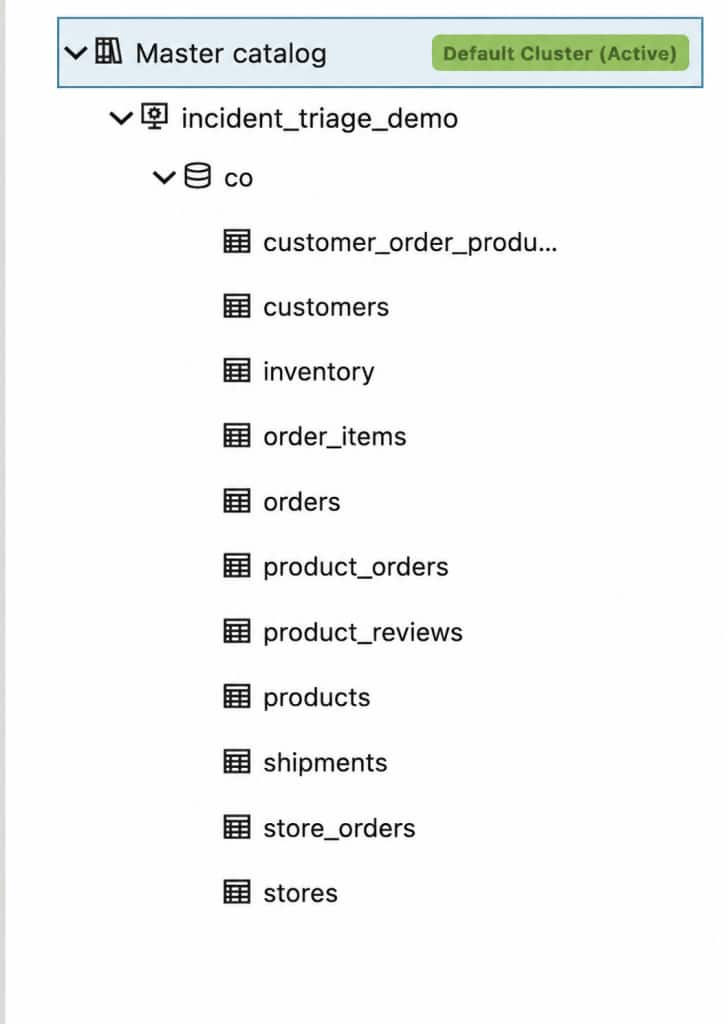
For INC-48271, the business-impact tool retrieves 24 orders, 48 order lines and a total order value of 4,267.80 across Online and Seattle.
See the Difference with a Skill
We ask the agent the same question again:
“Triage INC-48271 and tell me whether this incident needs to be escalated.”
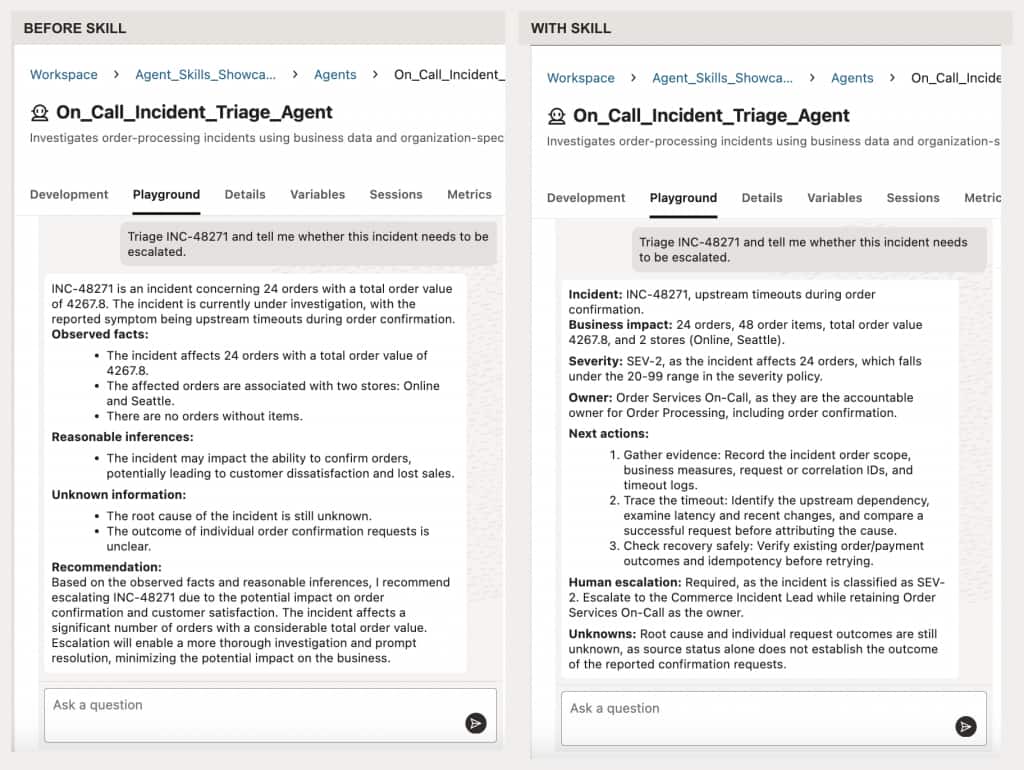
Same incident. Same business data. With the Skill, the response now includes a policy-based severity, accountable owner, response plan, and escalation path.
Under the hood
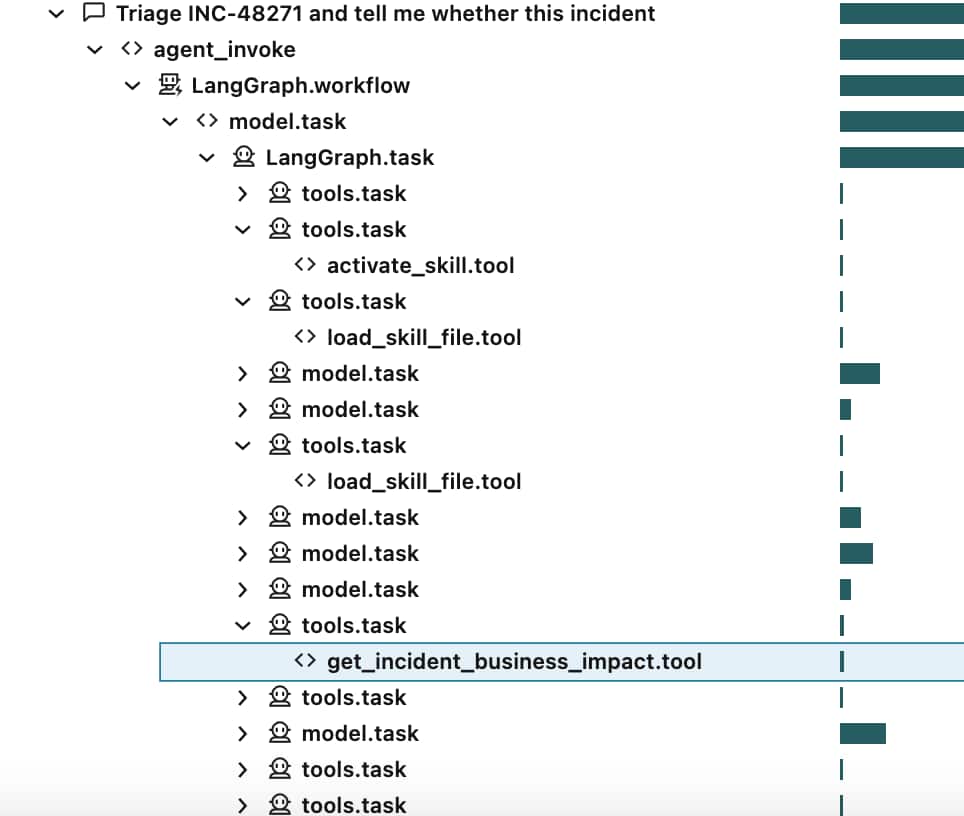
The Playground trace shows the agent activating the Skill, loading the relevant references, and retrieving the business-impact data it needs.
Where else can Skills help?
The same pattern can apply across many other use cases – for example, a finance agent that applies exception rules before routing a case, a support agent that follows the right recovery path for a high-value customer, or an engineering agent that uses the team’s runbook when something breaks in production.
By using skills with high code agents in Oracle AI Data Platform, you can turn reusable organizational know-how into expertise your agents can apply when it matters.