
Enterprise AI success depends on more than just access to data, it depends on controlling that access with precision. As organizations scale across teams and domains, a common problem emerges: access models that were designed for small teams begin to break down. Permissions become too broad, governance becomes reactive, and data either gets overexposed or underutilized.
Oracle AI Data Platform takes a different approach. It separates data access from workspace collaboration, and anchors governance in a catalog-first model. This allows organizations to scale AI and analytics while maintaining strict control over how data is accessed, shared, and consumed.
A Shift Toward Catalog-Centric Governance
In many platforms, access is implicitly tied to where work happens. If you have access to a workspace, you often inherit access to the data within it. That model does not scale in enterprise environments.
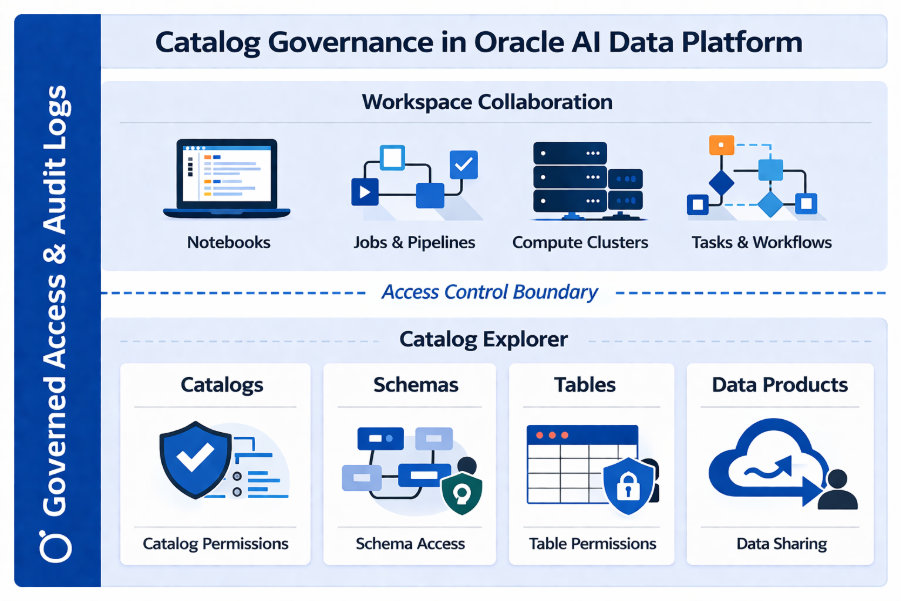
AI Data Platform decouples these concerns. Workspaces are designed for collaboration where data engineers, data scientists and analysts run notebooks, build pipelines, and share compute. Data access, however, is governed independently through catalogs, schemas, and tables.
This shift is subtle but powerful. It means that a user can work in the same environment as others without automatically gaining access to all underlying data. Governance follows the data itself, not the tools used to interact with it.
Catalog Permissions: Defining Ownership at the Right Level
Catalogs serve as the primary governance boundary in AI Data Platform. They are not just containers for data, they define who owns the data and how it can be accessed. Permissions at the catalog level determine who can discover data, who can use it, and who can manage it. Because these permissions can be inherited by all underlying objects, they provide a scalable way to enforce policy across large data estates.
This is particularly important in enterprises where data ownership is distributed. A finance team can manage its own catalog with tightly controlled access, while a marketing catalog might be more broadly accessible for analytics use cases. External catalogs can expose partner data without revealing internal structures.
By establishing governance at the catalog layer, organizations gain a consistent and centralized way to control access without managing permissions object by object.
Catalog, Schema and Table Controls: Enabling Precision Without Complexity
While Master catalog defines the boundary, real governance requires finer control. This is where catalog, schema and table-level permissions come into play.
A catalog is an isolation boundary that groups related schemas under a common domain, business unit, or environment, with centralized control over access, policies, and storage.
Schemas allow teams to organize datasets logically and delegate control within a domain. For example, a team might maintain separate schemas for raw, curated, and production-ready data. Permissions at this level allow organizations to control who can create or modify datasets within each layer.
At the table level, governance becomes even more precise. Access can be restricted to specific datasets, ensuring that sensitive or business-critical data is only available to the right users. Analysts may be given read-only access to curated tables, while engineers retain the ability to build and transform data upstream.
What makes this model effective is how it balances flexibility and control. Organizations can grant broader access where appropriate, while still enforcing strict boundaries where needed. This makes least-privilege access achievable in practice, not just in theory.
Master catalog explorer: Making Governed Data Discoverable
One of the biggest challenges in governed environments is discoverability. When access is tightly controlled, data can become difficult to find, leading to duplication or underutilization.
AI Data Platform addresses this through Master catalog explorer, a unified interface for browsing data assets. What makes it effective is that it is fully permission-aware. Users only see what they are allowed to access, but within that scope, discovery is seamless.
This creates a balanced experience. Governance teams can enforce strict access controls, while users can still explore and understand available data without friction. Instead of choosing between control and usability, organizations get both.
Governed Data Assets: Consistency Across the Platform
Governance in AI Data Platform is not limited to a single layer, it is applied consistently across all data assets. Catalogs, schemas, tables, volumes, and even external data sources are governed using the same underlying model. This consistency matters because governance gaps often appear at the boundaries between systems. When different tools enforce access differently, it becomes difficult to maintain control.
By applying a unified permissions model, AI Data Platform ensures that governance follows the data wherever it exists. Whether data is queried, transformed, or shared, the same access rules apply. This creates a more predictable and reliable operating model for enterprise data platforms.
Data Sharing Controls: Expanding Access Without Losing Control
As organizations scale, the need to share data across teams, domains, and external partners becomes unavoidable. The challenge is enabling this access without duplicating data or weakening governance controls.
Oracle AI Data Platform addresses this through Data Sharing, which leverages Delta Sharing an open standard for secure, real-time data sharing. Instead of moving or copying data, Delta Sharing allows organizations to share governed datasets directly from the source, ensuring that a single version of truth is maintained.
Access to shared data is controlled through the same catalog-level and object-level permissions used within the platform. This means that even when data is shared across domains or with external consumers, governance policies remain intact. Data providers can define exactly what is shared, down to specific tables or views, while retaining full control over access.
This approach has practical advantages. Internal teams can consume curated datasets without requesting direct access to underlying schemas. External partners can securely access selected data products without exposing internal catalog structures. And because data is not replicated, organizations avoid the operational overhead and risk associated with managing multiple copies.
By combining Delta Sharing with AI Data Platform’s governance model, data sharing becomes an extension of control rather than a compromise, enabling collaboration at scale while preserving security, compliance, and data integrity.
Data Product Access Management: Governing at Scale
As data ecosystems mature, organizations move beyond raw datasets toward curated, reusable data products. These data products represent trusted, business-ready assets that can be consumed across teams.
AI Data Platform supports this evolution by enabling access to be managed at the level of the data product itself. Instead of granting permissions table by table, organizations can control access by granting access to schemas with curated datasets.
This simplifies governance while improving usability. Consumers interact with stable, well-defined data products, while data owners retain control over how those products are accessed and used.
It also aligns governance with how businesses think about data, not as isolated tables, but as meaningful, reusable assets.
Separating Data Access from Collaboration
The most important takeaway is the separation between data access and workspace collaboration.
In AI Data Platform, workspaces provide the environment for teams to collaborate, but they do not define what data users can access. That control remains firmly at the catalog and data asset level. This separation eliminates implicit access and ensures that permissions are always intentional. Teams can share environments, tools, and workflows without introducing unnecessary risk.
For enterprises, this is a critical shift. It allows collaboration to scale independently of governance, without forcing trade-offs between speed and control.
Conclusion
Catalog governance in Oracle AI Data Platform is designed for the realities of modern enterprise AI. It provides a model where access is precise, scalable, and aligned with how organizations actually manage data.
By anchoring governance in catalogs, extending it through schemas and tables, enabling controlled discovery through Catalog Explorer, and supporting secure data sharing and product-level access, AI Data Platform Workbench creates a system where data remains both accessible and protected.
Most importantly, it ensures that access to data products and catalog assets is independent from workspace collaboration, giving organizations the control they need without slowing down the teams that rely on data every day.
For more information
Check out the following resources: