
AI is reshaping how organizations innovate, operate, and secure their businesses. While it is creating new opportunities, it is also changing the cybersecurity landscape by accelerating how quickly attackers can discover weaknesses, automate attack paths, and exploit vulnerabilities. As a result, organizations have less time to assess risk, deploy patches, validate changes, and demonstrate compliance
Oracle recently shared guidance on protecting business data amid emerging AI-enabled threats. For organizations running Oracle databases and Exadata estates, the challenge is turning that guidance into consistent operational action across increasingly large and distributed environments.
Organizations need to keep systems current with the latest recommended security patches, patch fleets faster, reduce manual steps and errors, validate changes before production deployment, maintain configuration consistency, and assess compliance regularly, all without increasing operational complexity.
Oracle Enterprise Manager provides that operational foundation. It is the control plane many customers rely on to monitor, manage, patch, configure, secure, and govern Oracle environments. By helping organizations automate lifecycle operations, speed up fleet-level patching, validate changes with confidence and maintain consistent operations, Enterprise Manager keeps Oracle environments secure and up to date.
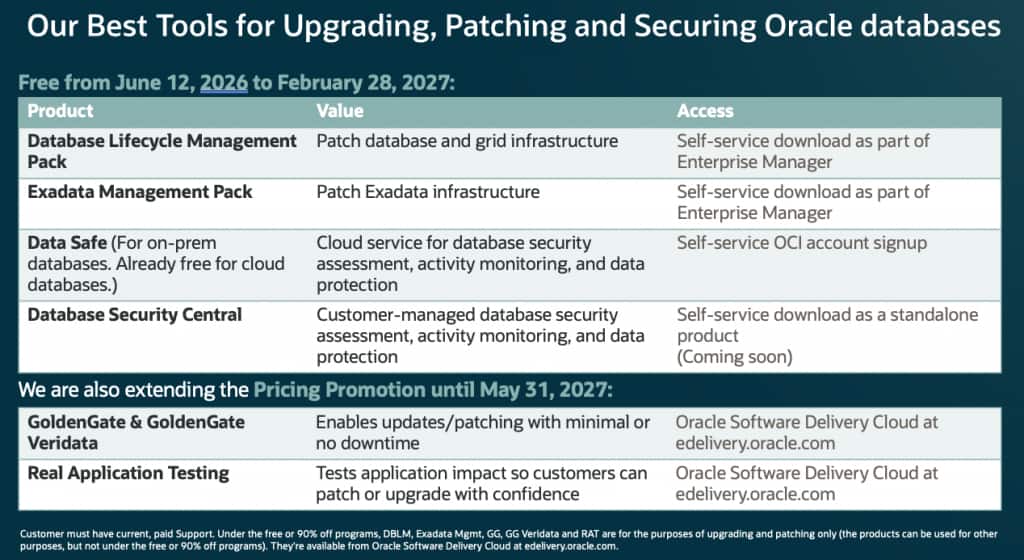
To help customers accelerate protection, Oracle is making select Enterprise Manager capabilities and other security and lifecycle management tools available at no additional cost for a limited time, or at a 90% discount on one-year term licenses.
Upgrade to Enterprise Manager 24.1
Enterprise Manager itself should be treated as critical infrastructure. Oracle recommends upgrading to the latest supported release, applying Release Updates promptly, and keeping the complete Enterprise Manager stack including Agents and certified JDKs current. Running the latest release provides access to the newest lifecycle management, monitoring, compliance, and security capabilities.
Customers running older Enterprise Manager releases should follow the documented upgrade path to Enterprise Manager 24ai, including any required interim upgrade to Enterprise Manager 13.5. Customers on Enterprise Manager 13.5 should continue applying the latest Release Updates while planning their move to 24ai.
Strengthen the Enterprise Manager security foundation
Enterprise Manager manages many of an organization’s most critical Oracle systems, it supports operations across on-premises environments, Oracle Cloud, and other supported public clouds, including AWS, Microsoft Azure, and Google Cloud. As attackers increasingly use automation to search for weak credentials, excessive privileges, and configuration gaps, securing the control plane is therefore fundamental.
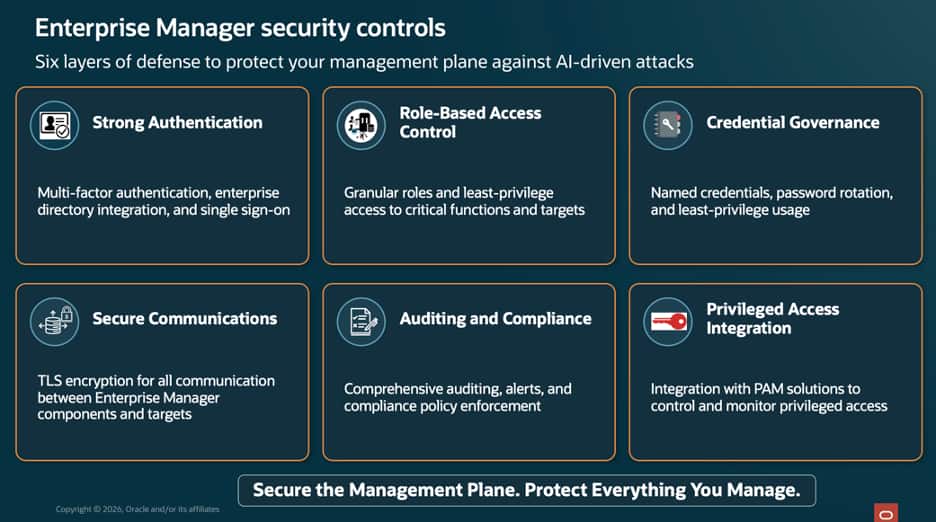
Enterprise Manager secures the control plane through strong authentication, role-based access control, credential governance, secure communications, privileged access integration, auditing, and compliance capabilities. Together these controls provide a secure foundation for managing Oracle environments at scale.
For a deeper look at Enterprise Manager’s security controls, see the Enterprise Manager Security Overview in the resources below.
Turn security guidance into operational action
Securing Enterprise Manager is the first step. The next is using that secure control plane to identify systems requiring attention, keep up with the latest patch updates, automate remediation, validate changes before production, and maintain compliance.
At enterprise scale, the challenge is twofold: gaining clear visibility into what needs to be upgraded or patched and doing so consistently across thousands of systems spanning data centers and cloud environments.
Enterprise Manager addresses these challenges through three complementary capabilities. Database Lifecycle Management automates Oracle Database and Grid Infrastructure patching, Exadata Management Pack extends automation to Exadata infrastructure, and Real Application Testing validates workload behavior before production deployment. Together, these capabilities enable faster patch adoption, standardized maintenance workflows, and more consistent operations across the Oracle estate.
Find and remediate Database and Grid Infrastructure patch gaps
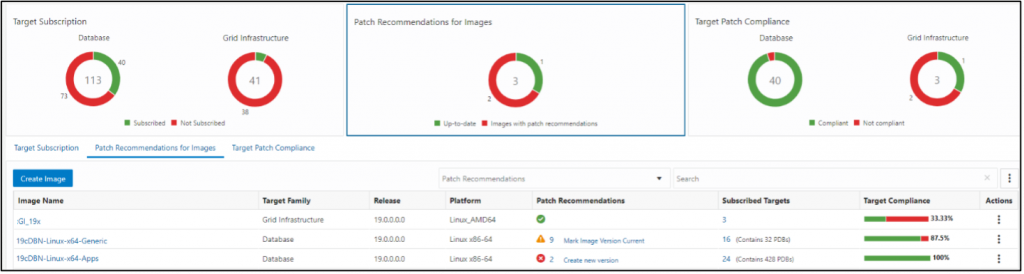
Fleet Maintenance, part of Database Lifecycle Management, identifies database and Grid Infrastructure systems requiring updates, recommends the latest patches, and automates remediation across the fleet. Administrators can view patch recommendations, compliance status, and remediation progress in the Fleet Maintenance Hub instead of relying on spreadsheets or custom scripts.
Gold-image based maintenance and standardized workflows make patching repeatable across hundreds or thousands of systems while reducing manual effort and operational risk.
Find and remediate Exadata infrastructure patch gaps
Database patching is only part of the lifecycle. Exadata infrastructure also requires regular maintenance across database servers, storage servers, switches, and virtualization components.
Exadata Management Pack extends Fleet Maintenance to Exadata infrastructure, enabling administrators to automate infrastructure patching from the same management platform. Together, Database Lifecycle Management and Exadata Management Pack deliver consistent lifecycle management across both the database and infrastructure layers
De-risk upgrades and patches with real workload validation
Patching and upgrading are necessary, but customers also need confidence that these changes will not affect application stability.
Real Application Testing captures production workloads and validates application behavior before deployment, helping administrators identify when patches may affect SQL performance, workload behavior, or application response. This enables organizations to remain current with recommended patches while minimizing operational risk.
Maintain configuration consistency
Upgrading and patching are important first steps in reducing exposure, but maintaining a secure environment requires consistent configuration.
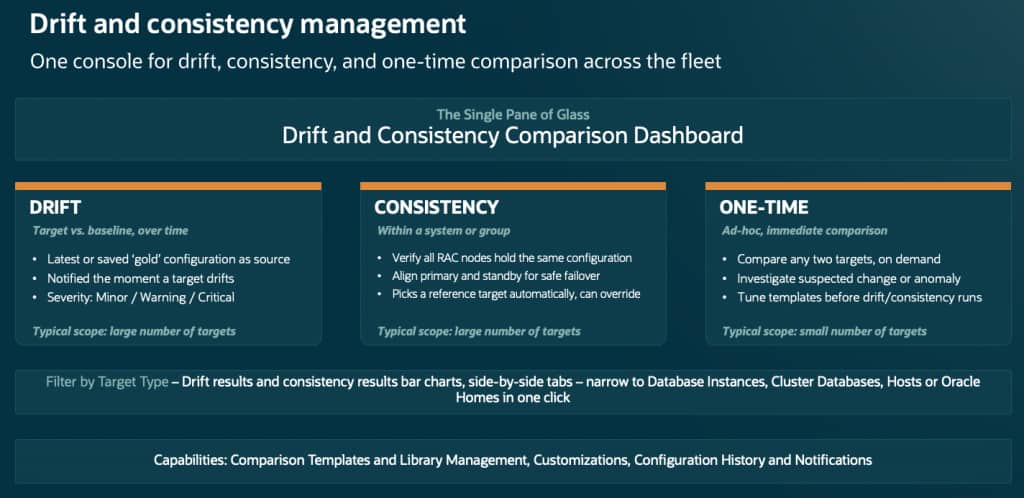
Database Lifecycle Management establishes approved configuration baselines, detects configuration drift, compares environments, and identifies unintended changes. These capabilities improve security, stability, and operational consistency across the database estate.
Strengthen compliance through continuous assessment
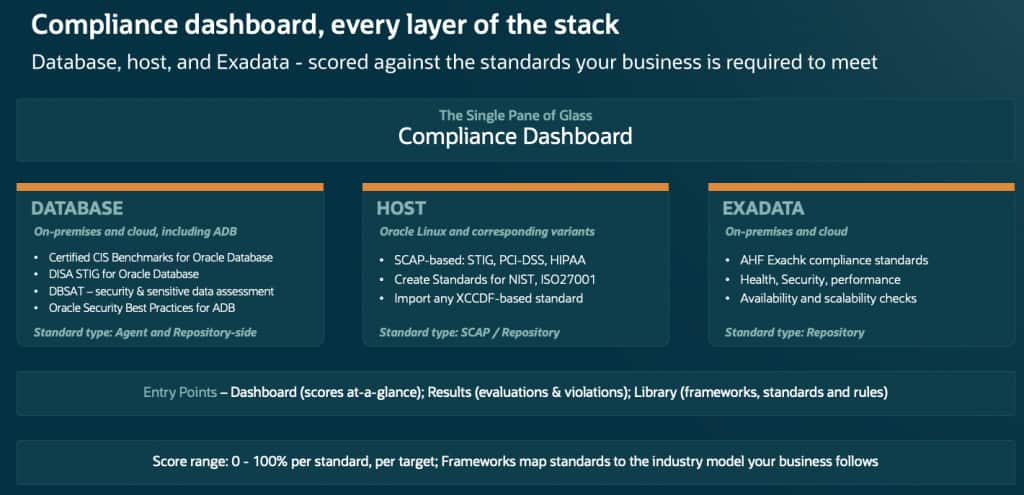
Enterprise Manager continuously evaluates databases, hosts, and engineered systems against built-in and custom security standards. Compliance dashboards, remediation guidance, and reporting provide security, operations, and audit teams with the visibility needed to identify policy violations, demonstrate compliance, and maintain a strong security posture.
Programs to help customers act now
Oracle is making several of its most widely deployed database security, patching, testing, and lifecycle management tools available at no additional cost for a limited time, or at a 90% discount on one-year term licenses.
For Enterprise Manager customers with current Oracle Database support, Oracle is providing no-cost access to Fleet Maintenance capabilities within Database Lifecycle Management and Exadata Management Pack for qualifying database, Grid Infrastructure, and on-premises Exadata infrastructure upgrade and patching use cases through February 28, 2027. These capabilities are intended specifically for upgrade and patching use cases and do not extend to all capabilities available within Database Lifecycle Management or Exadata Management Pack.
In addition, Oracle is extending promotional pricing for Real Application Testing through May 31, 2027, helping customers validate workload impact and de-risk upgrades and patches before production deployment.
| Product | Helps Customers |
| Database Lifecycle Management Pack | Upgrade and patch Oracle Database and Grid Infrastructure using Fleet Maintenance |
| Exadata Management Pack | Patch on-premises Exadata infrastructure using Fleet Maintenance |
| Real Application Testing | Validate application impact so customers can patch or upgrade with confidence |
Together, these programs help customers identify where action is needed, keep up with the latest patch recommendations, automate remediation workflows, and validate change before production rollout.
Getting started
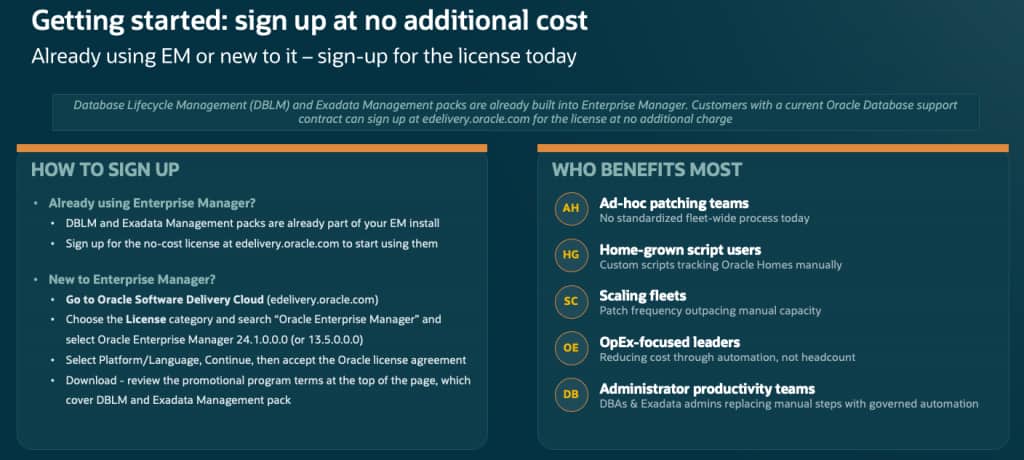
Existing Enterprise Manager customers can begin by signing up through Oracle Software Delivery Cloud. Because Database Lifecycle Management and Exadata Management Pack are already included in the Enterprise Manager installation, customers can quickly activate and begin using the qualifying upgrade and patching capabilities covered by the program.
Customers new to Enterprise Manager can download Enterprise Manager from Oracle Software Delivery Cloud, review the program terms, and begin planning adoption.
These programs are especially relevant for organizations with large or growing fleets, ad hoc patching processes, homegrown scripts, frequent maintenance demands, or limited DBA and infrastructure administration capacity. As fleets grow and patching frequency increases, automation becomes more important.
Conclusion
AI is accelerating the pace at which organizations must identify, assess, and remediate security risk. Keeping systems current, validating change, maintaining configuration consistency, and continuously assessing compliance are no longer isolated activities; they are part of an ongoing operational discipline.
Oracle Enterprise Manager helps customers automate remediation, validate change, maintain configuration consistency, and strengthen security readiness across the Oracle estate.
We encourage all Oracle Database customers to act now and take advantage of the offers for Oracle’s security and lifecycle management tools outlined in this blog.
In the blogs ahead, we will share practical guidance on how organizations can operationalize these practices at scale, from Fleet Maintenance for database and Grid Infrastructure patching to Exadata infrastructure patching, configuration drift and consistency management, compliance adherence, and Real Application Testing
Additional Resources
- Enterprise Manager Security Overview
- My Oracle Support (MOS) notes for the latest on EM13.5 and EM24ai Release Updates
- Secure your Oracle Databases and Grid Infrastructure through automated upgrades and patching using Fleet Maintenance
- Secure your on-premises Exadata infrastructure through automated patching using Fleet Maintenance
- Take the Guesswork Out of Database Upgrades with Oracle Real Application Testing
- Learn more about the limited-use initiative for Enterprise Manager 24ai and Enterprise Manager 13.5 through Oracle Software Delivery Cloud
- Take advantage of the offers for Oracle’s security and lifecycle management tools outlined in this blog: https://www.oracle.com/database/free/