
With MySQL 26.10, we’re announcing the general availability of the MySQL REST Service (MRS) Component, an installable component that runs MRS directly inside MySQL Server.
MRS: the MySQL REST Service
Many modern applications, well, not just applications, but also tools, CLIs, CI pipelines, and automation, use HTTP and JSON to communicate with other systems.
For developers who want to focus on the frontend, building another backend just to expose database operations can feel like a burden. They want to work on the application and use an API for data access.
But connecting applications to a database often involves custom APIs, authentication layers, serialization logic, and a lot of glue code. Along with that comes the operational overhead of keeping everything running. Over time, this API layer can become the real system we maintain.
MRS provides that data-access layer, exposing MySQL data through HTTPS REST APIs with relational-to-JSON mapping, authentication, and authorization.

Consider a customer checking an order. The application needs the order details and line items, with access restricted to the right customer. MRS can present that related data as a nested JSON document while the underlying data remains in relational tables. You choose which fields to expose, which operations to allow, and who can access them.
MRS brings together the tools to develop, serve, and use REST APIs:
- Develop: Define and manage the API with MySQL Shell.
- Serve: The MRS runtime serves the endpoints and handles incoming HTTPS requests.
- Use: Applications call those endpoints directly over HTTPS or through a generated TypeScript or Python SDK.
You still write the application’s business logic, but MRS handles the database-access operations you define.
MRS was originally introduced as part of MySQL Router, which hosts that runtime and connects to MySQL Server to execute database operations. In that deployment, MySQL Shell provides the API development and management tools, MySQL Router runs the service, and applications consume the API.
MySQL now speaks HTTP and JSON
The MRS Component adds another way to serve those REST APIs: directly inside mysqld.
MySQL Server can serve the application’s HTTPS API without a separate MySQL Router deployment to host MRS. Database operations execute through local Server services, avoiding the network hop between a separate MRS runtime and MySQL.
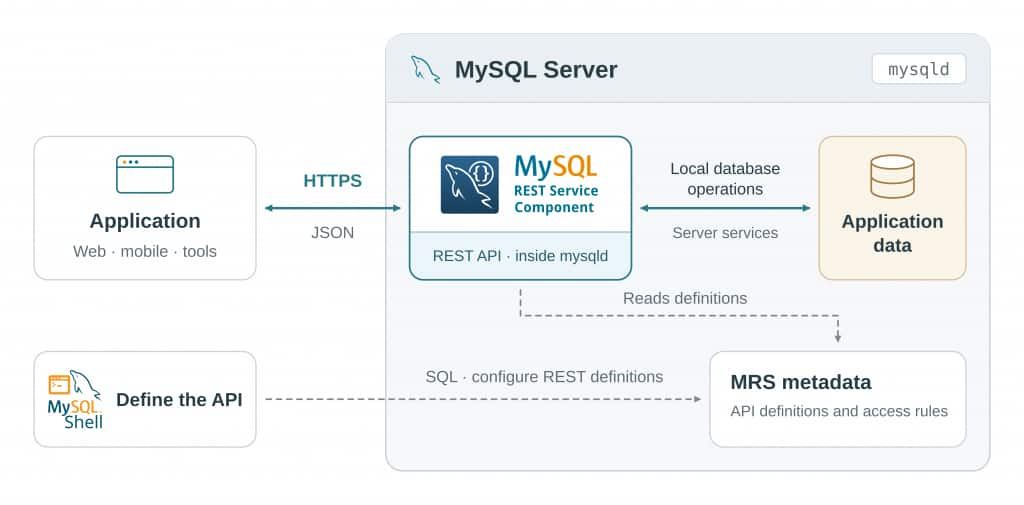
Running inside MySQL Server also lets MRS use the Server’s security infrastructure. MRS can authenticate users with MySQL accounts and, with user passthrough enabled, execute database operations under their MySQL privileges. MRS’s REST access controls also apply.
For HTTPS, MRS uses MySQL Server’s certificate and key settings as initial defaults. You can configure a different certificate and key for its HTTPS listener.
You configure MRS through system variables, check its state through status variables, and find its messages in the MySQL Server error log. The component integrates with Server startup and shutdown. SQL functions also let you start, stop, or restart MRS without restarting MySQL Server.
Summary
MRS provides HTTPS access to MySQL data, reducing the backend code needed to expose it to applications. With the Component, the REST service runs inside MySQL Server, without a separate MySQL Router deployment to install, configure, and manage.
Coming up in Part 2, “Getting Started with the MRS Component“: we’ll configure MRS, expose the order API introduced here, and make authenticated requests with curl. We’ll retrieve an order and its line items as nested JSON, update a delivery note, and verify the result in MySQL.
Get Involved
We’d like to hear how MRS works in your applications. What APIs are you building? Where do you still need custom backend code? Share your experience and ideas on MySQL Community Slack.
You can explore the MRS Component source code and contribute improvements. Our contribution guide explains how to get started.
Bugs and Feature Suggestions
If you find a problem or have a feature suggestion, please open an issue on GitHub or file a bug report.
For support requests, please open a support ticket.
More Information
Documentation
- MySQL REST Service Component Documentation
- MySQL REST Service Documentation
- MySQL REST Service SQL Reference
Downloads
- Download MySQL Shell & MySQL Community Server from MySQL Community Downloads.
- MySQL Enterprise binaries are available on My Oracle Support or through Oracle Software Delivery Cloud.
Enjoy, and thank you for using MySQL!