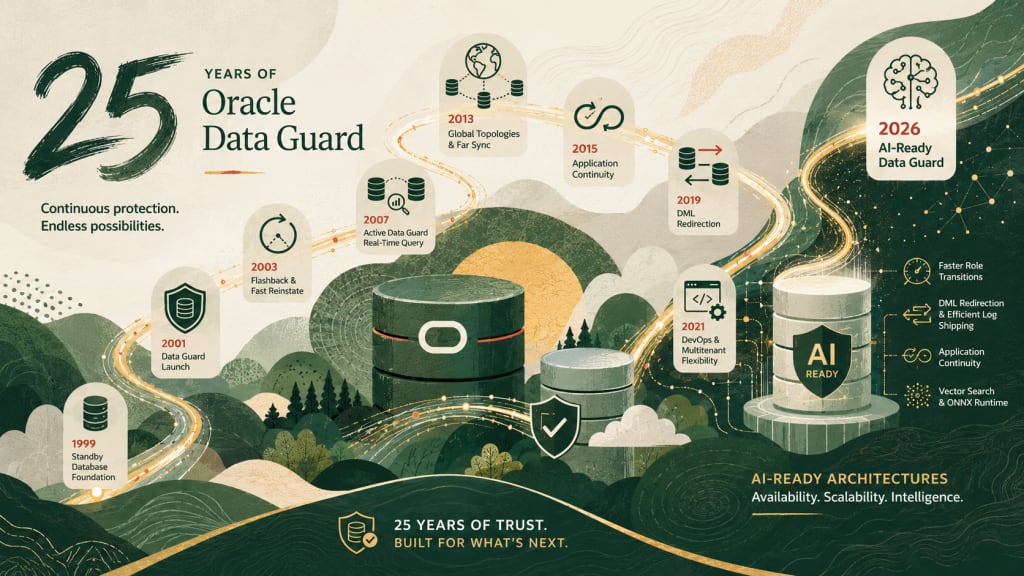
Please join me in celebrating 25 years of a remarkable technology that has safeguarded customer data and enabled businesses worldwide to scale their workloads with read-only replicas. Our collective innovation has made scalability, real-time analytics, and uninterrupted services the standard for organizations everywhere.
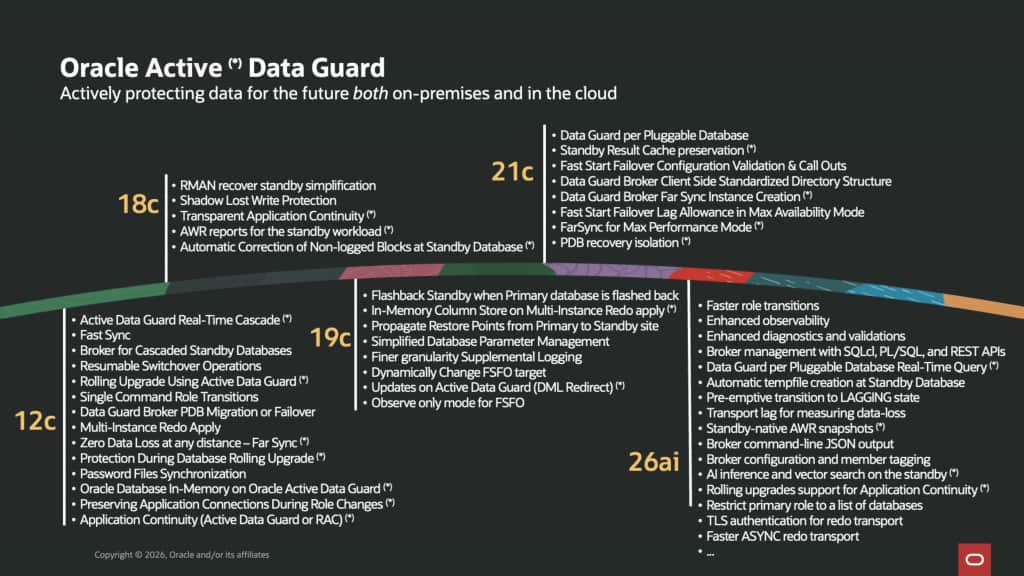
First released with Oracle 9i in 2001, Data Guard has become a cornerstone for DBAs and architects.
Over the years, it has become one of the most trusted tools for database professionals.
1999 – The pre-Data Guard era
Oracle began laying the foundation for Data Guard in 1999. With Oracle Database 8, the company introduced standby database support: replication using archived log shipping. Although some core features were present, it would be a few more years before the launch of Data Guard.
2001 – The first release of Data Guard
Oracle Data Guard 9i, released in 2001, introduced logical and physical replication with both synchronous and asynchronous redo transport. Key features included the Data Guard broker—a tool that keeps the configuration healthy with minimal intervention—automatic gap detection and resolution, support for multiple standby databases with real-time apply, and fast-start failover, which automatically promotes a standby database in case of a primary database failure.
2003-2005 – Flashback & fast reinstate
Oracle Data Guard 10g, released in 2003, introduced Flashback Database technology and enhanced recovery through reset logs. With these features, Data Guard recovery could span database incarnations, making it faster and easier to reinstate the former primary database after failover. It also introduced Maximum Protection mode, a configuration that guarantees zero data loss.
2007-2009 – Active Data Guard!
Oracle Data Guard 11g and 11g Release 2 brought several important advances. Snapshot Standby lets administrators open the standby database in read-write mode for safe testing, making deployment and validation easier. Once testing is complete, the system quickly resynchronizes with the primary database.
These releases also improved data protection. New features such as lost write detection, automatic block repair, and block change tracking accelerate incremental backups and help prevent data loss, increasing database reliability.
The most significant milestone is Active Data Guard Real-Time Query. With this feature, the standby database remains open for real-time queries and reporting while it continuously synchronizes with changes from the primary database. As a result, users can analyze live data and offload queries directly on the standby database, all without affecting production operations.
2013-2015 – Advanced topologies and performance
Oracle 12c introduced many new capabilities for Active Data Guard. One highlight is Application Continuity, available with Real Application Clusters and Active Data Guard. This feature allows applications to continue processing transactions without client errors, even across instance failures or role transitions.
This release also brought Real-Time Cascade Standby and Far Sync, enabling standby databases to be located around the world and supporting more advanced configurations for data protection and recovery.
Another key addition is Global Data Services, which offers a unified connection point for applications. This service automatically directs traffic to the optimal database, taking standby location and performance into account.
Additionally, Oracle 12c improved how reporting applications interact with standby databases. The system now supports sequences and global temporary tables, expanding the range of workloads supported on a standby environment.
Oracle Data Guard 12c Release 2 added support for Oracle’s in-memory feature on the standby database. This allows organizations to run analytics workloads on standby systems, improving resource use without affecting primary database performance.
The release also introduced multi-instance redo apply. By distributing recovery tasks across multiple database instances in a Real Application Clusters environment, this feature dramatically speeds up data recovery and enhances overall availability.
2019 – Support for read/write applications
Oracle Active Data Guard 19c introduced DML redirection, transforming standby databases.
Now, applications connected to a standby can run insert, update, and delete statements—these write operations are routed to the primary, while reads continue on the standby.
DML redirection turns standby environments from read-only databases into active components of regular applications, greatly expanding scalability.
2021 – New opportunities for DevOps and more flexibility for Multitenant
Data Guard 21c laid the groundwork for DevOps practices by introducing RESTful APIs for Data Guard through Oracle REST Data Services, making it easier to integrate broker configurations into automated deployment pipelines. The addition of SQLcl, a modern command-line tool, as a command line for the broker streamlines work for both developers and DBAs.
This release also debuted Data Guard per Pluggable Database, allowing individual pluggable databases to fail over or switch over independently for the first time. While its functionality is not as extensive as full Data Guard, it delivers a new level of flexibility and agility for managing consolidated environments.
2023-2026 – Faster, easier, and AI-ready
Oracle AI Database 26ai brings major performance improvements to Data Guard. For example, role transitions are now up to five times faster, and DML redirections and log shipping are more efficient.
The release also enhances availability by supporting Application Continuity during rolling upgrades.
Managing Data Guard is easier, thanks to new commands and view helping with the implementation, configuration, operations, and monitoring.
With new support for ONNX runtime and vector search, AI workloads can now run directly on standby databases.
Overall, version 26ai makes Data Guard a pivotal platform for availability, scalability, and AI architectures.
Happy 25th anniversary! 🎂