
Financial and digital services, healthcare, telecommunications, energy and transportation providers, as well as government institutions, operate some of the most demanding IT environments. These systems must support ultra-high transaction volumes, strict availability requirements, and complex regulatory obligations. Workloads continue to evolve, including real-time payments, electronic health records, network analytics, grid load forecasting, flight operations, identity management, fraud detection, and AI-driven operations.
In such environments, the database is not an interchangeable commodity but a critical component of service continuity and financial integrity. Although newer database platforms may claim feature parity, operational maturity is typically achieved through long-term deployment across diverse workloads, failure scenarios, and compliance requirements.
This article explores the factors that distinguish operationally mature database platforms from emerging alternatives in mission-critical environments. It covers the following topics:
- Database robustness is a board concern
- Risks of emerging databases for mission-critical use
- Oracle AI Database & Exadata for mission-critical systems
- Evaluating “feature parity” claims
- Recommendations
Database robustness is a board concern
Database robustness is a board-level concern because databases sit at the centre of revenue, operations, and trust. The organization’s ability to protect sensitive data, meet regulatory obligations, and recover quickly from outages or cyber incidents depends heavily on database governance, security controls, and resilience. When database capabilities lag, the impact is rarely technical only – it shows up as material financial risk, brand damage, and reduced strategic agility. Key areas of oversight include:
- Operational maturity is about failure handling, not parity
- In real-world critical operations, incidents rarely stem from missing features. Instead, they arise from edge cases: rare concurrency bugs, replication and failover anomalies, data corruption scenarios, performance cliffs under mixed workloads, multi-region latency and consistency interactions, and operational errors during backups, scaling, patching, and upgrades.
- Even highly mature enterprise databases continue to uncover defects over time, reflecting the vast space of possible workload patterns and infrastructure combinations. Systems with fewer years of broad production exposure have had fewer opportunities to encounter and remediate such failure conditions.
- Feature equivalence does not imply operational equivalence. In mission-critical systems, the cost of database failure can include regulatory exposure, brand damage, SLA penalties, revenue loss, and customer churn.
- Decades of proof vs. short-lived platform volatility
- Oracle AI Database has operated in mission-critical environments for decades, resulting in operational maturity that is difficult to replicate quickly: well-understood failure handling, hardened security processes, predictable upgrades, and deep global expertise.
- In industry rankings, Oracle AI Database is consistently recognized as a leading database platform by market presence and adoption, regularly ranking at the top in widely referenced industry trackers, such as DB-Engines’ long-running popularity ranking.
- Oracle AI Database also frequently ranks among the top platforms in analyst evaluations of mission-critical relational databases, including Gartner® Magic Quadrant Reports.
- This “time in production” correlates with lower operational uncertainty, stronger supportability, and clearer evidence for risk, compliance, and resilience. By contrast, many newer databases address specific needs but often have shorter lifecycles due to funding limits, acquisitions, limited ecosystem growth, or difficulty scaling to enterprise requirements. Even when innovative, this volatility can increase long-term product, migration, and exit risk—especially when the database underpins core systems.
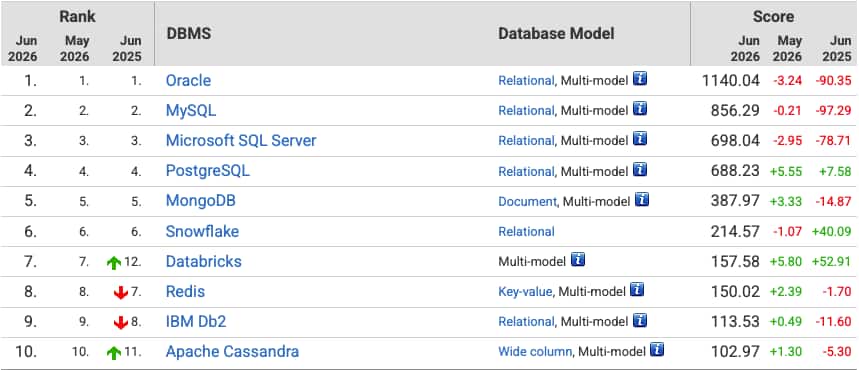
- Mission-critical workloads amplify database risk
- Mission-critical data platforms combine heavy transactional and analytical demands, strict consistency requirements, and continuous operation, even during planned maintenance operations. These conditions push databases to the limits of trade-offs between scale, consistency, and availability.
- A proven database platform meets this demand and mitigates the associates risks through decades of engineering and operational maturity: well-tested high availability and disaster recovery strategies, predictable performance under peak load, strong backup and restore capabilities, mature security controls, and a deep ecosystem of tools and expertise. The result is lower operational uncertainty, as issues are more likely to be understood, diagnosable, and recoverable within defined SLAs.
Risks of emerging databases for mission-critical use
Newer or less-proven databases can introduce risks beyond performance and cost. These databases must still meet always-on availability, latency and consistency requirements, and regulatory standards. Gaps in maturity, ecosystem, or support can increase the likelihood, impact, and recovery time of outages and other incidents. Key risks include:
- Security, supply chain, and compliance risk
- Organizations running critical systems often face strict security and regulatory requirements, making selecting a database a high-stakes decision for security, supply chain trust, and compliance. Platforms must provide strong encryption (at rest and in transit), robust auditing and access controls, reliable vulnerability management with transparent patching, and clear compliance alignment across jurisdictions.
- The choice of the database directly impacts audit effort and ongoing security operations and can either increase or reduce regulatory risk depending on how well the platform meets those industry requirements.
- Long-term product and roadmap risk
- Organizations running critical systems often face strict security and regulatory requirements, making selecting a database a high-stakes decision for security, supply chain trust, and compliance. Platforms must provide strong encryption (at rest and in transit), robust auditing and access controls, reliable vulnerability management with transparent patching, and clear compliance alignment across jurisdictions.
- The choice of the database directly impacts audit effort and ongoing security operations and can either increase or reduce regulatory risk depending on how well the platform meets those industry requirements.
- Ecosystem and support maturity risk
- Ecosystem and support maturity refers to the database’s ability to run reliably at the scale while meeting the demands of Tier-0 and Tier-1 workloads. Key considerations include the extent of real-world enterprise adoption for mission-critical use cases, the availability of experienced DBAs, and the presence of a mature ecosystem of systems integrators, tooling, and monitoring integrations.
- Equally important is the strength of the vendor’s global support model, including 24×7 coverage, multi-language capabilities, on-site escalation, and severity-1 response.
- In major outages, a mature ecosystem can significantly reduce time-to-recovery through experienced operators, established playbooks, known fixes, and rapid patch availability. In contrast, limited ecosystems often lead to longer incidents due to gaps in expertise, less proven procedures, and slower vendor escalation.
- Data portability and platform lock-in risk
- Data portability risk arises when databases make it difficult to move data and applications to alternative platforms. This risk increases when systems rely on non-standard SQL, proprietary replication or migration tools, or operational models that do not translate well across environments.
- These dependencies can create vendor lock-in, increasing future migration cost, time, and service risk. If the vendor’s roadmap, pricing, or support model changes, or if regulatory, security, or business requirements evolve, exit may require significant application and operational rework, with increased risk of downtime, data inconsistency, or prolonged transitions.
- This risk extends to the cloud layer. Tight coupling to a single cloud provider’s ecosystem can make it costly or impractical to move workloads as business or strategic needs change. Platforms that support deployment across on-premises, hybrid, and multicloud environments help preserve flexibility and reduce lock-in. In contrast, databases limited to a single cloud environment can significantly increase long-term portability risk.
Oracle AI Database & Exadata for mission-critical systems
Oracle AI Database and Exadata are commonly chosen for mission-critical systems because they combine high performance with proven availability, security, and operational maturity at global enterprise scale. Together, they provide a well-established platform for running core systems, supporting predictable SLAs, strong resiliency, and fast recovery capabilities needed for always-on operations. Key capabilities that make Oracle AI Database a preferred choice for many Fortune 100 organizations include:
- Operational maturity at a global scale
- Oracle AI Database has decades of experience running mission-critical systems globally. This maturity is reflected in predictable performance under mixed workloads, robust tooling for backup, recovery, patching, and diagnostics, and extensive operational experience across industries with strict uptime requirements. It is complemented by ongoing innovation, including cloud-native capabilities, autonomous operations, distributed scale-out, and AI features.
- At global scale, small performance or operational issues can quickly escalate into outages or SLA breaches. Mature platforms reduce this risk through proven practices, predictable behavior, and well-tested tools that enable early detection, faster recovery, and consistent operations across regions
- Always-on expectations and architectural integrity
- For globally distributed, mission-critical systems, architectural integrity includes maintaining strong consistency and relational integrity without forcing application workarounds. As Futurum notes, modern enterprises increasingly require platforms that preserve ACID and relational integrity for complex queries and constraints [1].
- For distributed database designs, some architectures introduce additional overhead by shredding relational rows into key-value fragments that must be reassembled during query processing, increasing network traffic and complexity [1]. In AI and analytics-heavy scenarios at large scale, such overhead can become a bottleneck [1]. Database architecture affects not just performance but the predictability and operational risk of scaling.
[1] Futurum Research (in partnership with Oracle), The Foundation for Innovation: Why Architectural Integrity is Critical for Scaling Mission-Critical, AI-Ready Applications (Dec 2025).
- Exadata as an engineered mission-critical platform
- Exadata is an engineered system that integrates compute, storage, networking, and database intelligence into a single, optimized platform. This approach delivers predictable low-latency performance, reliable scale-out, and simplified operations, monitoring, and recovery.
- By offloading data processing closer to storage (e.g., SQL filtering and aggregation), Exadata reduces data movement and improves efficiency for large-scale analytical and mixed workloads. Engineered systems help reduce integration risk and improve performance predictability in always-on environments.
- Oracle MAA: A proven blueprint for mission-critical resilience
- Oracle Maximum Availability Architecture (MAA) is Oracle’s set of best practices, recommendations, and reference architectures for designing and operating highly available, resilient Oracle AI Database deployments, commonly used with Exadata to meet strict uptime and recovery objectives. MAA helps enterprises reduce risk by providing proven patterns for high availability, disaster recovery, and data protection (for example, guidance around Oracle RAC, Data Guard, backup and recovery, and rolling maintenance), along with tested operational procedures.
- This results in more predictable RPO/RTO outcomes, fewer configuration errors, faster recovery, and a clearer path to meeting enterprise SLA and compliance requirements.
- Reducing database sprawl with a converged workload strategy
- Modern applications often require multiple data models (relational, semi-structured, spatial, and vectors for AI use cases). Futurum also highlights the growing need for multi-model databases supporting diverse workloads (JSON, spatial, vectors for similarity search & RAG)[1]:
- A converged approach can reduce integration complexity and governance overhead versus adopting multiple specialized databases and moving and copying data between them. In addition, a unified data platform can simplify governance, reduce operational and security complexity, improve consistency, while delivering reliable performance and high availability.
Evaluating “feature parity” claims
When vendors claim feature parity with Oracle AI Database, organizations should require clear, evidence-based validation. Parity must be demonstrated through real-world architecture, independent testing, customer references, and proven performance under mission-critical conditions. Some of the testing criteria include:
- Proven production references
- Proven production references are a key indicator of real-world maturity. Vendors should be able to provide multi-year, global Tier-1 customer references running at comparable scale and under comparable SLAs, showing stable operations through peak events, upgrades, and failure scenarios – not just short pilots or limited-scope deployments.
- Operational proof
- Evidence should come from live production environments, not demos. This includes measured RPO/RTO under load, documented multi-region failover behavior, consistent performance under mixed workloads, and proven resilience during adverse conditions such as node failures, network partitions, and rolling upgrades.
- Security assurance
- Security claims should be backed by independent assessments, transparent vulnerability management practices, and alignment with strong security stadnards (e.g., strong access controls, encryption, auditing).
- Beyond feature availability, organizations should assess whether capabilities have been hardened through years of real-world use and sustained testing.
Recommendations
When evaluating database technologies that are predominantly adopted within a single region or market, organizations should assess the potential implications for skills availability, ecosystem diversity, vendor resilience, and long-term viability. The following considerations can help reduce these risks and support a more informed platform decision.
Risks
- Procurement constraints -Are there export controls, sanctions, or policy limitations that could affect long-term viability?
- Concentration risk – Is adoption diversified across a broad set of international customers and regulatory environments?
- Supportability risk – Can the vendor deliver consistent global support and on-site escalation in all operating regions?
- Regulatory and customer perception risk – Would key enterprise or government customers raise concerns about supply chain, security, or data residency?
Considerations
- Prioritize proven platforms: For mission-critical workloads, select databases with demonstrated resilience, strong security, operational maturity, and a robust ecosystem.
- Treat database choice as a risk decision: Make database platform selection a cross-functional decision involving IT, security, compliance, and business stakeholders. Evaluate candidates against objective criteria such as availability, data integrity, operational resilience, regulatory compliance, and business impact—not solely on feature comparisons or vendor claims.
- Standardize on proven architectures: Reduce operational and integration risk by standardizing on proven resilience frameworks, such as Oracle MAA, and engineered platforms, such as Exadata, that provide validated configurations, predictable performance, and consistent availability.
- Reduce complexity with convergence: Where multiple data models are required, adopt a converged approach to minimize database sprawl, simplify governance, and maintain consistency.
- Adopt new databases selectively: Use emerging platforms only where risk is contained, exit strategies are validated, and maturity and supportability are independently proven.