
Every payment confirmed, every settlement recorded, and every account balance updated depends on a resilient database architecture designed to preserve committed transactions through server, storage, network, and site-wide failures. In FY 2024–25, the Unified Payments Interface (UPI) processed 185.8 billion transactions. In CY 2024, Real-Time Gross Settlement (RTGS) accounted for 69% of India’s payment-system value.
At this scale, losing a committed transaction can create reconciliation gaps, regulatory exposure, and loss of customer trust. For India’s critical banking systems, zero data loss is not simply a technical objective. It is a business requirement.
This blog introduces how Oracle Maximum Availability Architecture (MAA) can help Indian banks design for zero or near-zero data loss. The accompanying technical brief explores the architecture patterns, technology choices, and phased implementation roadmap in greater detail.
Building resilience into the database architecture
Indian banks operate under demanding availability and data-protection requirements. The Reserve Bank of India’s Master Direction on Information Technology Governance, Risk, Controls and Assurance Practices directs regulated entities to prioritize minimal Recovery Time Objective (RTO) and near-zero Recovery Point Objective (RPO) for critical information systems.
Oracle MAA provides a prescriptive framework for addressing these requirements for Oracle AI Database.
For the Tier-0 and Tier-1 banking workloads considered in the technical brief, Gold MAA establishes the minimum data-protection foundation. It combines technologies including Oracle Real Application Clusters for local database availability and Oracle Active Data Guard for data protection and disaster recovery.
For banks running or upgrading to Oracle AI Database 26ai on Oracle Exadata, a fully implemented Platinum MAA architecture is the recommended target for more stringent recovery objectives. It builds on Gold MAA with Exadata, Fast-Start Failover, appropriately placed standby databases, backups, and the prescribed MAA application and operational practices.
MAA validation of Oracle AI Database 26ai demonstrated up to five times faster failovers and more than three times faster switchovers, with failovers completing in less than 30 seconds across the tested configurations.
For qualifying workloads requiring extreme availability, the technical brief also introduces Diamond MAA options using Oracle GoldenGate 26ai active-active replicas or Oracle Globally Distributed AI Database 26ai with native Raft replication.
Protecting transactions across distance
Protecting committed transactions becomes more challenging when primary and disaster recovery sites are geographically separated.
Oracle MAA addresses this through direct synchronous redo transport where network latency permits, or through architectures that use a nearby standby database or Oracle Active Data Guard Far Sync. The appropriate pattern depends on network round-trip time, commit-latency tolerance, local failover requirements, and the required geographic protection.
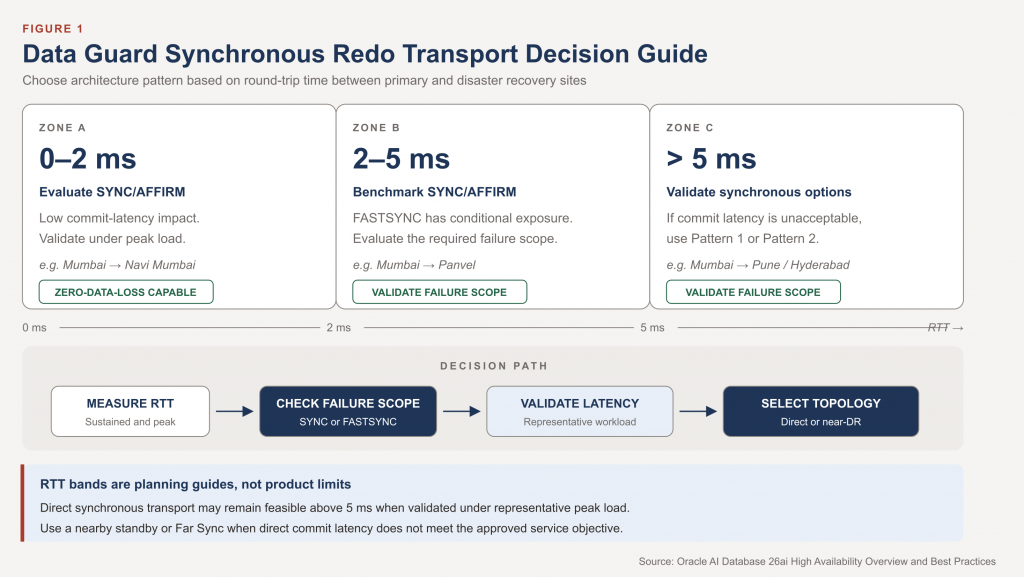
Figure 1: Data Guard synchronous redo transport decision guide. RTT bands are illustrative planning guidance, not Oracle product limits.
The technical brief explains these patterns and how Indian banks can progress from a Gold MAA data-protection foundation to Platinum MAA, with Diamond MAA options for qualifying workloads requiring extreme availability.
Read the technical brief
Explore the architecture patterns, technology choices, and phased implementation roadmap in Achieving Zero Data Loss in Indian Banking with Oracle Maximum Availability Architecture.