
Oracle Integration continues to advance intelligent automation and enterprise connectivity with this release, delivering enhancements across adapters, native actions, AI workflows, security, and cloud connectivity. This update focuses on helping customers build integrations that are more flexible at runtime, easier to move across environments, and better aligned with modern authentication, private connectivity, and cloud interoperability requirements.
With this release, Oracle Integration improves several common integration patterns, including event-driven processing, schema-based messaging, temporary data reuse, dynamic payload handling, intelligent search, document-processing workflows, and API resilience. These enhancements help reduce custom logic, minimize design-time reconfiguration, and make integrations easier to maintain as business applications, payload structures, and deployment environments change.
New Adapters
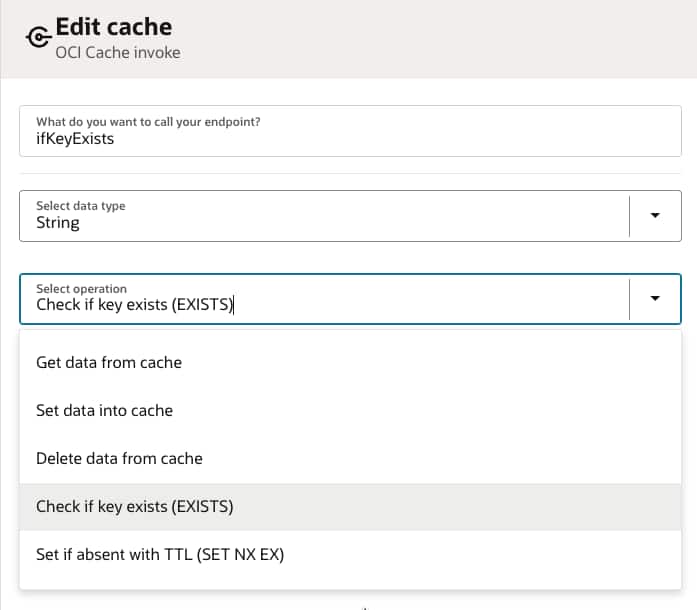
- OCI Cache Adapter – New adapter providing connectivity to OCI Cache clusters with support for string and list operations, TTL-based caching, key existence checks, private endpoint connectivity, and key prefix strategies.
- Azure Synapse Database – Microsoft SQL Server Adapter-certified to integrate with Azure Synapse.
New Native Action
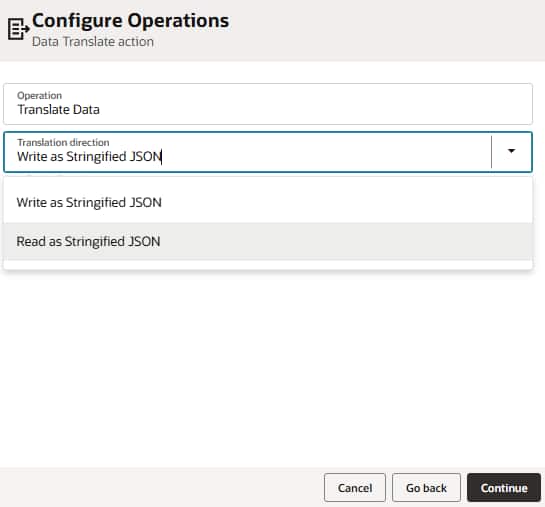
- Data Translate – Translate Native Payload (XML) to Stringified JSON and Vice versa.
AI-Infused Workflow Enhancements
- Oracle Autonomous AI Transaction Processing (ATP) Adapter – Adds support for Hybrid Index Operations, enabling document ingestion, hybrid index creation, intelligent search, and ingestion status tracking.
- AI Agent Native Action – Adds a Callback Agent operation for asynchronous tool responses and adds agent run status in the Get Agent Activity Stream response.
- OCI Document Understanding
- Support for cross region and non-commercial regions
- Support for confidence scores for custom models
- Support for multiple pages in a custom model
- OpenAI Adapter – File delete operation support
Enhancements to existing Adapters
- REST Adapter Enhancements
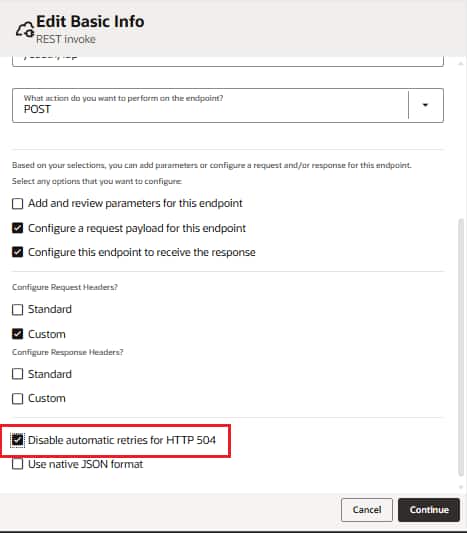
- HTTP 504 retry control for invoke connections
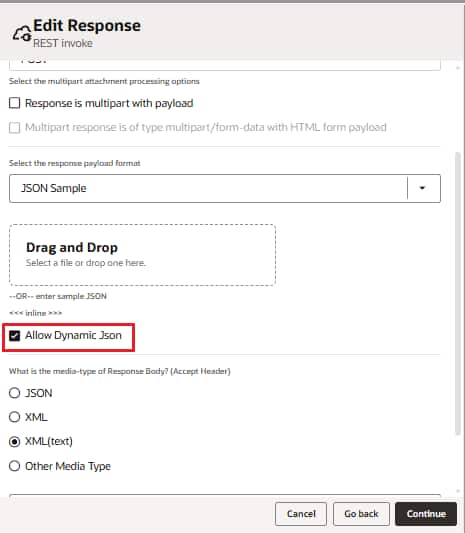
- Dynamic JSON request and response payload support for runtime payloads with additional keys
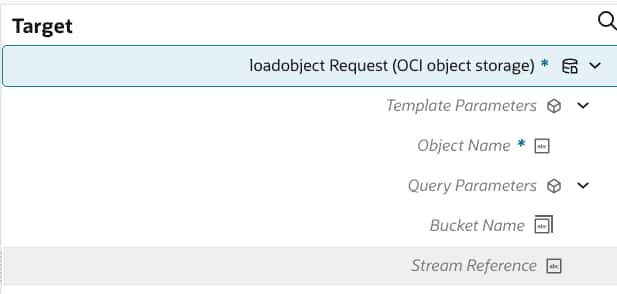
- OCI Object Storage Action – Supports dynamic bucket name mapping at runtime for Manage objects operations.
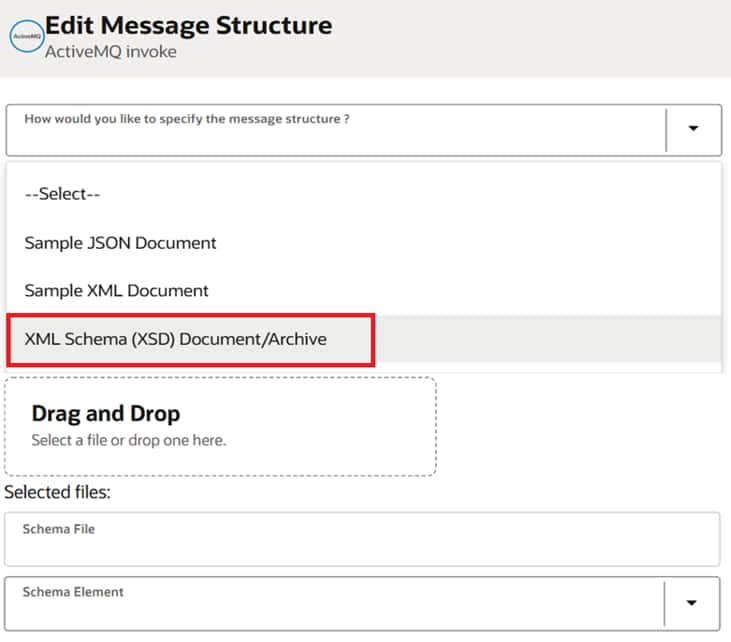
- ActiveMQ Adapter – Adds XSD document support and dynamic address and queue mapping for invoke connections.
- Microsoft SharePoint Adapter – Adds site search during endpoint configuration.
- Security and Authentication Enhancements – Modernizes authorization standards and connectivity across key ecosystem adapters:
- Jira Adapter – Adds PKCE support with the Authorization Code Credentials security policy.
- Microsoft SharePoint Adapter – Adds OAuth 2.0 Authorization Code Credentials support.
- Salesforce: Supports External Client Apps with ROPC and Basic Auth migration paths.
- Snowflake: Adds Key Pair Authentication and single-use refresh token rotation.
- Slack: Enables Private Endpoint (PE) support for secure, isolated OCI VCN connectivity.
Additional Updates
- Database Adapters – Introduces updated adapter names with no impact to existing integrations.
- Oracle Database Adapter → Oracle AI Database Adapter
- Oracle Autonomous Transaction Processing Adapter → Oracle Autonomous AI Transaction Processing (ATP) Adapter
- Oracle Autonomous Data Warehouse Adapter → Oracle Autonomous AI Lakehouse (LH) Adapter
Certification Updates
- IBM DB2 Adapter – Certified with IBM DB2 Version 11.5.7 for Linux, UNIX, and Windows, and IBM DB2 Version 11.5.9 for cloud.
- MySQL Adapter – Certified with MySQL Version 8.4, in addition to previously supported MySQL versions 5.6.14, 8.0, and 8.3.
****Important Deprecation Notices****
Review the following platform retirements and update affected integrations before the stated dates to avoid disruption.
- Salesforce Adapter ROPC-based connections – Salesforce is retiring ROPC for connected apps. Oracle Integration customers using Salesforce Adapter ROPC-based connections should migrate before the Salesforce Winter 2027 release by moving to Authorization Code Credentials and replacing affected connections in integrations. This change does not apply to the Salesforce REST Adapter. Read more.
- SAP SuccessFactors Basic Authentication and API retirements – SAP SuccessFactors is retiring Basic Authentication and selected APIs used by Oracle Integration customers. Affected areas include SAP SuccessFactors Adapter connections using SuccessFactors Custom Policy, SOAP-based Employee Central SFAPIs except CompoundEmployee, and Legacy People Profile Configuration OData V2 APIs. Basic Authentication and affected SFAPIs retire on November 20, 2026; Legacy People Profile APIs are deleted on November 13, 2026. Customers should migrate to supported authentication, move applicable SFAPI usage to OData APIs, and redesign Legacy People Profile API usage where needed. Read more.
OCI Cache Adapter – New Adapter
This release introduces the new OCI Cache Adapter, enabling Oracle Integration customers to store and retrieve temporary data for short-term reuse during integration processing. This helps reduce repeated calls to backend applications or databases for transient values such as tokens, order references, session data, or identifiers.
The adapter supports invoke integrations and connectivity to both sharded and non-sharded OCI Cache clusters. Key capabilities include:
String and list operationsfor storing and retrieving transient values during processingKey existence and TTL-based operationsfor common caching scenarios and automatic expiryPrivate endpoint connectivityfor secure access to OCI Cache clusters deployed in customer tenancies
This enhancement helps customers improve performance, reduce unnecessary backend calls, and simplify integration patterns that rely on temporary data reuse.
Azure Synapse Database – Microsoft SQL Server Adapter Certified to Integrate with Azure Synapse
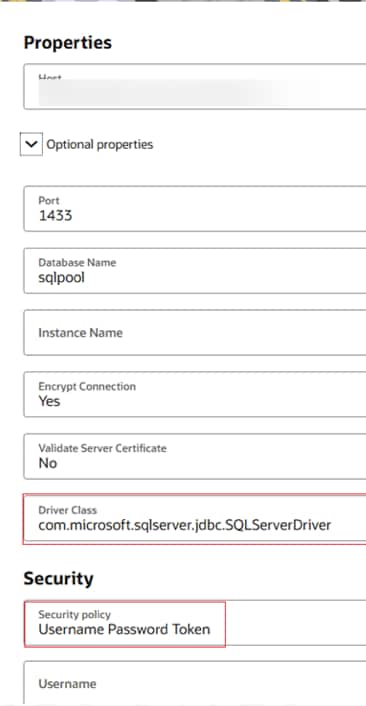
The Microsoft SQL Server Adapter is now certified to integrate with the Azure Synapse Database. This enhancement makes it easier for customers to connect Oracle Integration with Azure Synapse while continuing to use existing Microsoft SQL Server integration patterns.
Azure Synapse connections use the Username Password Token security policy, helping customers extend existing connectivity to support additional Microsoft data platform scenarios.
Data Translate – Native Payload (XML) to Stringified JSON and Vice Versa
This release introduces a new Data Translate native action for converting between Oracle Integration native XML payloads and stringified JSON. Customers can use it to write native XML payloads as stringified JSON and read stringified JSON back into native payloads for mapping and downstream processing.
This helps simplify integration design by removing the need for multi-step workarounds such as Stage File operations or custom JavaScript, reducing flow complexity and maintenance effort.
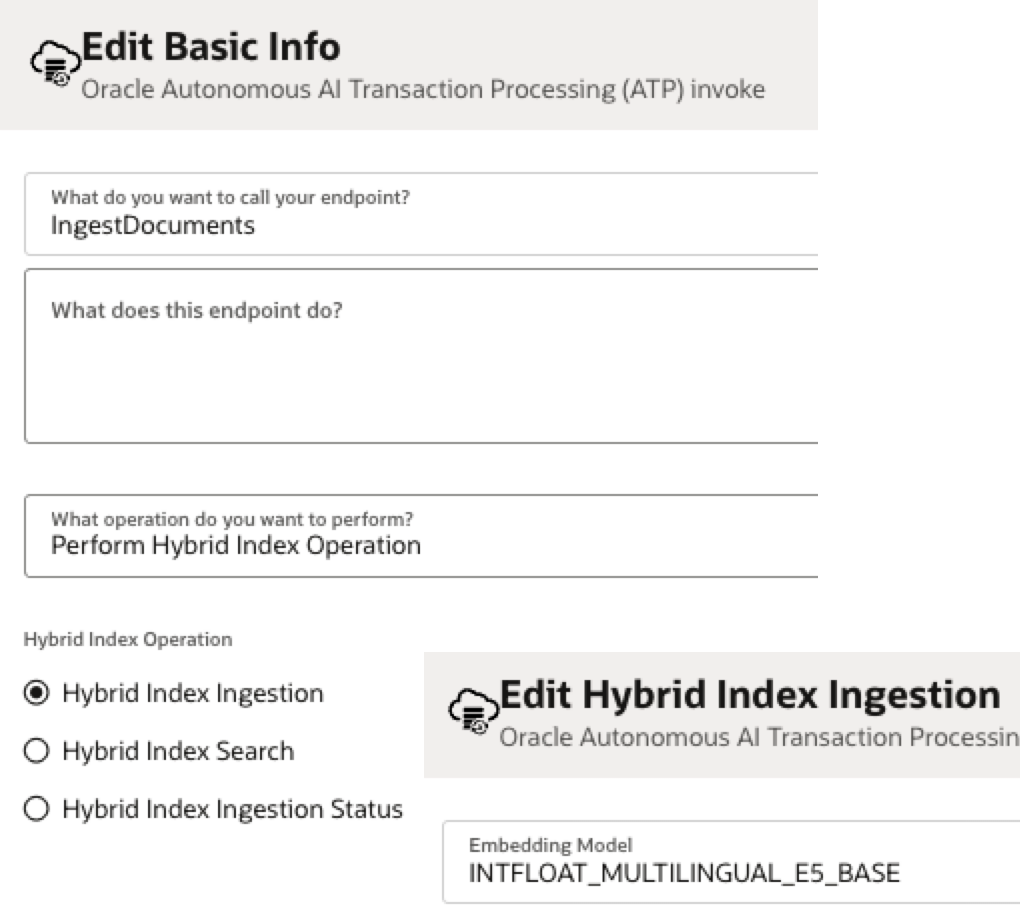
Oracle ATP Adapter Enhancement – Supports Hybrid Index Ingestion and Search Operations
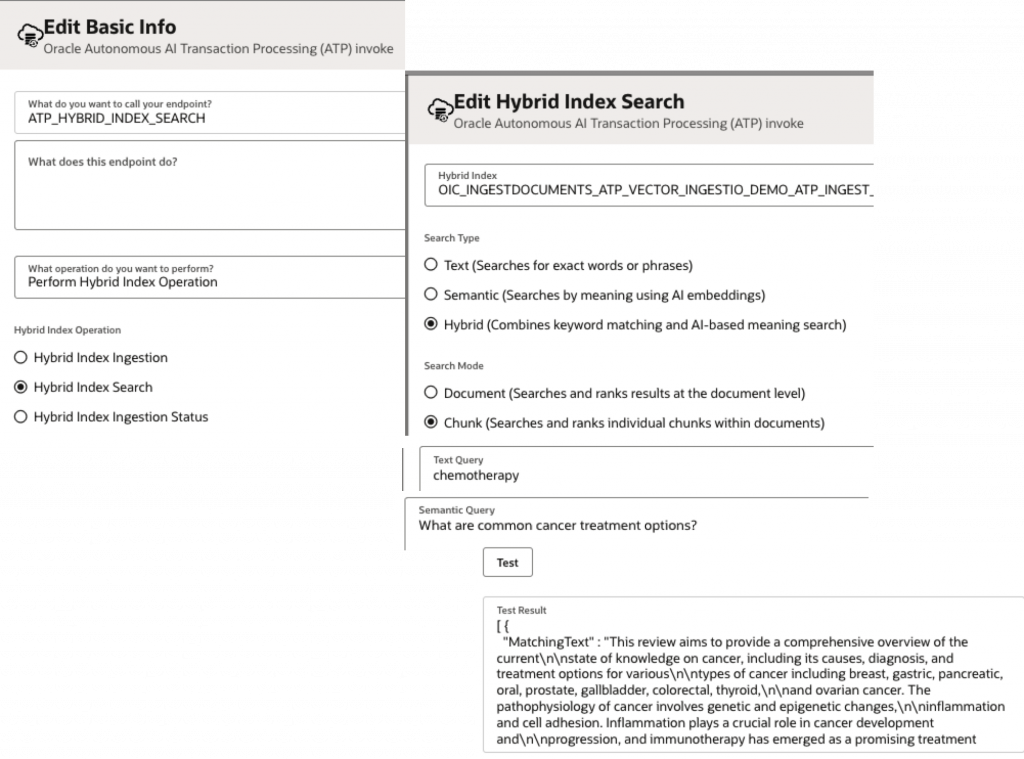
The Oracle Autonomous AI Transaction Processing (ATP) Adapter now supports Hybrid Index Operations for invoke integrations, enabling customers to ingest documents, create hybrid indexes, perform intelligent searches, and track ingestion job status directly from Oracle Integration.
The adapter includes three operations:
Hybrid Index Ingestionto create hybrid indexes using a selected embedding modelHybrid Index Searchto perform text, semantic, and hybrid searchHybrid Index Ingestion Statusto track ingestion progress using the job ID
Search results can be ranked at the document level or chunk level, helping customers build intelligent integrations that retrieve relevant information from indexed content more effectively while reducing manual lookup effort.
Hybrid Index Operations are supported with the JDBC With OCI Signature security policy.
AI Agent Native Action Enhancement – Callback Agent Operation
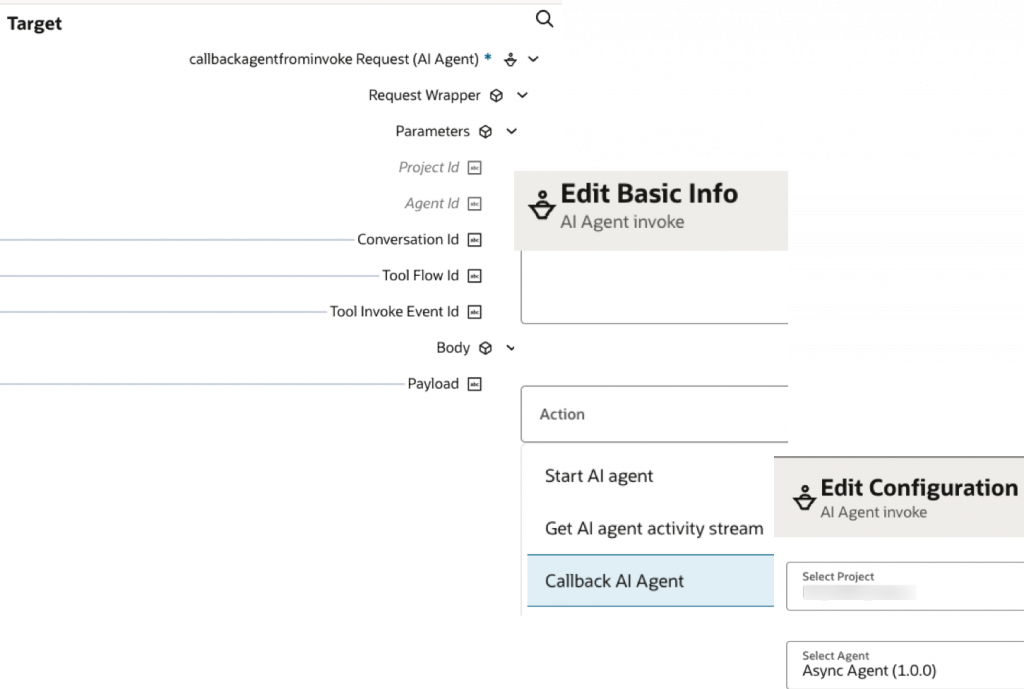
This release introduces the Callback Agent operation in the AI Agent native action. It supports agent runs that invoke asynchronous tools or long-running processes and need to continue after the tool response is available.
When an agent run is started from the Oracle Integration UI or by using the Start Agent operation, and the agent invokes an asynchronous tool, the run waits for the tool response. The asynchronous tool or downstream process can later invoke the Callback Agent with the response payload and callback context. Oracle Integration then applies the returned payload as the tool response and the agent continues processing.
The callback request uses the following context:
Conversation IDidentifies the original agent conversation.Tool flow IDidentifies the runtime tool flow instance associated with the asynchronous tool call.Tool invoke event IDidentifies the specific tool invocation being completed.Response payloadprovides the asynchronous tool response as a stringified JSON payload.
Project ID and Agent ID can also be mapped when the callback needs to override the agent selected during configuration. Otherwise, the agent selected in the configuration wizard is used.
For custom asynchronous tools, the initiating tool should pass the required callback context to the downstream application so it can return the response later. Human-in-the-Loop flows do not require this explicit callback setup because callback context is handled internally.
This release also adds a Status field to the Get Agent Activity Stream response so integrations can check whether an agent run is waiting for tool completion or has succeeded.
Document Understanding: Region Support, Confidence Scores, and Multi-Page Custom Model Support
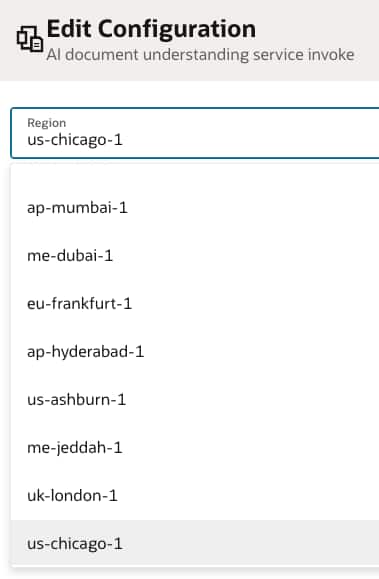
This release enhances the OCI Document Understanding Service native action in AI Workflows to help customers deploy document-processing integrations more flexibly and extract results more reliably.
AI Workflows now support region selection for OCI Document Understanding, allowing customers to align processing with the region where their resources are deployed. The OCI Document Understanding native action is also extended to non-commercial regions and dedicated regions Cloud@Customer (DRCC), helping customers use document extraction in more OCI deployment environments.
Custom model extraction now includes confidence scores, helping customers assess result reliability before using extracted values in downstream processing. It also supports multi-page documents, making it easier to extract information from business documents where relevant data spans more than one page.
OpenAI Adapter Enhancement – Adds File Delete Support
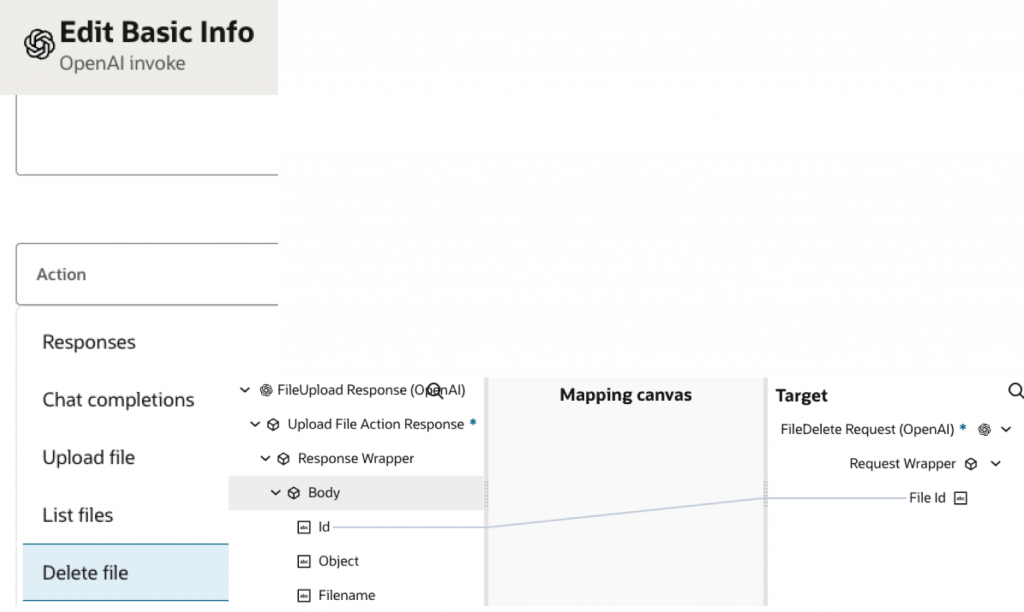
Open AI adapter now supports deleting files that were uploaded for OpenAI processing. This helps customers manage file lifecycle cleanup after files are no longer needed by the workflow. For the underlying OpenAI file lifecycle operation, see Delete a file.
REST Adapter Enhancements – Dynamic JSON Support and HTTP 504 Retry Control
With this release, the REST Adapter adds support for Dynamic JSON request and response payloads, and HTTP 504 retry control
Dynamic JSON Request and Response Payload
This release adds support for handling dynamic JSON in REST Adapter request and response payloads.
In many integration scenarios, customers configure the REST Adapter with a known request or response sample or schema, but the actual runtime payload can include additional JSON keys. Previously, if those keys were not defined in the configured structure, they were dropped during translation.
With this enhancement, customers can enable an option to allow dynamic JSON in request and response payloads. When enabled, additional keys present at runtime are translated and made available in the integration flow, even if they were not part of the originally configured structure.
These enhancements make REST integrations more flexible for APIs whose request or response content can vary across calls.
Without Dynamic JSON option
| { “freeformTags”: { “tagKey1”: “tagValue1” } } | { “freeformTags”: { “tagKey1”: “tagValue1”, “tagKey2”: “tagValue2” } } | { “request-wrapper”: { “freeformTags”: { “tagKey1”: “tagValue1”, } } } |
After allowing Dynamic JSON
| { “freeformTags”: { “tagKey1”: “tagValue1” } } | { “freeformTags”: { “tagKey1”: “tagValue1”, “tagKey2”: “tagValue2” } } | { “request-wrapper”: { “freeformTags”: { “tagKey1”: “tagValue1”, “tagKey2”: “tagValue2” } } } |
HTTP 504 Retry Control
The REST Adapter now allows Oracle Integration customers to disable automatic retry specifically for HTTP 504 Gateway Timeout errors on invoke connections.
This is useful in scenarios in which the downstream application continues processing the request, but the response times out before Oracle Integration receives it. In such cases, retrying the same request can result in duplicate processing for sensitive operations such as payment or transaction-related flows.
Customers can configure this behavior at the invoke level by selecting an option to disable retry for 504 responses.
This enhancement is targeted specifically at 504 timeout scenarios and preserves the existing retry behavior for other error conditions.
OCI Object Storage Action – Dynamic Bucket Name Support
With this release, the OCI Object Storage Action supports dynamic bucket name mapping at runtime for Manage Objects and Bucket operations, including list object scenarios.
Customers can continue to select the compartment and bucket during design time, while passing the bucket name dynamically at runtime. This allows the same integration to work across different buckets without requiring redesign or reconfiguration for each bucket change.
When a bucket name is provided at runtime, Oracle Integration resolves the associated compartment context automatically, even if the compartment is not mapped separately.
This enhancement is especially useful when promoting integrations across environments such as development, QA, and production, where bucket names may vary by tenancy or environment. By allowing bucket names to be passed dynamically, customers can reduce environment-specific updates and reuse integrations more easily across buckets and deployments.
ActiveMQ Adapter Enhancements – Support for XSD Documents
The ActiveMQ Adapter now supports XML Schema (XSD) documents or schema archives for defining structured message payloads. This enhancement enables customers to leverage schema-driven message definitions, ensuring data consistency and validation across integrations. XSDs define the structure, data types, and validation rules of XML messages, ensuring that payloads conform to expected formats. This is essential for maintaining data integrity, enforcing integration contracts, and supporting complex message structures across systems.
Oracle Integration customers can:
- Upload a single XSD file
- Upload an XSD archive containing multiple schema files
- Select the required schema during configuration
This support is available for both trigger and invoke connections.
This release also adds more flexibility for publishing messages. For invoke connections, you can now provide the address name and queue name dynamically in the mapper at runtime. Ensure that the address and queue names mapped at runtime match the routing type selected on the wizard page. The message structure remains the same as defined on the Message Structure page.
These updates help simplify setup, support schema-based message structures, and make ActiveMQ message publishing more flexible in Oracle Integration.
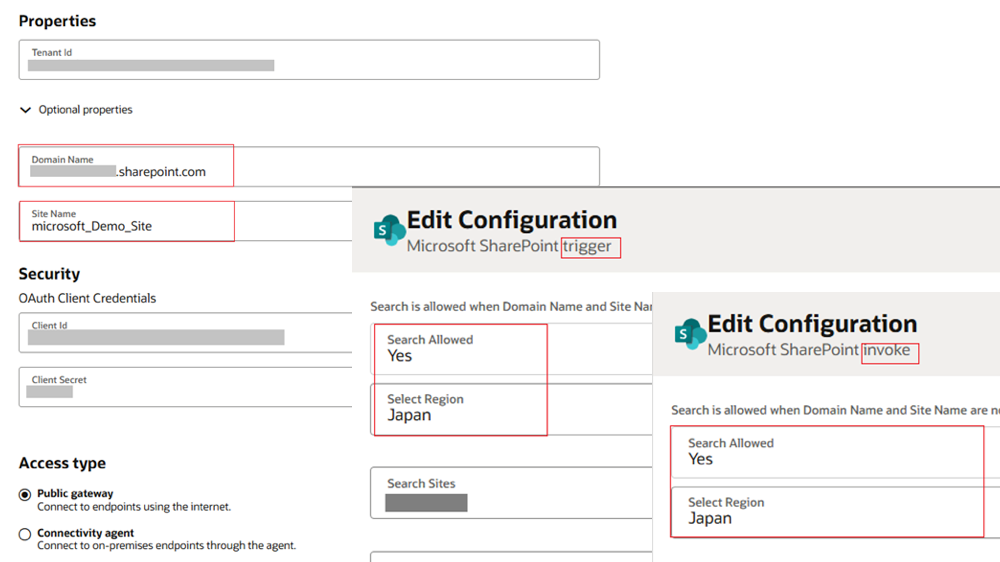
Microsoft SharePoint Adapter Enhancement – Site Search
With this release, the Microsoft SharePoint Adapter enhances site selection during endpoint configuration for both invoke and trigger connections.
Previously, site discovery relied on a paginated API response, which limited the number of sites displayed in the initial list and could make it difficult to locate the required site in large SharePoint environments.
To simplify site discovery, the adapter now includes a Search Site option in the configuration wizard. Users can search for SharePoint sites by specifying the Region and a keyword from the site name, making it easier to locate and select the required site during configuration.
This enhancement improves the configuration experience for integrations that work with multiple SharePoint sites and helps reduce the effort required to discover sites in large SharePoint environments.
Refer to the screenshots below for more details.
Connection, Invoke, and Trigger Pages
Security and Authentication Enhancements
This release introduces several security and authentication enhancements to support modern authentication standards and strengthen enterprise connectivity.
| Jira Adapter | Adds PKCE (Proof Key for Code Exchange) support with the Authorization Code Credentials security policy. |
| Microsoft SharePoint Adapter | Adds support for the OAuth 2.0 Authorization Code Credentials security policy. |
| Salesforce Adapter | Adds support for the Client Credentials security policy using Salesforce External Client Apps. As Salesforce transitions from Connected Apps to External Client Apps and retires legacy authentication mechanisms, customers should review ROPC Migration and Basic Auth to OAuth Migration guidance. |
| Snowflake Adapter | Adds support for Key-Pair Authentication and single-use refresh tokens for Authorization Code Credentials. When single-use refresh tokens are enabled in the Snowflake security integration, Snowflake issues a new refresh token each time the previous refresh token is used. The adapter supports this token rotation behavior for Authorization Code Credentials. |
| Slack Adapter | The Slack Adapter supports connectivity through a private endpoint (PE), allowing connections to both publicly accessible resources over the public internet and private resources within your OCI Virtual Cloud Network (VCN). This enhancement improves security and enables seamless integration with Slack instances deployed in private networks. |
Oracle Database Adapters Renaming Update
With this release, Oracle has introduced updated names for key database adapters to align with its evolving AI-powered database portfolio. This change reflects Oracle’s continued focus on embedding intelligence, automation, and advanced analytics across its cloud services.
The following renaming has been applied:
| Oracle Database Adapter | Oracle AI Database Adapter |
| Oracle Autonomous Transaction Processing Adapter | Oracle Autonomous AI Transaction Processing (ATP) Adapter |
| Oracle Autonomous Data Warehouse Adapter | Oracle Autonomous AI Lakehouse (LH) Adapter |
From a usability perspective, this is strictly a terminology update. There is no impact to existing integrations, and all current configurations, connections, and runtime behaviours remain unchanged.