


Enterprises are moving quickly to production-grade AI agents and Enterprises don’t struggle to build AI agents—they struggle to operationalize them safely. The gap is usually between insight (reasoning over enterprise knowledge) and action (executing approved changes across systems of record). A practical, repeatable architecture is to split these responsibilities.
What’s missing in many AI agentic solutions isn’t intelligence—it’s an operating model that connects trusted enterprise data, business processes, and application actions into one governed system, so recommendations reliably become outcomes.
That’s where a combined blueprint using Oracle AI Data Platform (AIDP) and Oracle Integration becomes compelling:
- Oracle AI Data Platform (AIDP) provides the intelligence and data foundation—governed access to enterprise data, analytics/AI lifecycle capabilities, and an environment to host agents for reasoning, grounding, and retrieval.
- Oracle Integration provides the action and orchestration layer—predictable execution across applications using integrations, automation, decisions, asynchronous flows, and human oversight.
This combination creates a reusable architecture for enterprises that already have:
- a data lake or lakehouse,
- enterprise integrations and workflows,
- and Oracle Fusion or other core operational applications.
Introduction to the blueprint architecture
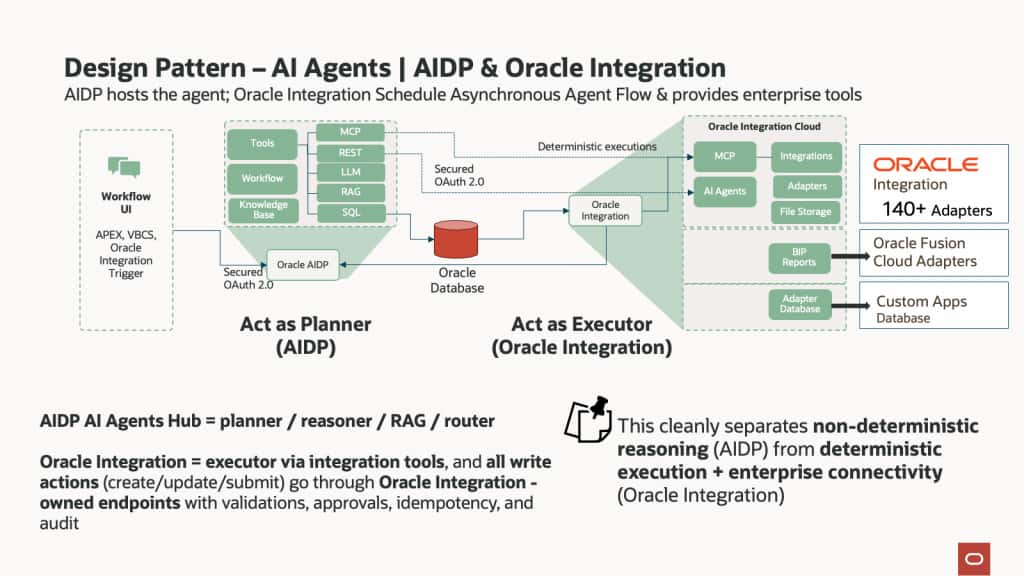
At a high level, the architecture follows a Planner–Executor pattern:
- AIDP hosts the agent (Planner / Intelligence Hub)
The agent interprets context, reasons over enterprise knowledge, performs retrieval and matching, and generates structured recommendations. - Oracle Integration schedules and executes asynchronous agent flows (Executor / Enterprise Control Plane)
Oracle Integration runs the reliable, auditable steps: orchestrations, decisions, approvals, integrations, and updates across systems of record—often asynchronously for scale and resilience.
The result is a reusable pattern that balances:
- Adaptive automation (agentic reasoning),
- Predictable automation (deterministic orchestration),
- Human oversight (approvals, exceptions, accountability).
Oracle AI Data Platform: the intelligence and data foundation
AI agents are only as strong as the data they can trust and the governance boundaries they operate within. Oracle AI Data Platform is designed to unify major steps across the data-to-AI lifecycle—data access and ingestion, preparation, modeling, deployment, governance, and reuse—in one governed environment.
Why that matters for agents:
- Agents need broad and reliable access to enterprise context, not fragmented extracts.
- Teams need repeatability: curated data products, reusable assets, and controlled policies.
Key strengths AIDP brings to enterprise agentic architectures:
- Governed access to enterprise data across sources, with policy enforcement.
- Zero-copy / zero-ETL patterns where appropriate to reduce duplication and data sprawl.
- A centralized foundation for catalog, metadata, and lineage, improving trust and traceability.
- Support for grounding and retrieval (RAG) over curated knowledge.
- Reusable AI and data assets that can be applied across multiple use cases and domains.
Broad ingestion/connectivity (databases, object storage, SaaS/enterprise sources, streams) to supply agents with timely context.
Continuous/near-real-time pipelines to keep agent context current (important for operational agents working on live processes).
In short: AIDP turns enterprise data into trustworthy intelligence.
Oracle Integration : the action and orchestration layer
Intelligence becomes business value only when it is translated into approved, tracked, governed action—inside the systems where the business runs.
Oracle Integration provides that execution fabric. Importantly, Oracle Integration is not “just connectivity.” In enterprise agentic designs, it acts as a control plane spanning:
- Integrations and adapters across SaaS and on-premises systems (including Oracle Fusion connectivity).
- Orchestration for multi-step workflows.
- Asynchronous execution (schedules, long-running flows, resilient retries).
- Decisions / rule-based services where predictability and policy enforcement matter.
- Human oversight (approvals, exception routing, escalations).
- Enterprise automation patterns that commonly appear in production workflows (including RPA and B2B, where applicable).
Where Oracle Integration AI Agents fit
For steps that are inherently non-deterministic—such as interpreting semi-structured inputs, handling exceptions, or performing iterative “investigate → act → verify” tasks—Oracle Integration AI Agents (where available) can be introduced within the Oracle Integration layer while still benefiting from Oracle Integration governance and operational controls.
In this blueprint, Oracle Integration AI Agents can:
- Use ReAct-style loops (Reason → Act → Observe → continue) to complete tasks iteratively.
- Run asynchronously within long-running or queued orchestrations.
- Be invoked via REST APIs, making them callable from AIDP, UIs, or other services.
- Evolve toward agent-to-agent (A2A) collaboration patterns as capabilities mature and governance models are established.
In short: Oracle Integration turns intelligence into enterprise-grade execution—and can also host agentic steps when adaptive behaviour is needed inside orchestrations.
The blueprint: a shared agent fabric across data and applications
Core architectural idea
Use AIDP agents for data-intensive reasoning and grounding. Use Oracle Integration for orchestration and controlled execution. Let them communicate through secure way and share structured context and tools.
AIDP-side responsibilities
AIDP agents are best suited for:
- Grounding responses in enterprise data.
- Retrieving structured and unstructured context.
- Pattern analysis and correlation.
- Skill or entity matching.
- Summarization and recommendation.
- AI reasoning on curated business knowledge.
Because AIDP unifies data, analytics, and AI in one environment, these agents can work on governed, reusable, high-quality enterprise data rather than fragmented extracts.
Oracle Integration-side responsibilities
Oracle Integration agents are best suited for:
- Invoking application APIs.
- Orchestrating multi-step workflows.
- Applying decision logic where predictability matters.
- Routing approvals and exceptions.
- Handling notifications.
- Updating operational systems.
- and Managing human-in-the-loop interactions.
Why both are needed
- An agent may correctly recommend “what to do,” but enterprises still need “how to do it” safely—through validations, approvals, policies, and reliable integration patterns.
- Deterministic workflows alone can automate known steps, but they don’t interpret unstructured intent, synthesize knowledge, or adapt to ambiguity.
Together:
- AIDP supplies trusted intelligence.
- Oracle Integration supplies controlled execution.
- Fusion and enterprise apps remain the system of record and system of action.
How the blueprint works technically (step-by-step)
Step 1: Connect and contextualize (Oracle Integration)
ORACLE INTEGRATION triggers on a schedule, event, or UI action and retrieves authoritative context from systems of record:
- IDs and current statuses.
- Structured fields required for processing.
- Any constraints needed to enforce policies.
Step 2: Ground and reason (AIDP)
AIDP hosts the agent that reasons over:
- Curated knowledge bases and documents (RAG).
- Historical records and analytics context.
- Governed metadata and reference/master data (where relevant).
The agent produces structured outputs (recommendations, ranked lists, rationale snippets, next actions).
Step 3: Define the decision boundary (agentic vs deterministic)
Explicitly separate:
- Agentic steps: interpretation, ranking, summarization, recommendation, adaptive exception handling (AIDP and/or Oracle Integration AI Agents).
- Deterministic steps: compliance checks, approvals, transactions, updates to systems of record (Oracle Integration workflows + decisions).
Step 4: Execute through governed tools (Oracle Integration)
Oracle Integration exposes enterprise capabilities as reusable “tools”:
- Integrations/adapters (Fusion and beyond).
- Orchestrations and automations.
- Decision services and validations.
- Notifications and task routing.
Oracle Integration executes reliably with retries, exception management, and operational monitoring.
Step 5: Observe, review, and improve (AIDP + Oracle Integration)
Operationalizing agentic solutions requires:
- Traceability (what happened and why).
- Human oversight and exception queues.
- Feedback loops to improve retrieval, prompts/config, rules, and playbooks.
- Reuse of assets across domains (data products, models, integrations).
Use case example: Talent Requisition AI Agent
Business scenario
When a requisition is opened (or on a schedule), the enterprise wants to:
- Retrieve requisition requirements from ATS/HRMS.
- Find matching candidates from a governed CV/profile knowledge base.
- Persist shortlist results with traceability.
- Notify stakeholders and update downstream recruiting workflows.
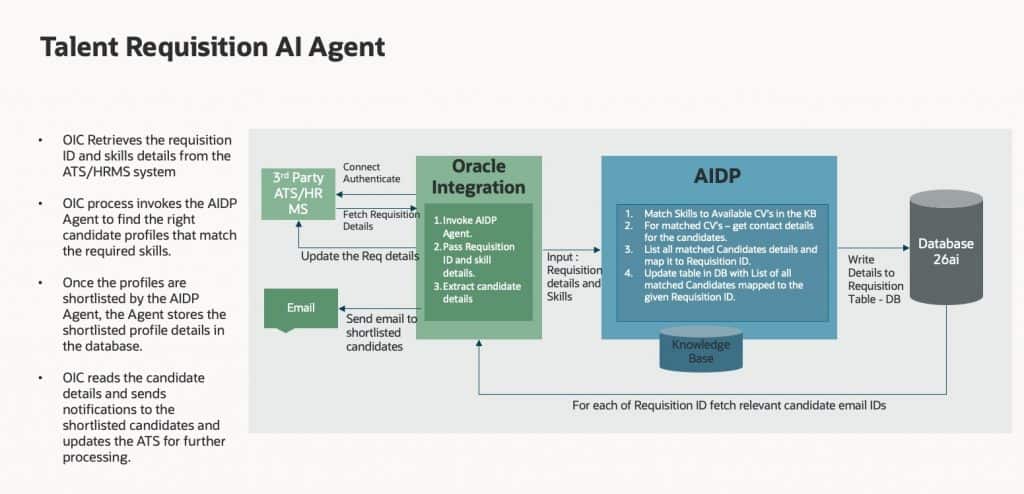
End-to-end flow
- Oracle Integration extracts requisition context from system of record (ATS/HRMS / Fusion HCM)
- Oracle Integration runs an integration/orchestration flow to fetch Requisition IDs, Job/Position metadata, and required competencies/skills (plus optional constraints like location, grade, clearance, employment type).
- Oracle Integration invokes an Oracle AIDP Agent endpoint with a structured, minimized input
- Oracle Integration calls the AIDP-hosted Agent (REST) and passes a compact JSON payload (e.g., requisitionId, requiredSkills, seniority, must-have criteria, weights).
- The call includes correlation IDs / headers for traceability and any required auth (per enterprise integration standards).
- AIDP Agent performs grounded retrieval + ranking using RAG and tool invocation
- The Agent executes a retrieval-augmented generation (RAG) pipeline:
- Builds embeddings for the requisition skills/criteria. Queries the vector index over curated candidate artifacts (profiles, skills matrix, resumes, assessments, interview notes—only approved sources).
- Applies grounding by attaching evidence snippets (source doc references) to every match/rationale.
- The Agent applies ranking/scoring logic (LLM-assisted + deterministic rules, as designed): skill coverage, recency, proficiency level, domain alignment, must-have compliance.
- The Agent generates job-relevant rationale and “evidence citations” (e.g., extracted lines from candidate sources) and returns structured outputs suitable for downstream automation.
- The Agent executes a retrieval-augmented generation (RAG) pipeline:
- AIDP persists shortlist artifacts and run-level metadata for auditability/observability.
- Stores results as Requisition → Candidate mappings with:
- Normalized score vector (overall + per-skill), evidence snippets/citations (grounding references), model/agent configuration identifiers, Session Id, timestamp, version metadata and status.
- This enables reproducibility (what model/index produced the result) and operational tracking.
- Oracle Integration executes deterministic post-processing and transactional updates.
- Oracle Integration retrieves approved contact details (subject to permissions/consent) and optionally routes results through a human-in-the-loop recruiter approval step.
- Oracle Integration sends notifications using approved templates/channels and updates the ATS/HRMS/Fusion HCM workflow state (e.g., “Shortlisted”, “Review Pending”, “Contact Initiated”).
Where Oracle Integration AI Agents can complement
If there’s ambiguity or exceptions (e.g., incomplete requisition text, inconsistent skills, inbound recruiter emails, candidate availability clarifications), an Oracle Integration AI Agent can run a ReAct loop to resolve the missing pieces—then hand off the final updates to deterministic Oracle Integration steps.
Business value of the combined pattern
- Unifies the journey from data to action
AIDP strengthens grounding and intelligence; Oracle Integration closes the last mile to execution. - Reduces architecture sprawl
Instead of separate stacks for data, AI, and automation, enterprises adopt a repeatable blueprint with clear responsibilities. - Improves trust and control
AIDP governance (metadata/lineage/policies) plus Oracle Integration predictability (decisions/approvals) enables safer operational AI. - Protects and extends Fusion investments
Oracle Integration acts as the natural action layer for Fusion; AIDP extends reasoning beyond transactional boundaries into broader enterprise data. - Accelerates reuse
AIDP promotes reuse of AI/data assets; Oracle Integration promotes reuse of integrations, automations, and decision services. - AIDP patterns encourage passing a small, structured requisition payload (req_id, skills, level, location, constraints) while keeping sensitive HR data in system-of-record. This reduces prompt-injection surface area and privacy exposure.
- Because content is governed and cataloged, we can drive retrieval using filters (e.g., region, clearance, employment type, last-updated, consent flags) to avoid retrieving ineligible/expired profiles.
Guardrails and compliance considerations (especially important for HR)
Recruiting is a high-sensitivity domain. Build guardrails into the design:
- Data minimization: send only what the agent needs; avoid unnecessary personal data in prompts/contexts.
- Job-relevant criteria only: ensure matching is based on requisition requirements; avoid using or inferring protected attributes.
- Human-in-the-loop: require recruiter approval before outreach or system-of-record updates where policy demands it.
- Explainability & audit trail: store scores, evidence snippets, run metadata, timestamps, and who/what triggered actions.
- Secure communications: use approved templates and channels; ensure consent/opt-out practices match policy and regional regulation.
- Access controls: least privilege for tool access; separation of duties for sensitive actions.
- Policy-gated disclosure: flow is strengthened when AIDP stores tokenized candidate references and Oracle Integration performs a policy-checked lookup only after approval. AIDP supports the pattern by not requiring PII inside the model context.
(Validate against Oracle security, privacy, and HR data-handling requirements and your organization’s compliance obligations.)
Best practices: what makes this enterprise-grade
- Responsibility split across AIDP (intelligence), Oracle Integration (execution), and Fusion-native capabilities where appropriate.
- Tool catalog + RBAC (Role Based Access): expose APIs/actions as governed tools with role-based permissions.
- Decision boundary: keep critical updates deterministic; enforce approvals and validations through Oracle Integration.
- Strong contracts: structured schemas; correlation IDs end-to-end.
- Idempotency and resilience: retries with backoff, dead-letter patterns, compensation strategies.
- Observability: step-level logs/metrics and audit records across agent + orchestration layers.
- Reusable playbooks: versioned workflow/task definitions for common patterns (shortlist, notify, update, exception routing).
- Continuous improvement: feedback loops from exceptions and user review into retrieval tuning, rule updates, and prompt/config versioning.
What enterprises should consider before adopting the pattern ?
- Is an agent truly needed?
Use agentic steps where interpretation/adaptation adds measurable value; keep purely deterministic work as orchestration. - Which framework belongs where?
Don’t force one approach across everything:- Fusion-native agents for app-centric processes
- AIDP agents for data/knowledge-centric reasoning
- Oracle Integration orchestration for cross-system execution and governance
- Oracle Integration AI Agents for adaptive tasks within orchestrations (where appropriate)
- Data readiness and governance
Ensure curated, permissioned knowledge sources; define retention and access controls early. - Operating model and ownership
Define SLAs, runbooks, exception handling, and approval responsibilities (HR ops, IT integration teams, CoE). - Security and compliance posture
Confirm identity propagation, least privilege, auditing needs, and regional constraints before enabling automation at scale.
Conclusion
The future of enterprise AI isn’t isolated agents operating outside business systems. It’s architectures that connect trusted data, adaptive reasoning, predictable execution, and human oversight.
- Oracle AI Data Platform provides governed data access and reusable intelligence across the data-to-AI lifecycle.
- Oracle Integration provides the integration, orchestration, decisions, and operational controls to turn intelligence into business action—and, where appropriate, Oracle Integration AI Agents can handle non-deterministic tasks using ReAct-style loops within asynchronous orchestrations.
Together, they provide a practical blueprint to move from experimentation to scalable operational value—from data to action.