
Ajay Narayan,
Senior Manager, Equinix
Enterprise users do not think in APIs, integrations, orchestration logic, or backend systems. They think in questions.
At Equinix, business teams needed a faster and more intuitive way to access invoice information from Oracle Fusion. The information was already available, but the experience of retrieving it was still shaped by traditional enterprise integration patterns: predefined inputs, structured requests, and logic-heavy flows maintained by IT.
The business expectation was simple: a user should be able to ask a question from Microsoft Teams and receive an accurate answer from Oracle Fusion. A request could be as straightforward as, “Show me the status of invoice 12345,” or more conversational, such as, “Need invoice details.” From there, the system should guide the user, understand the intent, retrieve the right data, and return a clear response.
With the Agentic AI capabilities in Oracle Integration Cloud (OIC), Equinix and Oracle explored a new approach: shifting from rigid orchestration to intelligent, context-aware integration
The Business Need: Ask Naturally, Get Accurate Answers
The use case started with invoice inquiry. Business users wanted to retrieve invoice status, invoice details, payment information, pending approvals, and overdue invoice information directly from Microsoft Teams.
In a traditional model, users often need to know exactly what to ask and how to ask it. They may be expected to follow a specific format, choose from a predefined menu, or provide data in a way the integration can understand. That format creates friction, especially when different users phrase the same request differently.
With a conversational experience, the interaction becomes much more natural. A user can begin with a broad request like “Need invoice details,” and the agent can guide the next step by asking whether the user wants to search by invoice number, PO number, supplier name, or supplier number.
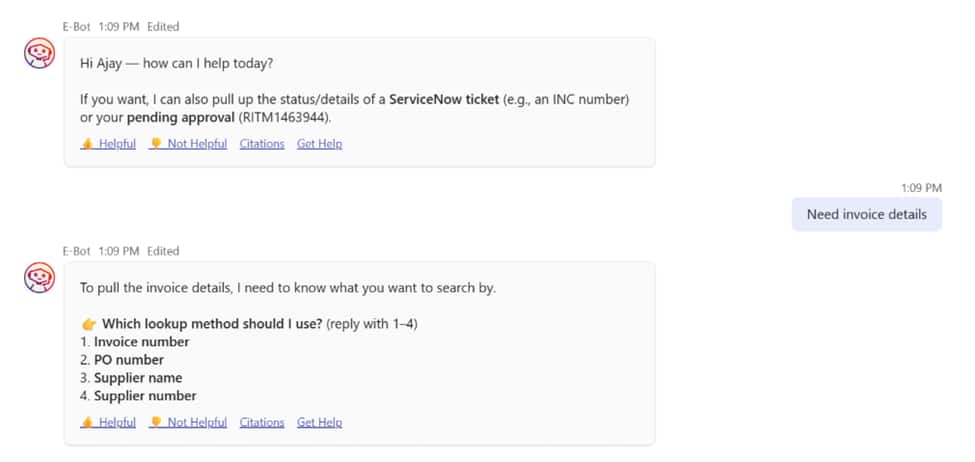
This experience is important because the user does not need to understand the backend implementation. The experience feels like a conversation. While OIC handles the integration, agent invocation, tool selection, and response delivery occur behind the scenes.
Before Agentic AI: When Integration Logic Became Too Complex
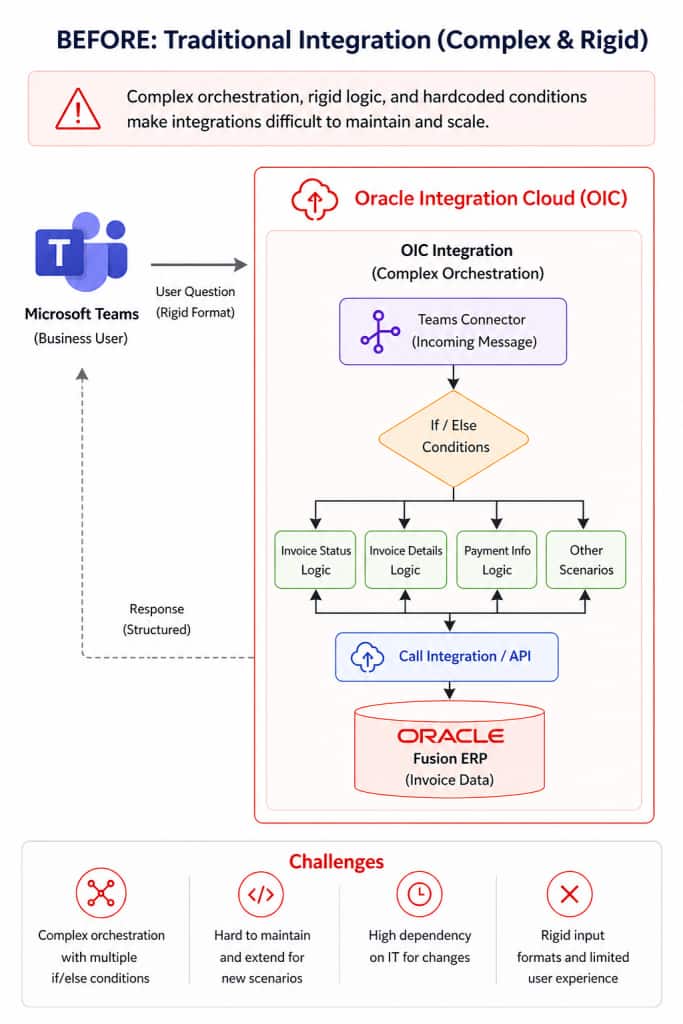
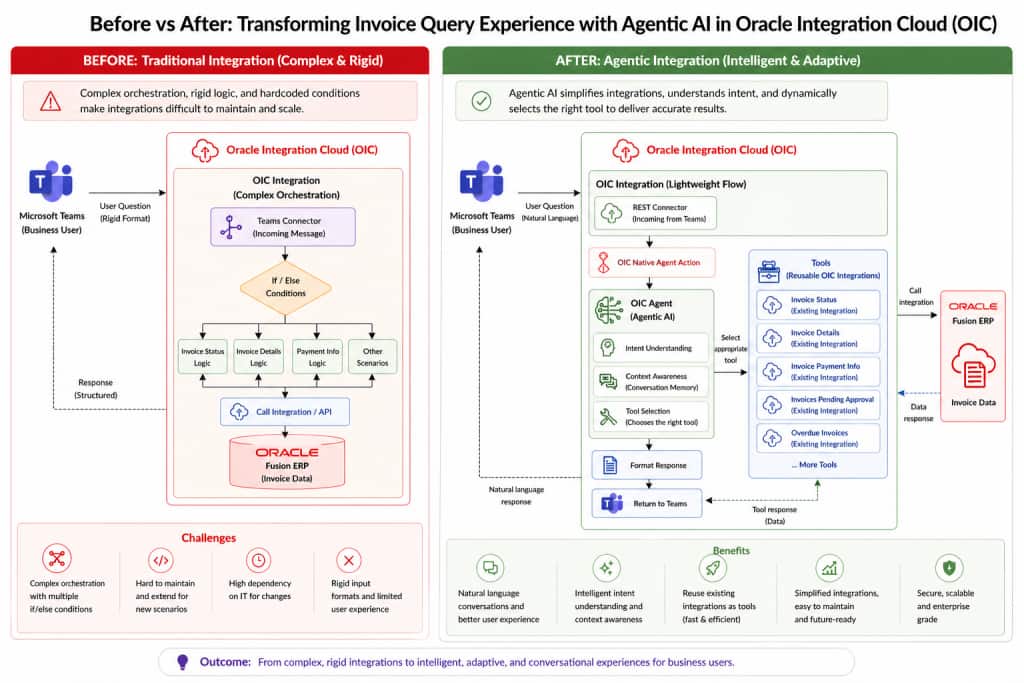
Before adopting the agentic pattern, the invoice inquiry flow was handled using a more traditional integration design. The integration had to interpret the incoming request, determine the lookup path, validate inputs, and route the request through the right branch of logic.
Over time, this type of integration naturally becomes harder to maintain. Each new query type, lookup method, or business variation can introduce additional branching logic. What begins as a straightforward integration can evolve into a large orchestration with multiple conditions, hardcoded paths, and tightly coupled logic.
For IT teams, this creates ongoing maintenance overhead. Small changes can require careful updates to decision logic. New business requirements may need additional branches. Testing becomes more involved because every change can affect multiple paths.
For business users, the experience can feel constrained. They may need to ask questions in a specific way, even when the intent is obvious.
“Even small changes required updates to increasingly complex logic, which wasn’t scalable for how our business teams wanted to interact with data,” said Ajay.
After Agentic AI: From Hardcoded Orchestration to Intelligent Delegation
With Agentic AI in OIC, the architecture changes significantly. Instead of building every possible decision into the integration, the integration can pass the user prompt to an OIC Agent using the OIC Native Agent Action.
The agent then interprets the request, understands the conversation context, and determines which tool should be used. Those tools can be existing OIC integrations that already connect to Oracle Fusion. In this way, Equinix can preserve previous integration investments while enabling a more adaptive user experience.
In this architecture, Microsoft Teams becomes the user entry point. OIC receives the request through a REST connector and invokes the OIC Agent. The agent evaluates the user’s intent and selects the appropriate tool, such as invoice status, invoice details, invoice payment information, pending approvals, or overdue invoices. The selected tool calls Oracle Fusion and returns the result back through OIC to Microsoft Teams.
The key shift is that OIC is no longer just executing a rigid process. It is enabling an intelligent interaction pattern where the agent can reason over intent and context before selecting the right integration capability.
Why This Matters for Business Users
The biggest change for business users is freedom. They are no longer tied to a single predefined question or rigid format. They can ask naturally, clarify, and continue the conversation.
For example, a user may start with “Need invoice details.” The agent can ask what lookup method should be used. The user can respond with “invoice number,” then provide the invoice number, and receive the result. In future interactions, the same user may ask in a different way, such as “Is invoice 98765 paid?” or “Which invoices are pending approval?” The agentic flow is designed to handle this variability more naturally than a deterministic integration.
This creates a chat-like experience from within Microsoft Teams, where users can work from an interface they already use every day. The result is faster access to information, less dependency on IT for query formats, and a more intuitive way to interact with enterprise data.
Why This Matters for Technical Teams
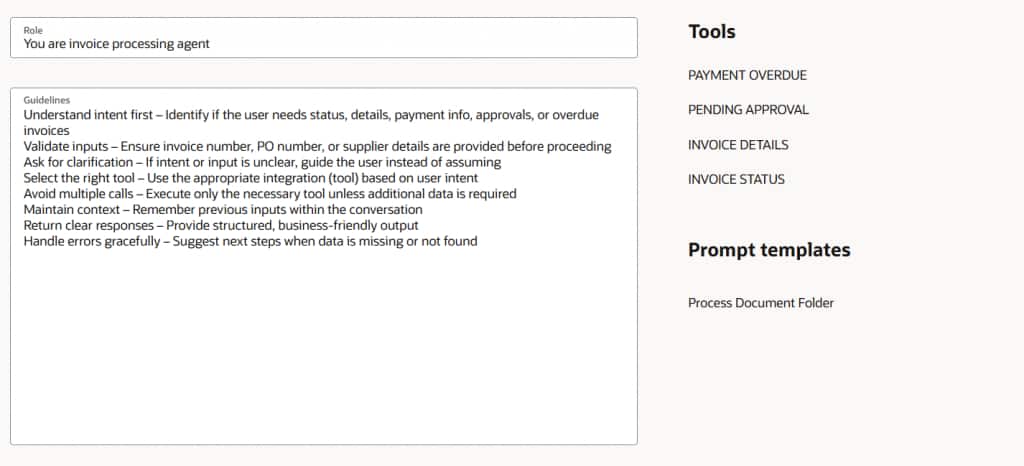
For technical teams, the value is just as significant. The integration becomes simpler because it does not need to contain every possible condition and decision branch. Instead, the integration focuses on receiving the prompt, invoking the agent, formatting the result, and returning the response.
The agent handles intent understanding, context awareness, and tool selection. Existing OIC integrations can be reused as tools, which reduces rework and allows teams to build on what already exists.
This separation of concerns makes the architecture easier to maintain. OIC continues to provide enterprise-grade integration, connectivity, monitoring, and governance. The agent adds the intelligence layer that determines what action should be taken based on the user’s request.
Simplifying Complex Orchestration with the OIC Agent Action
One of the most important capabilities in this pattern is the use of the OIC Agent Action to simplify complex orchestration.
In the pre-agentic model, the integration itself carried the burden of understanding all user variations. It had to parse, validate, branch, and route. In the agentic model, the integration delegates the decision-making responsibility to the OIC Agent.
That does not mean the integration becomes less important. Instead, it becomes more focused. It handles the enterprise integration responsibilities, while the agent handles the conversational and reasoning responsibilities. This shift turns a deterministic flow into a more adaptive flow without forcing the IT team to manually define every possible user phrase or path.

Reusing Existing Integrations as Agent Tools
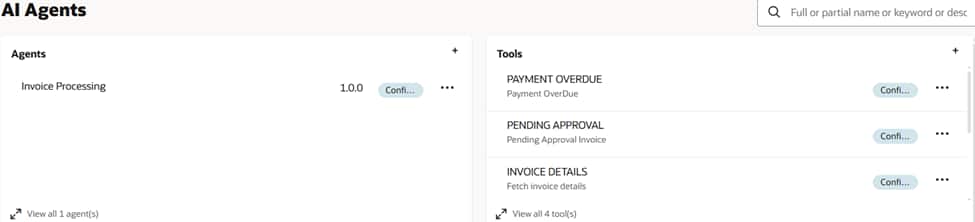
Another important capability is reuse. Existing OIC integrations that already connect to Oracle Fusion can become tools for the agent.
This allows organizations to preserve prior investments and accelerate agentic adoption. Rather than rebuilding backend services, teams can expose existing integrations as callable tools. As new business capabilities are needed, new tools can be added without redesigning the entire user-facing flow. This approach also supports a clean operating model. The agent is responsible for deciding which tool to use. The tool is responsible for executing a specific business function. OIC remains the foundation for integration, security, and observability.
“This has fundamentally changed how our teams interact with enterprise data. It’s faster, more intuitive, and removes friction from everyday operations,” said Ajay
What This Means: The Equinix and OIC Transformation Story
This use case demonstrates an important direction for enterprise integration. Agentic AI is not just about adding a chatbot in front of existing systems. The real value comes from combining conversational intent, enterprise integration, reusable tools, and trusted backend systems into one cohesive pattern.
With OIC Agentic AI, Equinix can enable users to ask questions from Microsoft Teams while still relying on Oracle Fusion as the system of record. OIC provides the integration foundation, the agent provides intelligence, and reusable integrations provide the execution layer.
The outcome is a modern integration experience that feels conversational to the user and remains governed, observable, and maintainable for IT.
Conclusion
Equinix’s invoice inquiry use case shows how Agentic AI in OIC can reshape enterprise integration design.
Instead of asking business users to adapt to system constraints, the system can adapt to how users naturally ask questions. Instead of building larger and more complex orchestration flows, IT teams can design simpler integrations that delegate intent understanding and tool selection to an agent.
This marks a meaningful shift in integration architecture: from hardcoded workflows to intelligent, context-aware interactions. For Equinix, the result is a more intuitive experience for business users and a more maintainable model for technical teams. For enterprises broadly, it highlights how OIC Agentic AI can help bridge the gap between conversational experiences and mission-critical enterprise systems
Guest Author

AJAY NARAYAN
Ajay Narayan is a Global Information & Technology Integrations Architect with two decades of experience, currently serving as Senior Manager at Equinix. He specializes in Oracle PaaS, AI-driven solutions, and enterprise cloud architecture. Recognized as an “AI and Cloud Architect of the Year,” he has led several large-scale digital transformation initiatives. Ajay brings deep expertise in designing scalable integrations and modern cloud solutions.