
2025 was a standout year for Exadata. We delivered the X11M generation, two significant Exadata System Software releases–Exadata System Software 25ai releases 25.1 and 25.2, broader multicloud availability, and major new capabilities to Exadata Database Services. This post summarizes the most important announcements and what they mean for performance, efficiency, and flexibility.
Exadata X11M
Exadata X11M couples faster hardware with our next generation intelligent data architecture and latest software. It launched everywhere at once, on-premises, Exadata Cloud@Customer, Oracle Cloud Infrastructure (OCI), and through multicloud partners (Microsoft Azure, Google Cloud, and AWS), the first Exadata generation to do so. X11M is priced the same as the prior generation, delivering higher performance, better efficiency and sustainability. Running Oracle AI Database 26ai on Exadata X11M allows teams to build anywhere and run everywhere for the same cost as X10M. You can watch Kodi Umamageswaran’s X11M launch video below.
With Exadata System Software 25ai, X11M improves AI workloads:
- Up to 43% faster in-memory vector index scans on database servers
- Up to 55% faster neighbor partition vector index scans on storage servers
- Up to 4.7x more filtering on storage servers with adaptive Top‑K
- Up to 4.6x faster queries from offloaded VECTOR_DISTANCE and column projection
- Up to 32x faster queries with binary vector formats
For OLTP workloads, X11M improves on X10M:
- Up to 1.25x more concurrent transactions and 1.25x faster serial transactions
- Up to 1,000,000 write IOPS per storage server (9% increase)
- Up to 21% lower read latency from Exadata RDMA Memory (XRMEM), now as low as 14 microseconds (14 µs)
- Up to 43% lower OLTP read latency from flash
Finally, let’s look at analytics workloads:
- Up to 25% faster analytic query processing on database servers
- Up to 2.2x faster Smart Scan throughput on storage servers, now up to 100 GB/s per storage server
Sustainability and Efficiency
The need for our customers to address sustainability is more urgent than ever. They must minimize environmental impact, reduce operational costs, and navigate a complex regulatory landscape. Keeping up with today’s sustainability demands, Exadata X11M helps customers reduce their power consumption and costs. Exadata X11M’s extreme performance enables customers to efficiently consolidate even more Oracle Database workloads on fewer systems, saving on infrastructure, power, cooling, data center, and operational costs. As IT executives are constantly faced with increasing workload demands and less budget to execute with, Exadata X11M is the obvious choice to do more with less.
Exadata X11M also includes new intelligent power efficiency capabilities to limit the power consumption of database server CPUs to a specific power target or enable the database server to automatically and dynamically save power when workload demand is low, for example, on weeknights and weekends. Exadata X11M also intelligently turns off unneeded cores further enabling customers to conserve energy.
These improvements are staggering and enable our customers to:
- Run more databases and host more users
- Run more workloads and store more data
- Run more AI, analytics, and transactions
- Or, run the same workload using less hardware
Exadata Hardware
For our on-premises customers, X11M offers a choice of database servers and multiple storage server options to create the ideal Exadata system for your workloads.
New in X11M, the Database Server-Z and High Capacity-Z (HC-Z) Storage Server replace the prior Eighth Rack configuration. The “Z” servers can be mixed with any other server type, allowing customers to tailor compute and capacity. For example, you can combine two standard database servers with 192 cores each, and three HC-Z storage servers with 120 TB usable capacity.
Also new in X11M, the reimagined eXTended (XT) Storage Server is built for Exadata Exascale as well as ASM and is ideal for less-frequently accessed data, such as online archives and dev/test databases with lower performance needs. X11M XT is the first XT server with Exadata Smart Flash Cache. Two 6.8TB performance-optimized flash cards (the same used in EF, HC, and HC-Z) cache hot data, avoiding hard disk I/O and delivering up to 600,000 OLTP read IOPS and 500,000 write IOPS with much lower read latency. With optional licenses, Smart Scan accelerates analytics up to 50 GB/s of SQL scan throughput.
X11M XT storage servers are the first generation of XT storage designed for Exadata Exascale, the next-generation, data-intelligent architecture for Exadata. Exascale reimagines how compute and storage resources are managed in Exadata by decoupling storage management from the database servers and paving the way for powerful new snapshot and cloning features. Exascale enables space-efficient thin clones from any read/write pluggable and container database, which significantly boosts developer productivity. Customers get Exascale’s capabilities and XT’s high‑performance, cost‑efficient storage.
Zero Data Loss Recovery Appliance
Alongside Exadata X11M, and aligned with its increased flexibility, customers of the Zero Data Loss Recovery Appliance (RA) gained additional choice for their system size with the new RA23‑Z storage servers. Based on the X11M HC‑Z storage server, RA23‑Z uses six 22‑TB HDDs, providing 135 TB of usable capacity (1 PB virtual) in a base rack and up to 779 TB (7 PB virtual) in a fully populated rack.
This addition to the RA family delivers real‑time transaction protection and continuous data validation for databases of any size. It provides database-integrated management and automation and database-aware ransomware protection, including space-efficient encrypted backups and immutable backups with retention lock.
Exadata System Software 25ai
As I briefly mentioned above, Exadata System Software 25ai (25.1), released in December 2024, enables X11M to deliver the full potential of the latest generation hardware. It also enables a host of fantastic new capabilities, most of which are available on all Exadata systems with active support. In July, Exadata System Software 25ai (25.2) was released with even more exciting new capabilities and optimizations.
Let’s look at some of these key capabilities available across both releases:
AI Workload Acceleration
First up are the new optimizations to accelerate AI workloads. Adaptive Top-K Filtering reduces data returned the database servers by up to 4.7x by offloading and maintaining a running Top-K on each storage server. At the same time, queries that require the distance between an input vector and those returned by the query are up to 4.6x faster with the result of the VECTOR_DISTANCE() function projected to the database having been already calculated on the storage servers. This has the addition benefit of reducing data sent to the database server by up to 24x and avoiding the need to re-calculate distances.
Oracle AI Database 26ai allows non‑vector columns (e.g., price, zipcode) to be included in neighbor partition vector indexes. With 25.2, when all the needed columns—both vector and non-vector—are included in the index, filtering, vector distance calculation and column projection are offloaded to the storage using only the index and are up to 3x faster and eliminate ROWID lookups.
Finally, AI Smart Scan accelerates queries using INT8 and BINARY vectors by up to 32x. It also seamlessly offloads space-efficient SPARSE vectors, which typically have many dimensions but few non-zero values.
For more details, watch the Exadata AI Smart Scan Deep Dive.
Exascale innovation continues at breakneck pace
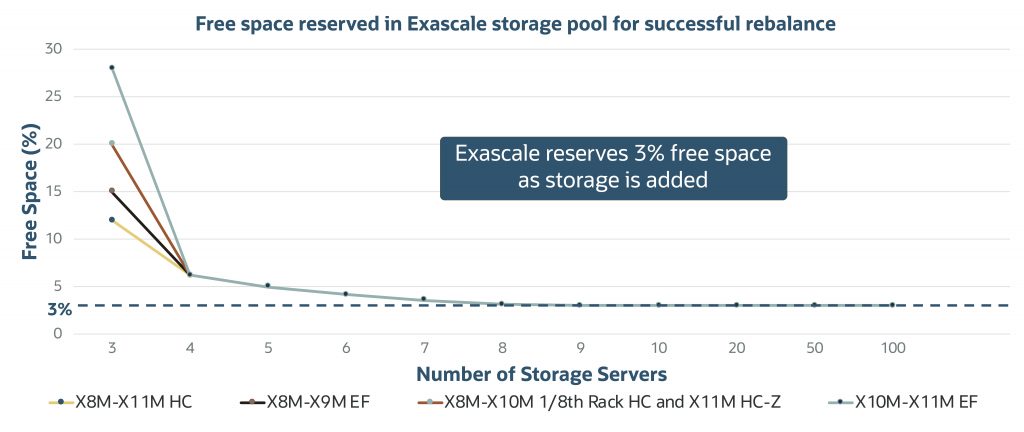
Exascale significantly improves free‑space management, lowering the recommended free‑space reserve to as little as 3% of capacity. This enables storing more data, creating more thin clones, and boosting developer productivity. Exascale also enhances free‑space alerting, and built‑in automation defers unnecessary I/O rebalancing after a disk failure until free‑space thresholds are restored.
To accelerate redundancy restoration and improve durability, Exascale delta tracking persists new writes even when a target disk is offline, maintaining the configured redundancy. When the disk or storage server comes back online, the delta tracking resynchronizes changes quickly at 8 KB granularity. This also protects data and simplifies data recovery in the rare event of multiple disk failures: by reviving any of the failed disks, data can be recovered using delta tracking changes, rather than requiring revival of the last failed disk.
Lastly, several management optimizations have been added to Exascale including Volume Groups across virtual machine volumes, unique point-in-time consistent snapshot across VM volumes within a volume group, simplified (1-step) volume clones, and JSON output for Exascale Shell (XSH) to simplify integration with common automation tools.
Exadata Smart Flash Cache
Multiple optimizations have been made to the flash cache to further improve analytics and OLTP performance. Analytic queries run up to 1.6x faster because the flash cache reclaims temp I/O space instantly and skips disk flushes. Temp data isn’t after the query is complete, so we don’t waste resources writing it to disk. At the same time, Exadata prioritizes large temp and flashback log write I/Os to flash over other large write operations, such as ASM rebalance, to ensure active database workloads are always given priority to flash cache resources.
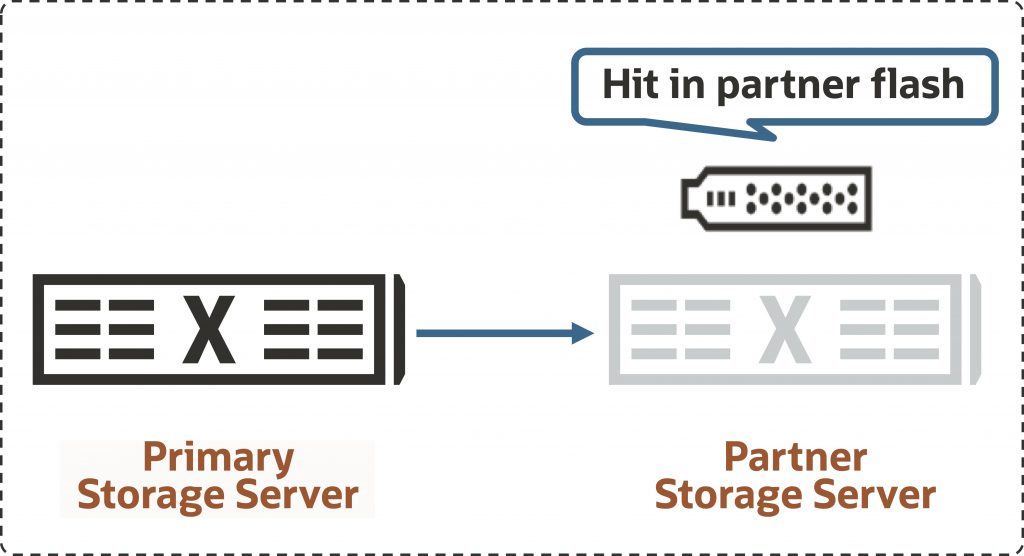
Finally, Exadata now automatically redirects reads to flash on a partner storage server after maintenance rather than incur slow I/O from disk. Reading and transferring data from flash on a partner storage server is much faster than reading from local disks, ensuring consistently high performance before and after storage server downtime.
Observability, availability, manageability, and security
Rounding out our overview of the latest two releases are a collection of important capabilities to improve observability, availability, manageability, and security.
With the latest Grid Infrastructure, ASM rebalance is now automatically adjusted based on the current workload. ASM and Exadata software constantly monitor database I/Os and dynamically change the rebalance power resulting in up to 3.6x faster redundancy restore, 2x faster resync after updates, 2.6x faster server adds.
The Exadata Cache Statistics (ecstat) utility has been enhanced to include additional information such as flash cache bypass reason, top space consumers, and top I/O consumers, providing administrators with deeper insight into cache usage and performance.
New in 25.2, CellSQLStat provides real-time, per-storage server insights into active Smart Scan operations such as CPU and memory usage, storage index and columnar cache I/O savings, flash and XRMEM hits, scan rate, and more, enabling administrators to understand and monitor Smart Scan performance.
Both ecstat and CellSQLStat data are automatically included in the automated ExaWatcher collection.
ExaPortMon increases availability by detecting stalled or sick RDMA over Converged Ethernet (RoCE) ports and automatically moves IP addresses to healthy ports to keep network traffic flowing and ensure database clusters remain stable. When the sick port or path becomes healthy again, ExaPortMon automatically returns the IP address to its original port.
In addition to Exadata Live Update, introduced in Exadata System Software 24ai (24.1), patchmgr allows administrators to include additional Linux rpms during database server updates to satisfy dependencies for 3rd party software that many customers may install. Resolving dependencies during the update avoids the need for administrators to remove and reinstall software required in their environments. Storage server updates have also been optimized further and are now up to 1.45x faster.
Security has been increased by trimming Linux package dependencies further to minimize the potential attack surface and enabling SELinux in ‘permissive’ mode by default for all new deployments. Exadata Secure RDMA Fabric Isolation (Secure Fabric)–which enables strict isolation for VMs across the RoCE network and prevents database servers in separate clusters communicating with each other–is now chosen by default for all new on-premises deployments aligning on-premises with the cloud which always uses Secure Fabric.
As you can see, this summary only scratches the surface of the software capabilities released in 2025. Make sure you read the announcement blogs for more details.
For more, watch the Exadata System Software 25ai 25.2 release video.
Exadata in Cloud
Exadata has had an amazing year in the cloud. Beginning with the simultaneous release of X11M in OCI, Exadata Cloud@Customer, our multicloud partner regions, and on-premises, this latest generation enables Oracle database workloads wherever customers need them to run. Coupled with the awesome capabilities outlined above, and new cloud service capabilities, Exadata X11M has quickly become the platform of choice for all workloads and organizations.
Exadata Database Service on Exascale Infrastructure (ExaDB-XS)
- ExaDB-XS continues to be rolled out in new regions and realms across the globe to enable customers to use this fantastic new deployment option wherever they need. ExaDB-XS is also now available in Google Cloud in addition to Azure!
- Data Guard can be configured between ExaDB-D and ExaDB-XS to enable easy migration and increased availability and developer productivity.
- Exascale’s reimagined snapshotting capabilities are available for PDBs and VM in ExaDB-XS. For PDBs, customers can create point-in-time read-only snapshots and space-efficient read-write PDB thin-clones for increased developer productivity. For VMs, this enables customers to capture and preserve point-in-time images of their virtual machine file systems instantly with exceptional storage efficiency.
- Exascale vaults now automatically scale as usage of the vault increases. The removes the need for manual administrator monitoring and intervention, or reliance on developers to increase the vault as their usage grows.
- Oracle Database 19c support on Exascale Infrastructure enables customers to gain the benefits of ExaDB-XS such as extreme low cost, scalable pooled resources, and Exadata performance, reliability, availability, and security capabilities integrated by design. 19c databases on ExaDB-XS provide customers with pay-per-use pricing, low upfront costs, and no cost per IO, delivering Exadata performance at extremely low cost on a completely elastic architecture.
More new service capabilities can be found at: https://docs.oracle.com/en-us/iaas/exadb-xs/doc/exa-whats-new.html
Exadata Database Service on Dedicated Infrastructure (ExaDB-D)
Some of the multitude new capabilities include:
- API access control enables administrators to manage and restrict access to REST APIs and Cloud Console operations and enforces approval workflows to prevent inadvertent and malicious use.
- Exascale can now be configured on X8M and newer Dedicated Exadata environments. This enables customers to deploy Exascale on new and existing Exadata infrastructure to gain the benefits of reimagined database-aware snapshots and clones with Oracle AI Database 26ai alongside earlier database releases utilizing ASM. Additionally, Data Guard can be configured between ExaDB-D and Exadata Database Service on Exascale Infrastructure (ExaDB-XS) to enable easy migration and increased availability and developer productivity.
- Exadata Database Service for Developers enables customers to use more of the idle Dedicated Exadata infrastructure for development purposes at no additional cost. This service capability allows developers to access database resources quickly using the CPU, memory and storage resources already available and included in the infrastructure subscription.
- Autonomous Recovery Service is now the exclusive backup destination for new ExaDB-D deployments in new tenancies and select regions.
- Enhanced control over VM cloud automation updates allowing administrators to define when updates are applied, prioritize which clusters receive them first, and set freeze periods aligned with business policies to pause updates during critical timeframes. Also included is the flexibility to test updates on non-production clusters first, ensuring a smooth rollout with every new release.
- Integration with AWS, Azure, and Google Cloud key management solutions is now available in Oracle Database@{AWS|Azure|GCP} respectively, allowing customers to use cloud provider native key management solutions with Exadata Database services.
Many more service capabilities can be found at: https://docs.oracle.com/en-us/iaas/exadatacloud/exacs/exa-whats-new.html
Exadata Database Service on Cloud@Customer (ExaDB-C@C)
In addition to many of the great capabilities enabled in ExaDB-D, ExaDB-C@C gained the following features in 2025:
- Convert physical standby to a snapshot standby and back again using REST APIs, the Cloud Console or cloud tooling to enable root cause analysis, perform tests with on production data in a simple and risk free manner.
- Choice of 100 Gbps NIC for the backup network in new ExaDB-C@C subscriptions enabling faster database backups and restores.
You can read more at: https://docs.oracle.com/en/engineered-systems/exadata-cloud-at-customer/ecccm/ecc-whats-new-in-exadata-cloud-at-customer-gen2.html
Zero Data Loss Autonomous Recovery Service
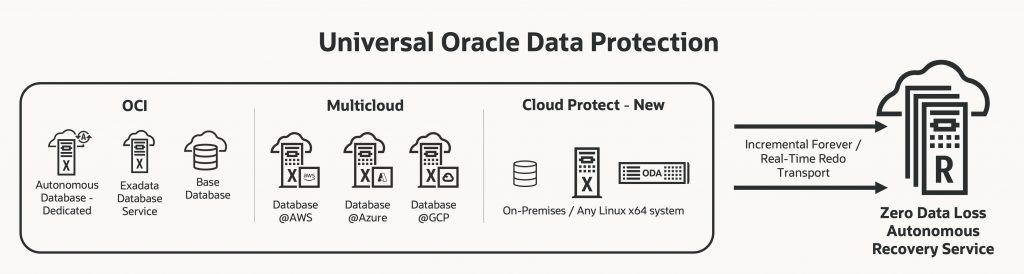
Since it was first introduced in 2023, the Autonomous Recovery Service has focused on Oracle databases deployed in the cloud enabling incremental-forever backup strategies in the cloud with real-time transaction protection, zero data loss, immutable backups, storage-efficient encrypted backups and many more excellent data protection capabilities.
Now on-premises databases on x86 Linux platforms, particularly those running on Exadata, can be protected in the cloud with Oracle Database Zero Data Loss Cloud Protect. Cloud Protect provides the same benefits for on-premises databases as it does for those in the cloud simplifying administration and increasing data protection.
Summary
2025 was a watershed year for Exadata: X11M, Exascale, and 25ai delivered higher performance, lower latency, and extreme efficiency, with simultaneous availability on-premises, in OCI, and across our multicloud partners, while Recovery Appliance and Autonomous Recovery Service continued to strengthen data protection. From AI-optimized storage offload and thin-clone snapshots to broader regional reach and tighter manageability, we raised the bar so you can run more AI, analytics, and mission-critical OLTP workloads wherever you need them, at the same price as the prior generation. Explore the announcement posts, try the new capabilities, and connect with your Oracle team to discover even more across our products and services to drive your business further. Thank you to our customers, partners, and engineering teams for an incredible year; enjoy the break, and we’ll see you in the new year with even more. 2026 is shaping up to be simply astonishing!