
This blog post is the first in a new series of posts on digital sovereignty in the cloud.
In the summer of 2023, we launched Oracle EU Sovereign Cloud and became the first hyperscaler to offer customers a sovereign public cloud dedicated to the European Union. With EU Sovereign Cloud, customers enjoy all the same benefits as Oracle’s commercial public cloud, but with added technical, organizational, and contractual controls to further enhance their sovereignty posture.
In the nearly three years since EU Sovereign Cloud’s release, other companies have slowly started releasing their own sovereign cloud regions—a clear sign of the growing demand for these offerings. Even companies that previously dismissed ‘data sovereignty’ as a buzzword have shifted their stance and followed Oracle’s lead. We welcome these new entrants into the market as their investment underscores the importance of sovereignty and operational resiliency for organizations doing business in the EU.
Pending regulations, growing customer demand, and the rapid rise of AI have kept us busy. In the last two and half years, we’ve evolved our EU Sovereign Cloud offering to keep up with these changes in the market. Our goal is to continuously demonstrate that sovereignty at hyperscale is not only possible but doesn’t require compromises, shortcuts or even to cost more.
Previous blogs on the topic of EU Sovereign Cloud have focused on the legal, technical, and operational aspects of the cloud offering. In this post, we shift our attention to reflect on the lessons learned since the product’s inception and the thinking behind our sovereign-by-design approach.
Pioneering and its challenges
When designing EU Sovereign Cloud, our mission was clear: deliver the same pricing, value and customer experience as our commercial public cloud regions, with added sovereignty controls. But what, exactly, would make our cloud ‘sovereign’?
Since this was a cloud intended to meet the requirements of organizations in the EU, we actively engaged with EU customers, regulators, and policymakers to define the requirements. Through their collective input, we turned the abstract concept of sovereignty into a real, working sovereign cloud solution.
A few of the design questions we had to answer
Should we build one or two regions?
Customers and regulators consistently expressed a preference for geographically dispersed regions, rather than hosting the cloud in a single country. In response to this feedback, we implemented a two-region strategy, establishing regions in Germany and Spain. These regions were purposely located in two different EU member states to ensure customers’ data wasn’t restricted to only one nation. Each region consists of two Tier 3 data centers and three fault domains, providing a total of four data centers and six fault domains. This approach offers customers a more resilient high availability and disaster recovery design, in contrast to more geographically constrained architectures using Availability Zones
How do we offer customers the same value as Oracle’s commercial public cloud?
It was essential that EU Sovereign Cloud maintain parity with our commercial public cloud regions, while layering on the necessary sovereignty enhancements. Rather than providing a limited subset of services, we ensured customers have access to our full portfolio of 200+ OCI services, GPUs, Oracle SaaS products, and Customer Support Services. Importantly, the pricing of our cloud infrastructure remains the same as our commercial public cloud—no added charge for sovereignty.
How do we maintain a segregated, sovereign environment?
Central to Oracle’s definition of sovereignty is our commitment to customers that their data remains in the physical and logical location they selected. We achieve this by using Oracle’s unique concept of a realm. However, this is only one pillar of our broader sovereignty framework. We also maintain a comprehensive and dedicated set of organizational and contractual controls across our seven EU Sovereign Cloud legal entities. For added operational stability, we also chose to avoid the volatility and risks associated with joint ventures and complex partnerships.
Who will operate it while preserving sovereignty?
We knew that offering a comprehensive sovereign cloud solution at every level of the stack would require a skilled and dedicated team based in the EU. Since launch, we have scaled our staffing to 130+ EU Sovereign Cloud support and operations teams, spread across our seven dedicated legal entities. As of 2026, Oracle has over 1,500 EU residents providing support and operations for EU Sovereign Cloud.
These are just a few of the essential questions we discussed when EU Sovereign Cloud was in its earliest planning stages. These discussions shaped the product design and earned the trust of organizations across the EU, who now rely on EU Sovereign Cloud for their most sensitive workloads.
Multinational companies are quickly adapting to European requirements
The next lesson we learned was that the demand for EU Sovereign Cloud extended beyond customers in the European Union. Soon after launch, we saw adoption not only from organizations within the EU, but also from companies headquartered outside the EU—and even outside Europe.
Through conversations with these customers, we found several common drivers for their shift to EU Sovereign Cloud:
- To serve the business requirements of their subsidiaries in the EU
- To enable collaboration with their EU partners and to meet customers’ needs
- To seek the predictability and stability of the EU regulatory environment in an uncertain world
Today, organizations from 34 countries use EU Sovereign Cloud, spanning 16 industry segments.
This adoption has enabled multi-jurisdictional collaboration within and between multinational organizations, unlocking new opportunities that we did not anticipate at launch in 2023. To support this expanding demand, we have increased our contracted power and server positions within the EU Sovereign Cloud regions by over 400%.
Date sovereignty was once thought to be a barrier to trusted collaboration. Those days have passed in the EU. Our customers continue to demonstrate that our EU Sovereign Cloud is enabling trusted collaboration because of our transparent approach to governance.
Clients don’t think in layers: sovereign infrastructure led to demand for sovereign SaaS and AI
After the launch of EU Sovereign Cloud, it quickly became clear that customers wanted more than just sovereign cloud infrastructure; they were also interested in using sovereign SaaS and AI offerings.
In November 2024, Oracle extended its EU Sovereign Cloud to include SaaS applications—marking a significant milestone in delivering fully sovereign, end-to-end cloud service. Since then, demand for sovereign cloud–based SaaS has accelerated dramatically. Customers across most industries—including government, defense, financial institutions, and other regulated enterprises—have started using Oracle SaaS applications on EU Sovereign Cloud to support their most critical processes.
At the same time, Oracle Applications are being transformed by embedded predictive AI, generative AI, and AI agents—all of which are now available by default. To power this next generation of intelligent applications, Oracle deployed its first Nvidia GPU shapes into EU Sovereign Cloud. This enables both SaaS and OCI customers to run generative AI, inference and training workloads directly within EU Sovereign Cloud and to bring large language models (LLMs) into a fully sovereign environment.
What sets this offering apart is the combination of innovation and trust. Customers can use AI services with the assurance that their data and prompts remain entirely within the European Union. With infrastructure owned and services operated by Oracle EU Sovereign entities, customers benefit from stronger end-to-end sovereignty across the entire technology stack.
The sovereign journey does not stop here. Oracle is expanding GPU capacity, onboarding new LLMs, and making models available within EU Sovereign Cloud that were previously only accessible via the public internet. This gives customers more choice, greater flexibility, and increased confidence to scale AI securely.
By anticipating customer needs, Oracle continues to expand the capabilities of EU Sovereign Cloud, helping organizations to move faster and innovate with confidence.
Sovereignty by design—no exceptions
Because cloud is not “one size fits all,” Oracle offers the industry’s most comprehensive portfolio of sovereign cloud deployment models. Our sovereign-by-design architecture has empowered us to build sovereign clouds worldwide—adapting to the needs of different countries, regions, and use cases. The launch of EU Sovereign Cloud set the standard, demonstrating our fundamental belief that every customer—no matter where they are—deserves control of their data by design.
This sovereign-by-design philosophy guides every Oracle cloud deployment model.
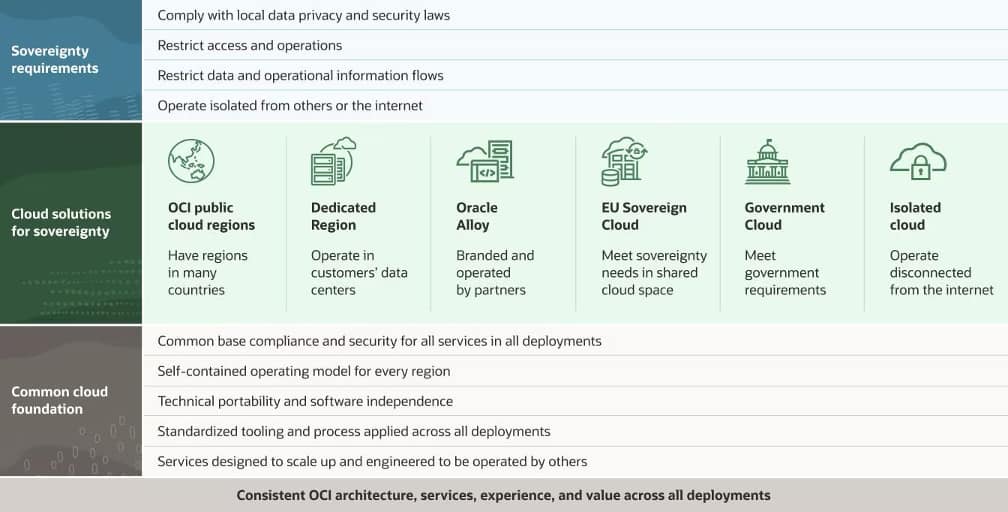
Our customers, including those using EU Sovereign Cloud, have found creative ways to combine offerings from across our portfolio to meet both their business requirements and sovereignty needs. Examples include:
- Customers running workloads on their OCI Dedicated Region alongside EU Sovereign Cloud workloads.
- Organizations are increasingly using Exadata Cloud@Customer and Compute Cloud@Customer (~30% of consumption and growing) with their dedicated control planes in our EU Sovereign Cloud Regions. This provides customers with the confidence of EU sovereign operations and support while meeting their unique residency requirement for data localization within their own data centers.
- Oracle Alloy partners can request EU Sovereign Cloud operations and support under certain circumstances to bolster their solution.
To better support customers with these hybrid cloud strategies, EU Sovereign Cloud has recently introduced Cross-Realm Credit Sharing. This functionality enables Oracle customers to share their existing OC1 (i.e., Oracle’s commercial public cloud) Universal Credit commitments with their EU Sovereign Cloud realm, helping them minimize overages and optimize use of committed credits.
Oracle’s sovereign cloud portfolio continues to grow. Recent launches like Dedicated Region 25 provide customers new ways to address their requirements for location, access, data residency, and operational control—without compromising on cloud services, SLAs, or pricing.
Setting the standard for sovereign cloud
Through our work with organizations across Europe, we’ve seen firsthand how nuanced and complex the concept of sovereignty can be. Sovereignty is not static—it evolves rapidly with shifting policies, geopolitical changes, and new compliance requirements. Oracle EU Sovereign Cloud is designed to stay ahead of these shifts, setting a new benchmark for what a sovereign public cloud should deliver. We are continually enhancing both the underlying technology and data governance controls, so customers can expect more announcements soon.
Finally, we want to thank our EU Sovereign Cloud customers for your trust and partnership on this journey. You have helped validate our vision that sovereign cloud capabilities fill a critical gap in the cloud market. With your feedback and support, we were able to create the first and most robust hyperscale sovereign cloud offering in the European market.
To learn more about how Oracle EU Sovereign Cloud can support your organization, visit the Oracle EU Sovereign Cloud product page.