
Introduction
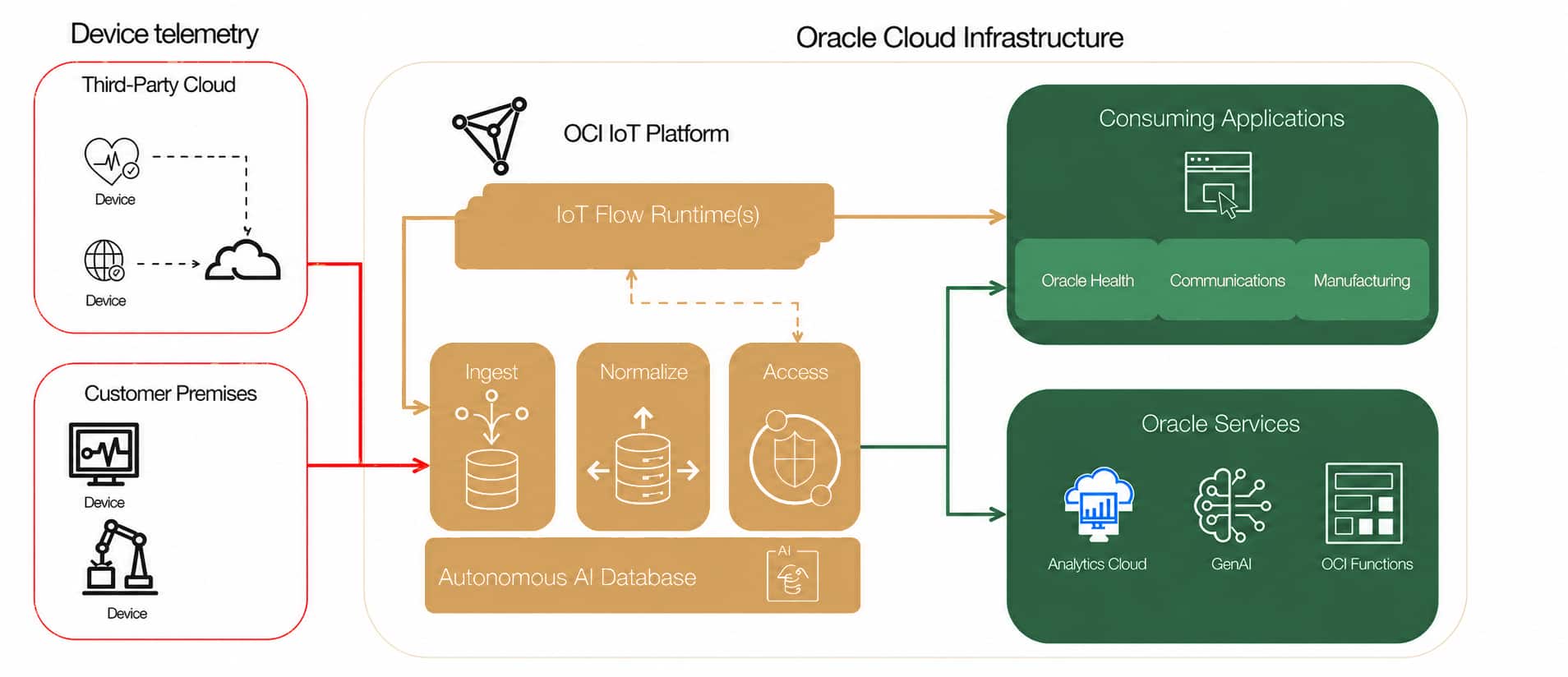
Oracle Cloud Infrastructure Internet of Things Flow Runtime (OCI IoT Flow Runtime) is a new feature within OCI Internet of Things Platform (OCI IoT Platform). It is an OCI-native managed resource that runs Node-RED flows within an IoT domain.
OCI IoT Flow Runtime gives solution developers a visual environment to combine telemetry from OCI IoT Platform with information from other sources, such as MQTT brokers, batch files, and application endpoints; transform and route that data; and send the resulting information to applications and endpoints, including other OCI services.
What OCI IoT Flow Runtime does
An OCI IoT Flow Runtime executes flows that work with IoT devices, device hosts, data hosts, applications, file storage, and network endpoints. A flow can receive data, reshape it, and route it to the next system in the workflow.
Developers can open the OCI-integrated Node-RED editor from the OCI Console. They can build and deploy flows with the editor and its OCI and Oracle Database nodes without maintaining a separate set of editor credentials.
Use cases for flows
Ingest live data from an external broker
Many environments already collect messages in external MQTT brokers. A flow can subscribe to a broker, transform gateway or HVAC messages, and ingest the resulting data into OCI IoT Platform. This creates a path from existing message infrastructure to an IoT domain when upstream systems use different payload formats.
Ingest and normalize batch data
IoT data does not always arrive as a live stream. Teams can use flows to bring in commissioning data, backfill device history, or process periodic exports. A flow can download sequential CSV objects from OCI Object Storage, transform each record, and ingest the batch into OCI IoT Platform.
Monitor data, send commands, and publish alerts
Flows can act on normalized IoT data. For example, a flow can dequeue data, evaluate against a threshold, issue a command, poll for command status, and publish a success, failure, or timeout alert. This pattern links observation to a response while keeping the decision logic visible in the flow.
Integrate operational systems and endpoints
Flows can integrate applications, storage, and endpoints alongside devices. A flow might route an event to an application, write a file for downstream processing, or incorporate a service into an IoT data path. OCI IoT Flow Runtime provides the managed execution point for that integration work within OCI.
Runtime management in OCI
Each OCI IoT Flow Runtime is scoped to a compartment and associated with an IoT domain. Administrators can create separate runtimes for different integration workloads and activate or deactivate them to control processing. They can configure network access, attach File Storage mounts, and use OCI Identity and Access Management (IAM) policies for access to OCI resources.
Administrators can also send Node-RED system-console logs to OCI Logging and review runtime metrics and lifecycle events. Each runtime has read access to the IoT database schema for its domain and a runtime-specific schema for data that its Node-RED flows need to store.
Summary
OCI IoT Flow Runtime gives teams an OCI-native resource for running Node-RED flows in an IoT domain. Teams can use flows to ingest, transform, and distribute data; monitor data; send commands; and trigger alerts across the systems that support their IoT environment.