






Large healthcare groups operate across multiple hospitals and specialties, each generating vast clinical, operational, and financial data. Leadership must manage these units holistically—balancing quality, efficiency, compliance, and financial performance—because even small KPI shifts can materially affect outcomes and regulatory exposure.
The challenge for executives is not data availability but converting fast-changing, fragmented information into consistent, actionable insights. Without a standardized performance framework, organizations often find themselves responding to problems rather than proactively addressing them, leading to inconsistencies, and scaling problems.
Traditional performance dashboards cannot keep pace with enterprise healthcare complexity. This article outlines how healthcare organizations can overcome KPI overload by adopting standardized AI/ML-assisted enterprise performance intelligence using Oracle Cloud Infrastructure (OCI).
From Fragmentation to Enterprise Intelligence: The OCI-Powered Approach
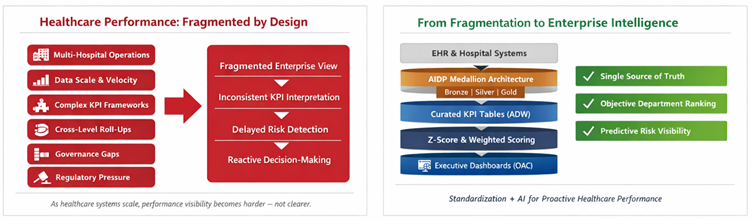
Built on OCI, the framework integrates scalable data processing, governed storage, machine learning, and executive analytics into a unified architecture. Using Oracle AI Data Platform (AIDP) with a Medallion architecture, enterprise data are consolidated into a trusted source of truth within Autonomous Data Warehouse.
Oracle APEX enables centralized KPI governance, while Z-score-based standardization and business weighting ensure objective specialty and hospital ranking. Machine learning adds anomaly detection and six-month forecasting, while insights are delivered through interactive dashboards created in Oracle Analytics Cloud and AI Natural Language queries, thus empowering leaders with proactive, enterprise-wide performance intelligence.
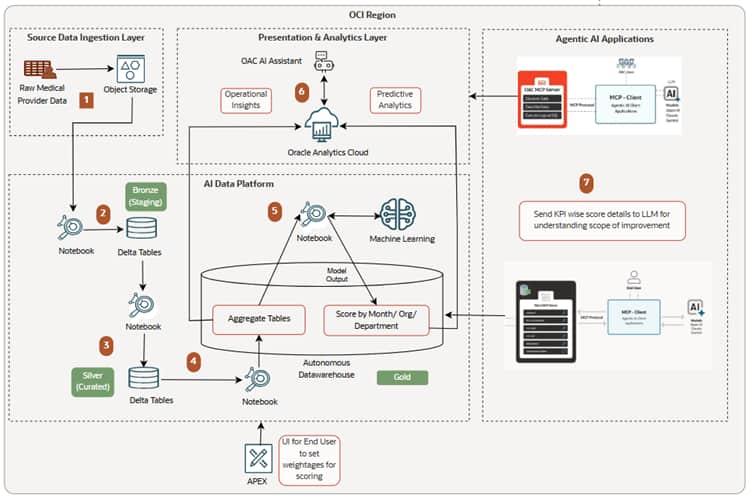
OCI Logical Architecture
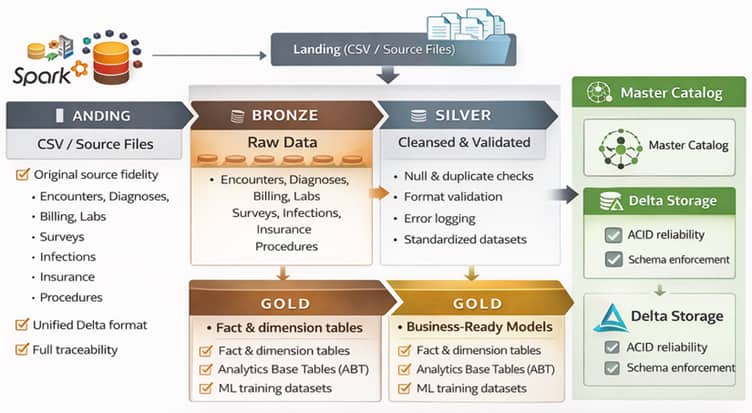
Data Engineering: From Raw EHR Data to Trusted Analytics
Enterprise healthcare entities—encounters, diagnoses, billing, labs, and infections—are ingested and processed through distributed Spark clusters within AIDP using a Medallion architecture.
Business Outcomes: Trusted single source of truth, High data quality, Scalable ML-ready foundation, Consistent reporting across hospitals
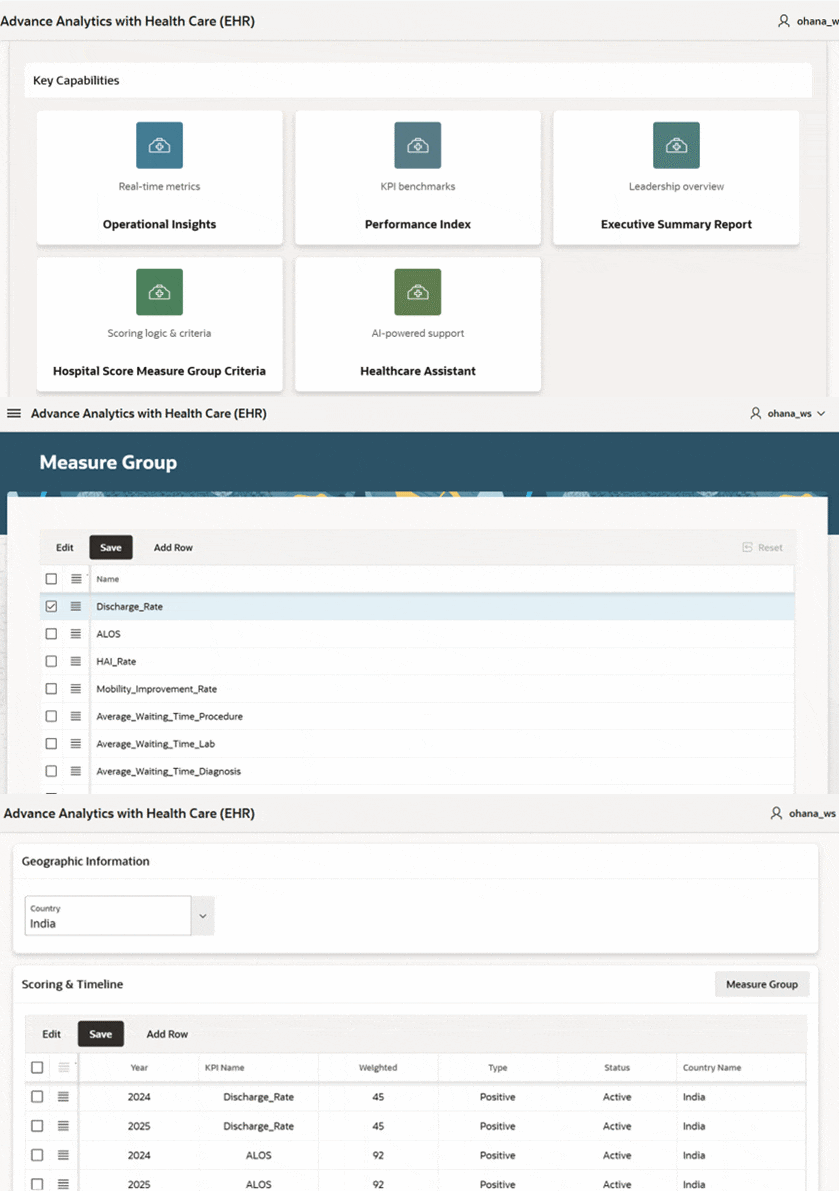
Governed KPI Configuration
Oracle APEX serves as the configuration and governance layer for the performance framework. Through a secure, intuitive interface, healthcare users can define KPI weightages, thresholds, and scoring parameters that directly influence Z-score calculations. APEX also connects seamlessly with analytics dashboards and supports AI assistant interactions, enabling governed customization without requiring technical intervention.
Objective, Enterprise-Wide Scoring
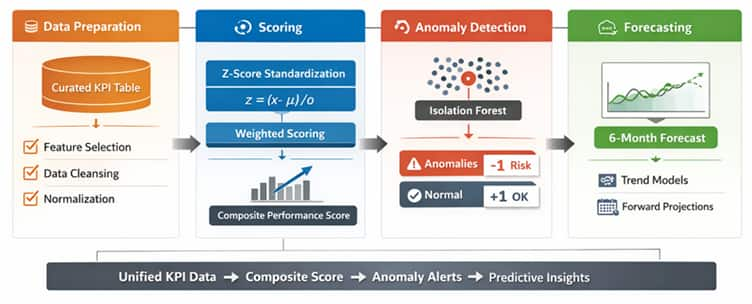
Healthcare KPIs span disparate KPIs like mortality (percent), wait times (counts), cost efficiency (financial), and patient experience (score) – all on different scales. To ensure fairness, metrics are standardized using Z-score normalization and weighted by strategic importance. This levels the playing field across departments – regardless of size or volume – enabling fair comparison of KPIs.
Z-score normalizes KPIs by measuring how far a value deviates from the mean:
z = (x − μ) / σ
where, x = Data Point, μ = Mean of features, σ = Standard Deviation
Business Outcomes: Objective ranking, cross-hospital comparability, and balanced aggregation – where no single metric disproportionately drives enterprise performance.
Built-In Machine Intelligence: Standardize, Detect, Predict
Machine learning operates on standardized composite scores – not raw KPIs – ensuring consistent enterprise-level insight. This framework embeds intelligent automation into healthcare performance management by transforming curated KPI data into a composite performance score, automatically identifying unusual trends, and predicting future outcomes. Instead of manually analyzing complex metrics, leaders receive early warning signals, allowing them to address risks before they escalate into systemic performance issues.
Business Outcomes: Early detection of performance risks, Objective and data-driven department ranking, Reduced reporting complexity, Proactive intervention before compliance or quality issues escalate, Enterprise-wide visibility with predictive insights.
Executive Intelligence with Oracle Analytics Cloud (OAC)
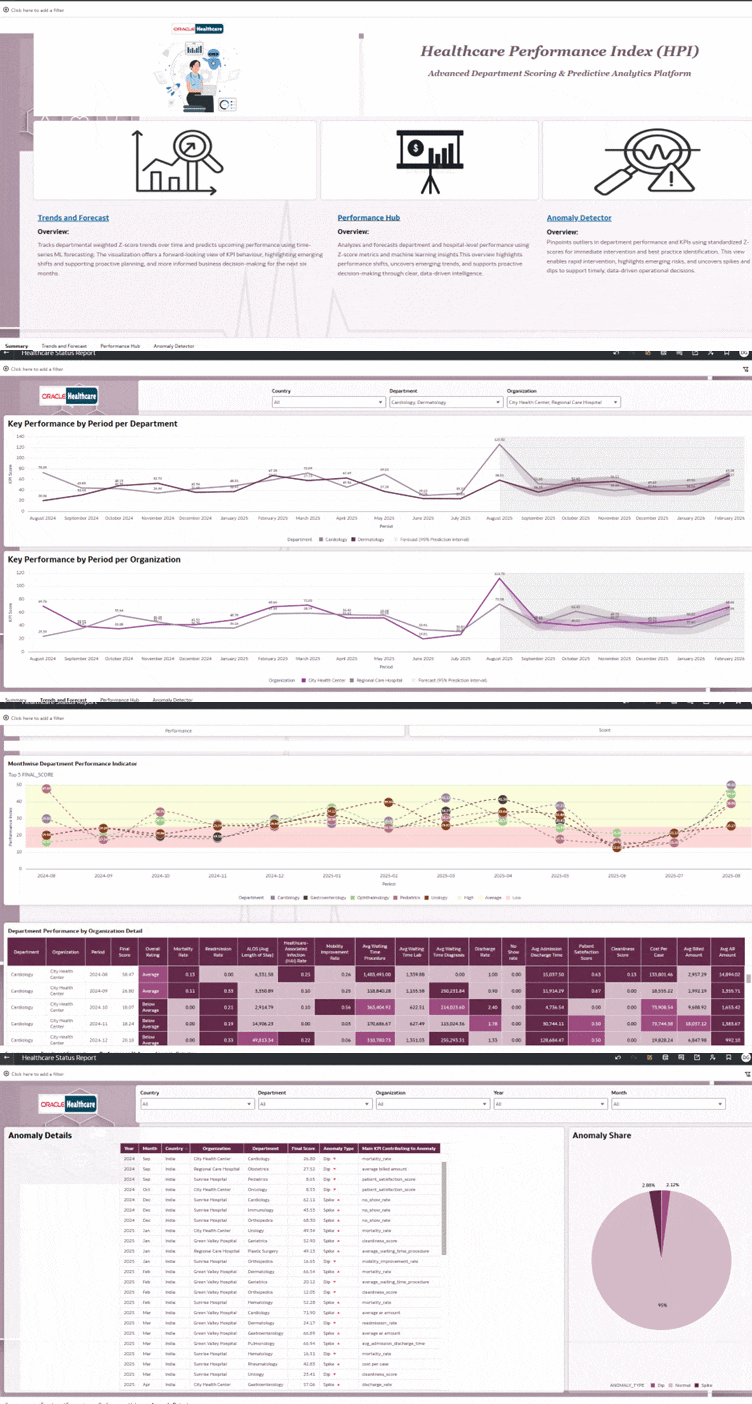
Oracle Analytics Cloud delivers executive-ready dashboards that transform standardized scoring into actionable insights.
The Healthcare Performance Index (HPI) dashboard transforms standardized scoring into executive-ready insights. Rather than navigating complex reports, leadership interacts with three focused analytical views designed for monitoring, benchmarking, and early intervention.
| Dashboard | Focus Area | Business Outcome |
| Trends & Forecast | Z-score–based performance with 6-month forecast | Early risk visibility |
| Performance Hub | YoY comparison, top departments, KPI contribution | Strategic alignment & ranking |
| Anomaly Detector | Performance spikes/dips with root-cause KPIs | Proactive corrective action |
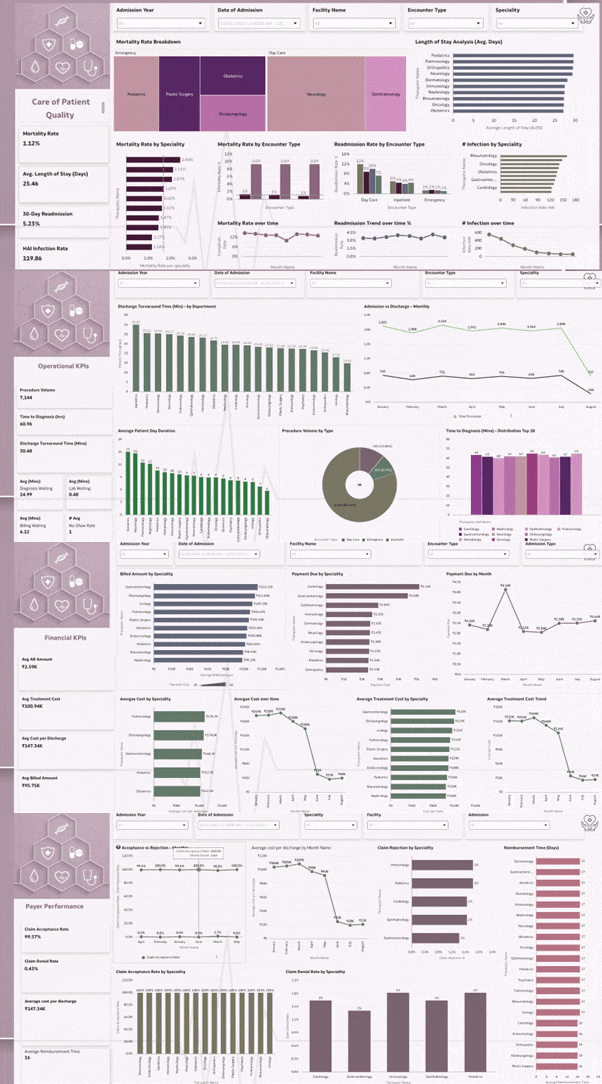
Beyond enterprise ranking, OAC dashboards extend into domain-specific operational analytics:
| Dashboard | Focus Area | Business Outcome |
| Care of Patient | Quality & satisfaction KPIs | Improve clinical outcomes |
| Operational KPIs | Procedure volume, wait times, discharge turnaround | Workflow optimization |
| Financial KPIs | Cost efficiency & medical billing trends | Financial sustainability |
| Payer Performance | Claims, denials, reimbursement efficiency | Reduced revenue leakage |
AI-Driven Reporting Enhancements
OAC evolves from a dashboard tool into a governed, AI-accessible performance intelligence platform.
Seamless Collaboration
Dashboards can be shared directly from OAC into enterprise collaboration tools (Slack, Teams, X), embedding analytics into daily workflows – no screenshots or manual exports.
Conversational & Agentic Analytics
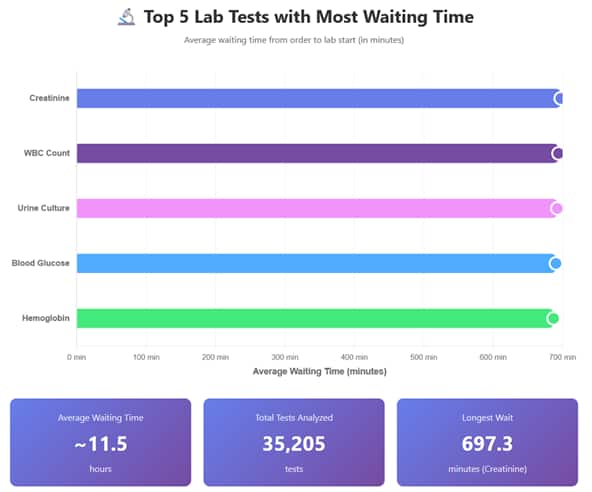
Through MCP integration, governed healthcare data becomes accessible via natural language – securely translated into compliant SQL and automation-ready workflows.
Example Queries:
- “Which departments show abnormal Z-scores this month?”
- “Summarize top 5 lab tests with most wait times between 2023–2025.”
Business Outcomes: Unified enterprise performance visibility, Cross-functional KPI transparency, Faster anomaly detection, Predictive performance oversight, AI-enabled decision support
Conclusion
Built on OCI, this framework transforms fragmented KPI tracking into unified, predictive performance management. By standardizing metrics, detecting anomalies early, and forecasting trends, leaders gain enterprise-wide transparency across hospitals and specialties—driving faster decisions, stronger clinical and operational outcomes, and sustained financial resilience. This foundation positions healthcare organizations to continuously expand into advanced AI, automation, and real-time intelligence on OCI.
Dive deeper with these recommended reads