

The Isolated Cloud Has Arrived. Most Providers Can’t Keep Up.
Geopolitical volatility. Data sovereignty mandates. High-profile cloud outages that cascade across continents. The pressure on enterprises and governments to control where their data lives, and who can access it, has never been higher.
In its new research, How to Successfully Deliver an Isolated Private Cloud (February 2026, G00839693), we feel Gartner analysts deliver a rigorous, independent insight for evaluating isolated private cloud solutions: infrastructure designed to run full cloud services in customer-controlled environments, potentially with zero connectivity to the outside world.
The finding that should matter most to every CIO, CISO, government, and defense technology leaders evaluating this space:
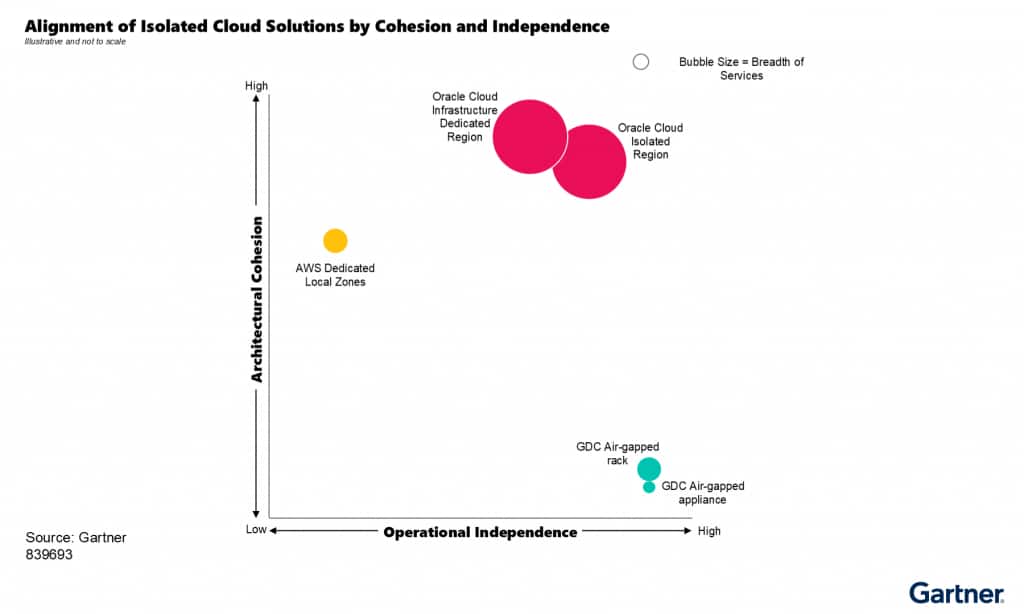
“The market largely adheres to an inverse correlation between architectural cohesion and operational independence, where optimizing for one attribute usually compromises the other. However, Gartner’s analysis finds that Oracle’s solutions stand out as an exception to this trend.”
In our opinion, the industry assumed you had to choose between a real cloud experience and true sovereignty. Oracle proved otherwise.
Why This Report Matters Now
Isolated private clouds are no longer a niche requirement for intelligence agencies and defense ministries. The Gartner research identifies two accelerating drivers pushing this market into the mainstream:
1. Data Sovereignty Is No Longer Optional
Regulations like the EU’s GDPR, the conflict with the US CLOUD Act, and an increasingly complex patchwork of national data-handling laws are forcing organizations to rethink where infrastructure runs and who operates it. Public sector, financial services, healthcare, and telecommunications organizations are leading this shift, but every global enterprise is affected.
2. Network Independence Is a Business Continuity Imperative
High-profile cloud provider outages exposed the fragility of architectures tethered to global control planes. Organizations in healthcare, finance, energy, and defense are decoupling critical workloads from public region dependencies to ensure that a disruption thousands of miles away doesn’t cascade into their local environment.
The Evaluation Framework: Two Dimensions, One Hard Trade-Off
Gartner insights evaluate isolated cloud solutions along two critical axes:
Architectural Cohesion: How closely does the isolated solution mirror its public cloud parent? Does it share the same APIs, services, pricing, and developer experience? High cohesion protects your investment against feature divergence and obsolescence..
Operational Independence: Can the solution operate without any connection to the provider’s global infrastructure or personnel? Can it run indefinitely air-gapped, with local control plane autonomy and no metadata leaking to external regions?
Most providers force a trade-off. Want full cloud services? You need a persistent network tether. Want true air-gap? Accept a stripped-down Kubernetes environment with a fraction of the services.
Gartner named Oracle in the report.
Oracle: High Cohesion AND High Independence
Oracle’s two isolated private cloud solutions, OCI Dedicated Region and Oracle Cloud Isolated Region, break the pattern that constrains every other provider in the market
OCI Dedicated Region
- 200+ services with identical APIs, pricing, and SLAs as the public cloud
- Full local control plane, all services continue to operate normally when disconnected
- Delivery in weeks (post-site readiness), compared to 9–15 months for AWS Dedicated Local Zones
- Partners can rebrand and deliver this same architecture through Oracle Alloy, a capability with no equivalent from any other provider
Oracle Cloud Isolated Region
- Indefinite disconnection tolerance, designed for permanently air-gapped environments
- All management performed by cleared, in-country personnel
- Full 200+ service catalog, no feature degradation from isolation
- Purpose-built for the most sensitive government, intelligence, and defense workloads
What We Believe Gartner Wants Decision-Makers to Understand
The report delivers four recommendations that we feel align precisely with Oracle’s approach:
1. This Is a Strategic Partnership, Not a Product Purchase
“Evaluate isolated private cloud solutions as long-term strategic partnerships, not as simple product acquisitions.”
Isolated clouds involve multi-year commitments, significant capital investment, and deep vendor dependency. In our view, Gartner urges organizations to prioritize solutions with high architectural cohesion, the strongest predictor of long-term value retention and protection against obsolescence.
2. Don’t Trust the “Sovereign” Label , Verify the Architecture
“Do not rely on a vendor’s branding of a solution as ‘sovereign.’ Instead, strictly assess the solution’s disconnection tolerance, personnel independence, and control plane autonomy.”
Marketing claims are not compliance evidence. Gartner recommends a structured framework that evaluates disconnection tolerance, personnel sovereignty, and control plane architecture against your actual regulatory obligations.
3. Plan for Day 2 Operations Before You Sign
“Organizations often underestimate the ‘Day 2’ operational burden, assuming that because the solution is provided by a hyperscaler, it will operate like the public cloud.”
The hidden costs of sovereignty, cleared staff, dedicated network tethers, facility power, physical remediation labor, can dwarf the vendor contract. Gartner discusses developing an operational plan and skills roadmap concurrently with the technology evaluation.
4. Calculate the Real TCO
“Unlike public cloud pricing, which bundles electricity, cooling, and physical security into the rate, many isolated private clouds expose these costs back to the customer.”
We believe Oracle’s fully managed model (where Oracle provides, installs, and maintains all hardware while the customer provides the facility) directly addresses this concern by keeping the operational boundary clear and the hidden costs minimal.
What This Means for Your Organization
If you are evaluating isolated private cloud solutions, this Gartner research names Oracle within the report:
- You don’t have to choose between a full cloud experience and operational sovereignty. In our view, Oracle is the only provider that delivers both.
- Service breadth matters. An isolated cloud with 20 services is a container platform. An isolated cloud with 200+ services is a cloud. The distinction determines whether your teams can innovate or are constrained to a subset of capabilities.
- Architectural cohesion protects your investment. Solutions built on different APIs and service models than their public cloud parent create divergence risk that compounds over time.
- Oracle Alloy has no equivalent. If you’re a telco, MSP, or systems integrator looking to deliver sovereign cloud services to your own customers, only Oracle enables you to rebrand and independently price a full cloud platform.
Read the Full Gartner Report
Oracle is making the complimentary Gartner reprint available to organizations. Get the full evaluation framework, vendor assessments, deployment models, and key insights to make an informed decision.
Access the Gartner Report: How to Successfully Deliver an Isolated Private Cloud
We feel the data is clear, the independent analysis is public, and the architecture speaks for itself. If your organization is navigating sovereignty mandates, operational resilience requirements, or the hard realities of isolated infrastructure, this report should be your next read.
Gartner, How to Successfully Deliver an Isolated Private Cloud, 24 February 2026. GARTNER is a trademark of Gartner, Inc. and/or its affiliates. Gartner does not endorse any company, vendor, product or service depicted in its publications, and does not advise technology users to select only those vendors with the highest ratings or other designation. Gartner publications consist of the opinions of Gartner’s business and technology insights organization and should not be construed as statements of fact. Gartner disclaims all warranties, expressed or implied, with respect to this publication, including any warranties of merchantability or fitness for a particular purpose.
This graphic was published by Gartner, Inc. as part of a larger research document and should be evaluated in the context of the entire document. The Gartner document is available upon request from Oracle.