
Scientific progress depends on systems that can reason rigorously, verify their own claims, and remain calibrated under uncertainty. Autopoiesis Sciences is a San Francisco-based AI research company building autonomous scientific superintelligence to accelerate breakthrough discoveries. Their researchers are building Aristotle, an AI co-scientist designed to support scientific discovery while preserving the systematic doubt that defines real science.
To scale the next phase of Aristotle’s development, Autopoiesis Sciences selected Oracle Cloud Infrastructure (OCI) AI infrastructure. OCI provides the performance, scalability, and enterprise-grade reliability required to support advanced AI research while maintaining the security and operational foundations expected by scientific organizations.
Building AI systems that know when they don’t know
Scientific knowledge is inherently provisional. Philosopher Charles Sanders Peirce described this principle as fallibilism: the idea that claims must remain open to revision as evidence evolves. In practice, this means researchers actively look for uncertainty, counterevidence, and failure modes rather than treating answers as final.
Aristotle is designed around this principle. Instead of optimizing purely for confidence or fluency, the system is trained for calibration—the ability to distinguish between what it knows, what it does not know, and where uncertainty remains. By explicitly surfacing uncertainty, Aristotle helps researchers reason more carefully about results rather than relying on overconfident outputs.
Why Oracle Cloud Infrastructure for AI research
Developing and operating frontier AI systems require more than general-purpose compute. Autopoiesis Sciences selected OCI because it is purpose-built for high-performance AI workloads and long-running research jobs.
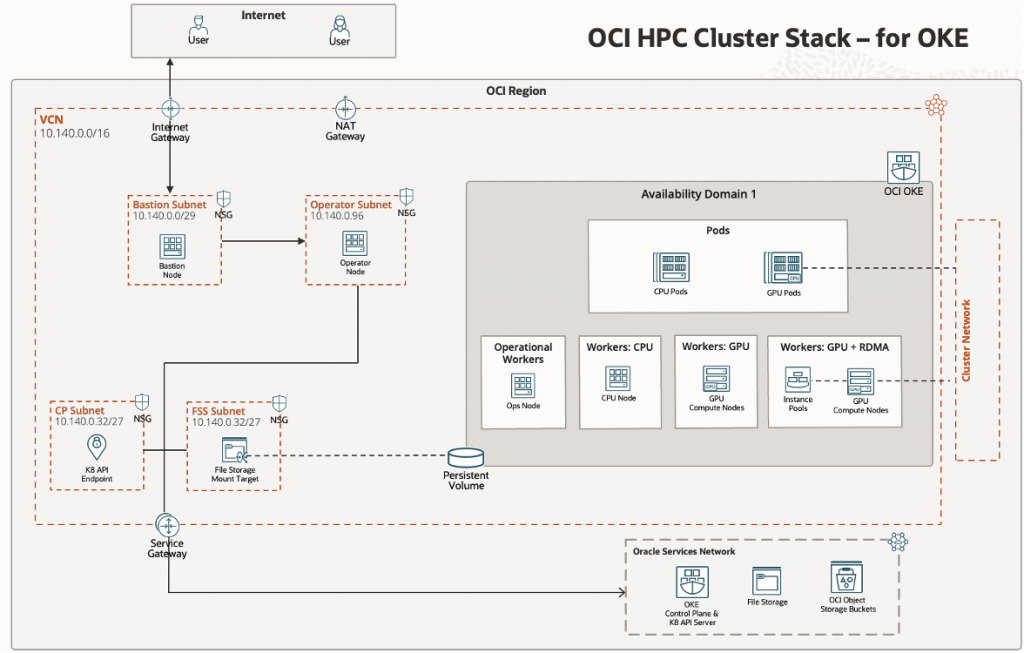
Key capabilities include:
- High-performance GPU infrastructure for distributed training
- Flexible VM and bare metal options to align infrastructure with specific research workloads
- RDMA-enabled cluster networking to reduce latency and improve throughput
- Enterprise-grade security and reliability for production research environments
OCI also provides a responsive technical partnership that helps teams scale quickly and address operational challenges as research needs evolve.
A modern AI stack on OCI
On OCI, Autopoiesis Sciences runs Aristotle across the full AI lifecycle, including foundation model development, fine-tuning, evaluation, and deployment. The research stack includes:
- PyTorch for training and experimentation
- Oracle Kubernetes Engine (OKE) for orchestration and scalable serving
- CI/CD pipelines to continuously validate changes across training and evaluation
- Serverless functions to automate workflows and supporting tasks
RDMA-enabled networking improves distributed training efficiency, helping researchers focus on experimentation rather than infrastructure management.
Infrastructure is evaluated based on research velocity: time-to-train, inference latency for interactive workflows, cost efficiency per experiment, and reliability for jobs that may run for days or weeks. OCI helps Autopoiesis Sciences improve across these dimensions while keeping engineering effort focused on scientific progress.
Demonstrating rigorous reasoning at scale
Aristotle has achieved 92.4% accuracy on GPQA Diamond, a PhD-level, multi-step scientific reasoning benchmark, and 96.1% accuracy on SimpleQA, OpenAI’s factuality benchmark. This combination highlights an important distinction in AI system design.
Many reasoning models perform well on complex problems but struggle with basic factual accuracy, often hallucinating with high confidence. Aristotle’s performance reflects a different approach: verification and procedural self-skepticism are integrated directly into the reasoning process, allowing the system to remain grounded on facts while addressing complex scientific questions.
Supporting the next phase of scientific discovery Calibration and epistemic humility are foundational requirements for AI systems intended to support scientific discovery. With Oracle Cloud Infrastructure, Autopoiesis Sciences is scaling Aristotle’s development using high-performance compute, advanced networking, and enterprise-grade operations—while maintaining the rigor and skepticism that make science work.
About Oracle Cloud Infrastructure (OCI)
Oracle Cloud is the first public cloud built from the ground up to be a better cloud for every application. By rethinking core engineering and systems design for cloud computing, OCI created innovations that solve problems that customers have with existing public clouds. OCI accelerate migrations of existing enterprise workloads, deliver better reliability and performance for all applications, and offer the complete services customers need to build innovative cloud applications.
To learn more information on OCI creating OKE with GPU instances: https://docs.oracle.com/en-us/iaas/Content/ContEng/Tasks/contengrunninggpunodes.htm
Contributors
Ryan Helferich – Oracle Enterprise Cloud Architect
Joseph Reth – Co-Founder, CEO – Autopoiesis
Vincent Karpf – ML Research Scientist – Autopoiesis
Eike Gerhardt – Co-Founder, CBO – Autopoiesis
Larry Callahan – Chief Scientist – Autopoiesis
- Autopoiesis Sciences: https://autopoiesis.science/
- Aristotle and GPQA Diamond results: https://autopoiesis.science/blog/92-4-gpqa-diamond
- Oracle Cloud Infrastructure for AI: https://www.oracle.com/ai-infrastructure/