
OCI Cache is built to help applications deliver low-latency performance at scale. For many production workloads, cache data is operationally important. This includes use cases like session state, frequently accessed reference data, computed results, and other hot data sets that can take time and effort to rebuild when something goes wrong. We are introducing Backup and Restore for OCI Cache to handle such scenarios effectively.
With this new capability, customers can create on-demand snapshot backups, retain backups in the service, or export them to a customer-owned OCI Object Storage bucket for longer retention, and restore them into a new cache cluster. This gives customers a practical way to protect important cache data, recover faster from unexpected events, and strengthen application resilience.
Faster recovery for real-world operations
Caches are often described as disposable. In real environments, that is not always true. When important cache data is lost or corrupted, the impact can ripple quickly. Applications may slow down while rebuilding warm data. Backend systems may see sudden load spikes. Teams may need to recover from accidental key deletion, bad releases, or infrastructure events while end-user experience is already degraded.
Backup and Restore for OCI Cache helps teams respond with more confidence. Instead of starting cold, customers can restore from a known snapshot and bring applications back to a more predictable state. Just as important, teams can create a recovery point before a major change, giving them a simpler rollback path if something does not go as planned.
How does it work?
Backup and Restore for OCI Cache introduces a flexible set of recovery workflows:
- Create on-demand backups using an RDB snapshot of cache data.
- Retain backups in OCI Cache for up to 35 days for in-service recovery.
- Export backups to a customer-owned OCI Object Storage bucket.
- Restore backups in a new cache cluster from either:
- a retained backup in OCI Cache, or
- an exported backup stored in Object Storage.
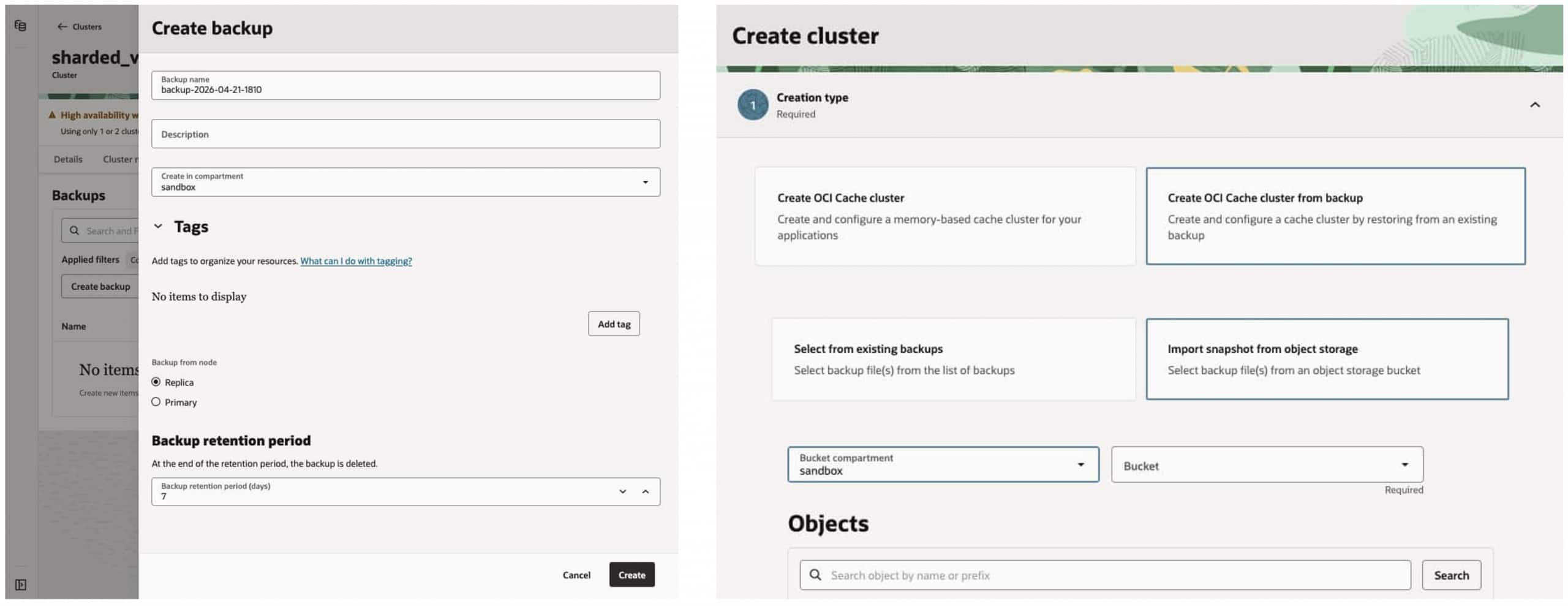
This flexibility is important because not every team approaches recovery the same way. Some want a simple in-service restore option. Others want backup copies under their own control for longer retention, governance, or broader recovery planning. Teams can use the Console or API/SDK for all backup-related operations.
Backup storage charges are passed through to customers, including Object Storage used to retain service-managed backups and temporary Block Volume usage during backup creation.
Recovery for broader resilience needs
Backup and Restore for OCI Cache is a practical first step toward stronger recovery readiness. Within a region, retained backups can help teams recover to a known good point after an operational issue. For organizations planning across OCI regions, exported backups can help support cross-region disaster recovery workflows. Teams can keep backup copies under their control and use them as part of a runbook for recreating application environments and restoring cache state in another region.
Here are a few examples of how customers can use Backup and Restore for OCI Cache in practice:
- Recovering from accidental data corruption: Restore a recent backup to quickly return the cache to a known-good state.
- Creating a rollback point before a major release: Take an on-demand backup before deployment so you have a recovery point if issues arise.
- Supporting cross-region disaster recovery planning: Export backups to a customer-owned Object Storage bucket to use as part of a cross-region DR workflow.
- Rebuilding without starting cold: Restore from a backup to bring applications back with a warm cache instead of rebuilding data from scratch.
With Backup and Restore in OCI Cache, customers now have more control over how cache data fits into their operational and recovery strategy.
Get started
Backup and Restore for OCI Cache gives customers a flexible way to protect important cache data and recover faster when it matters most. Whether the goal is operational rollback, recovery from data corruption, or support for cross-region disaster recovery, this new capability helps teams build more resilient application architectures on OCI.
To learn more and get started, see the OCI Cache Backup and Restore documentation.